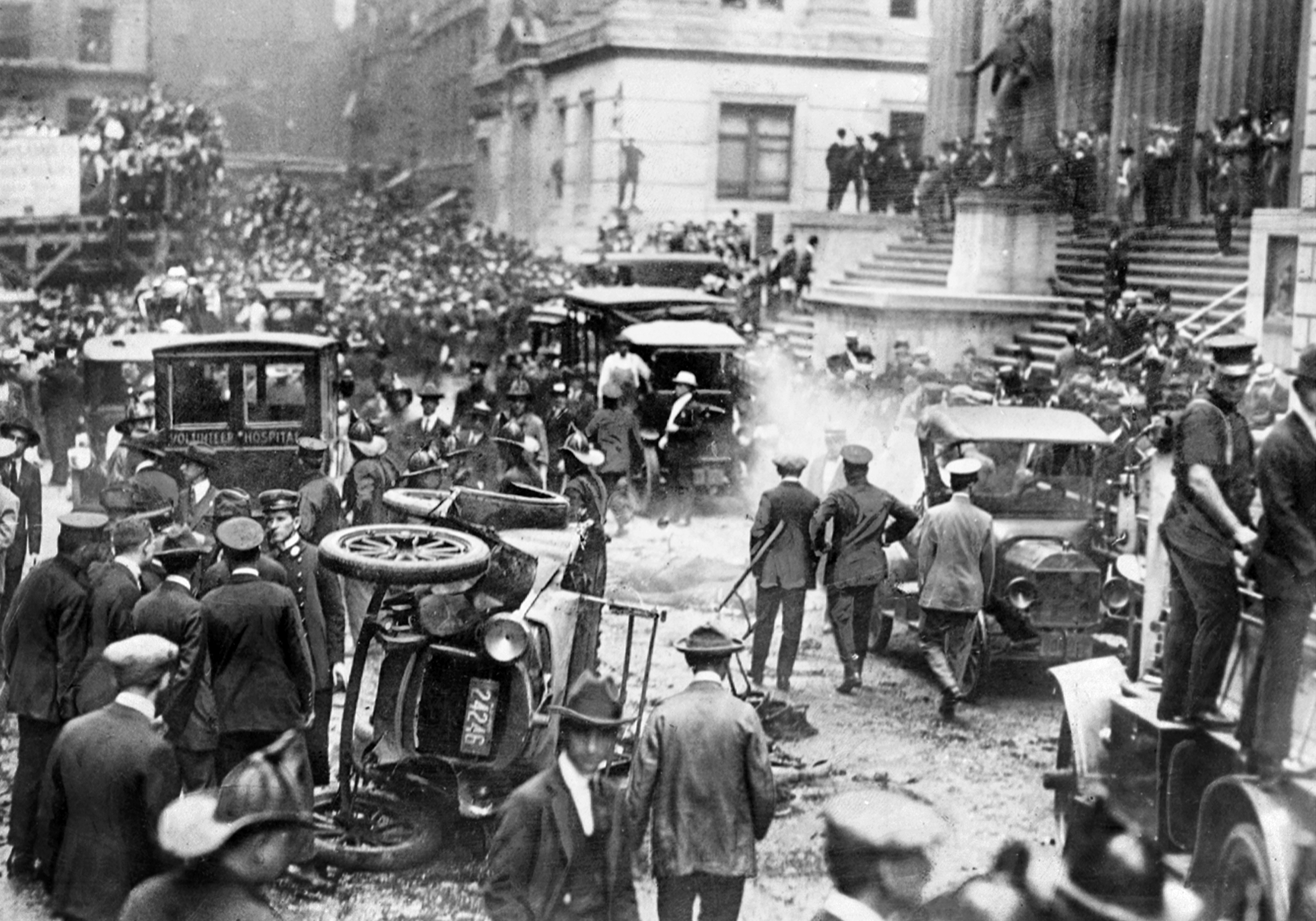
The Wall Street Bombing: America's First Major Terrorist Attack
At 12:01 PM on September 16, 1920, a horse-drawn wagon parked across from the J.P. Morgan bank on Wall Street exploded. The blast killed 38 people instantly and wounded over 400. Shrapnel - 500 pounds of cast-iron sash weights - shredded the lunchtime crowd. It was the deadliest terrorist attack in American history until 1995. The perpetrators were never caught. The case was never solved. A century later, the scars from the blast are still visible on the Morgan building's facade - silent witnesses to America's first major brush with modern terrorism.
The Target
Wall Street in 1920 was the financial heart of the world. The corner of Wall and Broad Streets housed the New York Stock Exchange, the U.S. Assay Office, and most importantly, the House of Morgan - J.P. Morgan & Co., the most powerful private bank in America. Morgan had financed the Allied war effort, making the firm a symbol of American capitalism.
The location wasn't random. Whoever planted the bomb knew exactly what they were targeting. The explosion was timed for noon, when workers poured onto the streets for lunch. The blast would hit the maximum number of people at the symbolic center of American financial power.
The Explosion
The wagon was unremarkable - a tired horse pulling a cart like thousands of others in the city. No one noticed when it stopped across from 23 Wall Street. At 12:01 PM, 100 pounds of dynamite detonated, propelling 500 pounds of iron weights outward at lethal velocity.
The explosion was catastrophic. Windows shattered for blocks. The awning of the Morgan building was torn away. Bodies lay scattered across the street. Inside the Stock Exchange, traders were knocked off their feet by the concussion. One victim was decapitated; another was driven through a plate glass window. The horse was vaporized - only a single hoof was ever found.
The Aftermath
The death toll reached 38, with over 400 wounded. Most victims were young - clerks, messengers, stenographers, pedestrians caught in the wrong place at the wrong moment. William Joyce, a veteran messenger, was killed instantly. Edward Sweet, a 14-year-old office boy, died in the blast. The dead were ordinary workers, not the financiers who were the presumed targets.
J.P. Morgan Jr. was in England that day. His building survived, though scarred. The next morning, Wall Street reopened. Workers swept up debris and glass. The Stock Exchange rang its bell on time. America's financial district refused to yield to terror. The pockmarks on the Morgan facade were never repaired - left as they remain today, defiant scars.
The Investigation
The Bureau of Investigation (precursor to the FBI) launched the largest manhunt in American history. Anarchists were the immediate suspects - the Palmer Raids had been rounding them up for months. Investigators found flyers near the scene: 'Free the political prisoners or it will be sure death for all of you.'
But no one was ever charged. The horse's shoes were traced to a blacksmith, but the trail went cold. Italian anarchists were suspected, particularly followers of Luigi Galleani, but evidence was circumstantial. The case officially remained open for decades. The truth died with whoever loaded that wagon on a September morning.
The Legacy
The Wall Street bombing faded from memory as the century brought new horrors - the Holocaust, Hiroshima, 9/11. But it established patterns that would repeat: the targeting of symbolic locations, the use of shrapnel to maximize casualties, the mysterious perpetrators, the defiant reopening the next day.
Today, tourists walk past 23 Wall Street without noticing the pockmarks on the limestone. The building is a landmark now, no longer a bank. But if you look closely at the corner of Wall and Broad, you can still see where iron sash weights punched into stone over a century ago - permanent scars from a crime that was never solved and killers who were never found.
From the Air
The Wall Street bombing site (40.71N, 74.01W) is at the corner of Wall and Broad Streets in Lower Manhattan. LaGuardia Airport (KLGA) is 13km northeast; Newark Liberty (KEWR) is 15km southwest. The area is surrounded by skyscrapers including One World Trade Center. Weather is temperate continental with four distinct seasons.