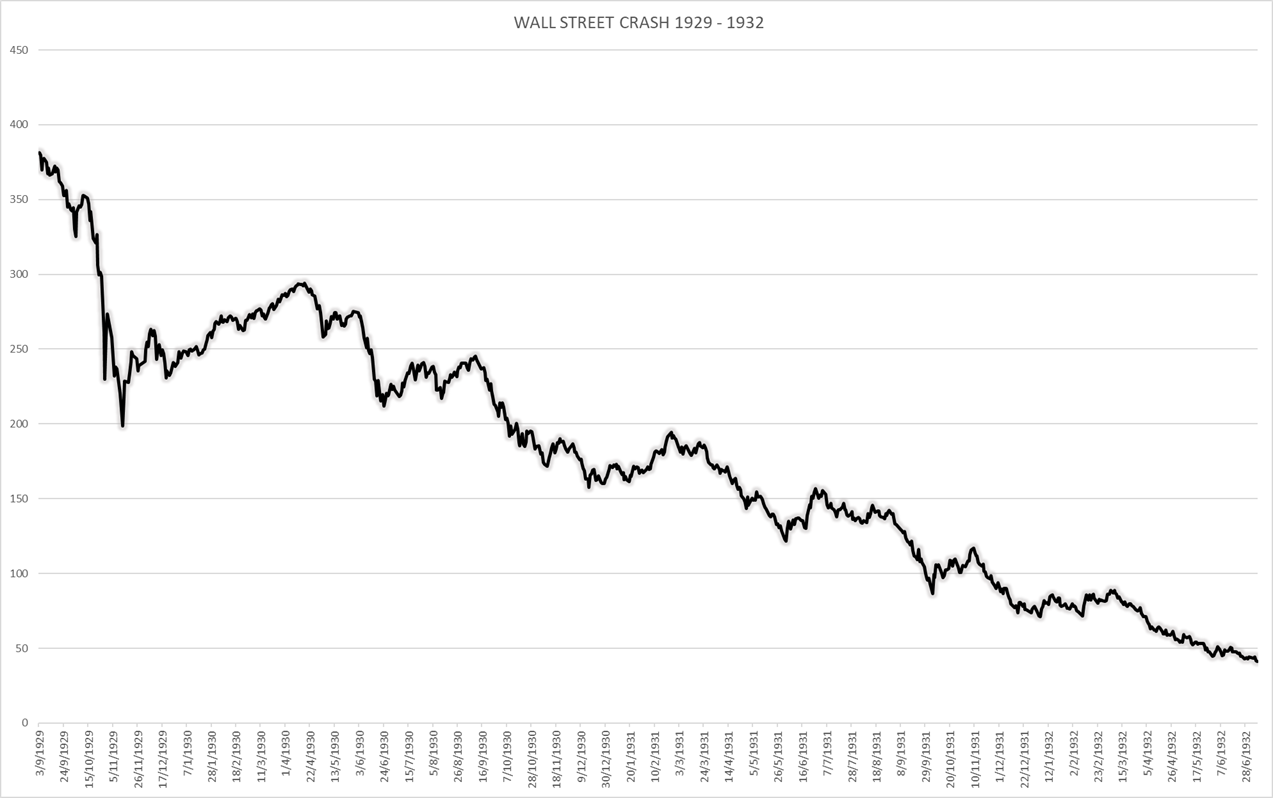
Wall Street Crash of 1929
On the morning of October 24, 1929, the opening bell at the New York Stock Exchange sounded like any other. By mid-morning, it had become a starting gun for panic. Sell orders overwhelmed the trading floor so completely that the ticker tape fell nearly two hours behind, leaving investors across the country staring at prices that no longer existed. That day, known as Black Thursday, began the most devastating financial collapse in American history. Within a week, $30 billion in market value had evaporated - roughly ten times the entire annual budget of the federal government.
The Fever of Easy Money
The crash did not arrive without warning. Through the 1920s, a speculative fever had gripped the nation. Industrial production was booming, and Americans of every class poured money into the stock market, many buying on margin - putting down as little as ten percent and borrowing the rest from brokers. By 1929, broker loans had ballooned to nearly $8.5 billion. The math was seductive: borrow cheap, watch stocks climb, pocket the difference. Barbers, shoe-shine boys, and taxi drivers swapped stock tips alongside bank presidents. The market had become a national pastime, and the assumption that prices could only go up had hardened into something resembling religious faith. Economist Irving Fisher declared in October 1929 that stocks had reached 'what looks like a permanently high plateau.' He would spend the rest of his career trying to live down that pronouncement.
Five Days That Broke an Era
The unraveling came in stages. On Black Thursday, October 24, nearly 13 million shares changed hands in a frenzy of selling. A consortium of bankers, led by Thomas Lamont of J.P. Morgan, pooled resources to buy stocks and stabilize prices - a tactic that had worked during the Panic of 1907. The market steadied briefly. But the following Monday, prices plunged again, and on Black Tuesday, October 29, the dam broke entirely. Over 16 million shares were traded, a record that would stand for decades. The ticker tape did not stop running until well after the market closed. Some stocks found no buyers at any price. The organized support that had calmed Thursday's panic was gone; the bankers were now selling too. In the galleries above the trading floor, visitors watched in stunned silence as fortunes were destroyed in real time.
A Contagion of Ruin
The damage spread far beyond Wall Street. Margin calls forced investors to sell everything they owned - houses, cars, businesses - to cover their debts. Banks that had lent heavily to speculators began to fail, taking depositors' life savings with them. Between 1929 and 1933, nearly half of America's banks would close their doors. The agricultural sector, already weakened by overproduction and falling commodity prices throughout the 1920s, collapsed entirely. Factories shuttered. Unemployment, which had hovered around three percent in the summer of 1929, eventually climbed above twenty-five percent. The crash did not cause the Great Depression on its own - structural weaknesses in agriculture, banking, and international trade all played their part - but it was the match that lit the fire, destroying the confidence that had sustained the entire economic system.
Ghosts on the Trading Floor
Today, the New York Stock Exchange still stands at the corner of Broad and Wall Streets in Lower Manhattan, its neoclassical facade largely unchanged since the 1920s. The trading floor where Black Tuesday unfolded is now quieter - electronic trading has replaced much of the human chaos - but the building remains a symbol of both American ambition and American vulnerability. The crash led directly to the creation of the Securities and Exchange Commission in 1934 and the Glass-Steagall Act, which separated commercial and investment banking for over six decades. The lessons of 1929 shaped financial regulation for generations, though the question of whether those lessons have been truly learned resurfaces with every subsequent market panic.
From the Air
Located at 40.706N, 74.009W in Lower Manhattan's Financial District. The New York Stock Exchange sits at the corner of Wall Street and Broad Street. From the air, Wall Street is the narrow canyon running east from Broadway toward the East River. Nearby landmarks include Trinity Church and Federal Hall. Closest airports: KJFK (John F. Kennedy International, 13 nm SE), KLGA (LaGuardia, 8 nm NE), KEWR (Newark Liberty, 9 nm W), KTEB (Teterboro, 12 nm NW). Best viewed at 1,500-2,500 ft AGL.