Wallace (Idaho)
In the summer of 1910, the mountains around Wallace exploded. A weekend of freakish weather pushed hundreds of small fires into a single conflagration that consumed three million acres - an area larger than Connecticut - in approximately two days. The Big Burn, as it came to be known, killed 85 people and forced the evacuation of towns throughout the Northern Rockies. Wallace took the full assault. Embers the size of trees rained down. Fire tornadoes touched the surrounding ridges. But the town fought back with a ferocity that matched the flames. Residents lit backfires, formed bucket brigades, and defended their buildings street by street. A third of Wallace burned anyway, but two-thirds survived - enough to rebuild, to remember, and to establish a civic identity based on stubborn resistance. That stubbornness would be tested twice more over the following century, and twice more Wallace would prevail.
The Mining Wars
Before the fire came the violence. The Silver Valley mines were among the richest in North America, and the struggle between miners and owners turned bloody. Twice in the 1890s, striking workers blew up company property - first a mill in 1892, then another mill and a train in 1899. The response was martial law. Army troops occupied the valley, rounding up every male over fifteen and confining them in a makeshift prison called the bullpen. The union was broken, but the bitterness endured. In 1905, a former Wallace-area miner named Harry Orchard assassinated Idaho's governor with a bomb at his Boise home. The men accused of hiring him - union bosses from the Western Federation of Miners - brought famed attorney Clarence Darrow to their defense and won acquittal. The labor wars receded, but they left Wallace with a reputation for conflict and a suspicion of outside authority that would prove useful decades later.
The Freeway Fight
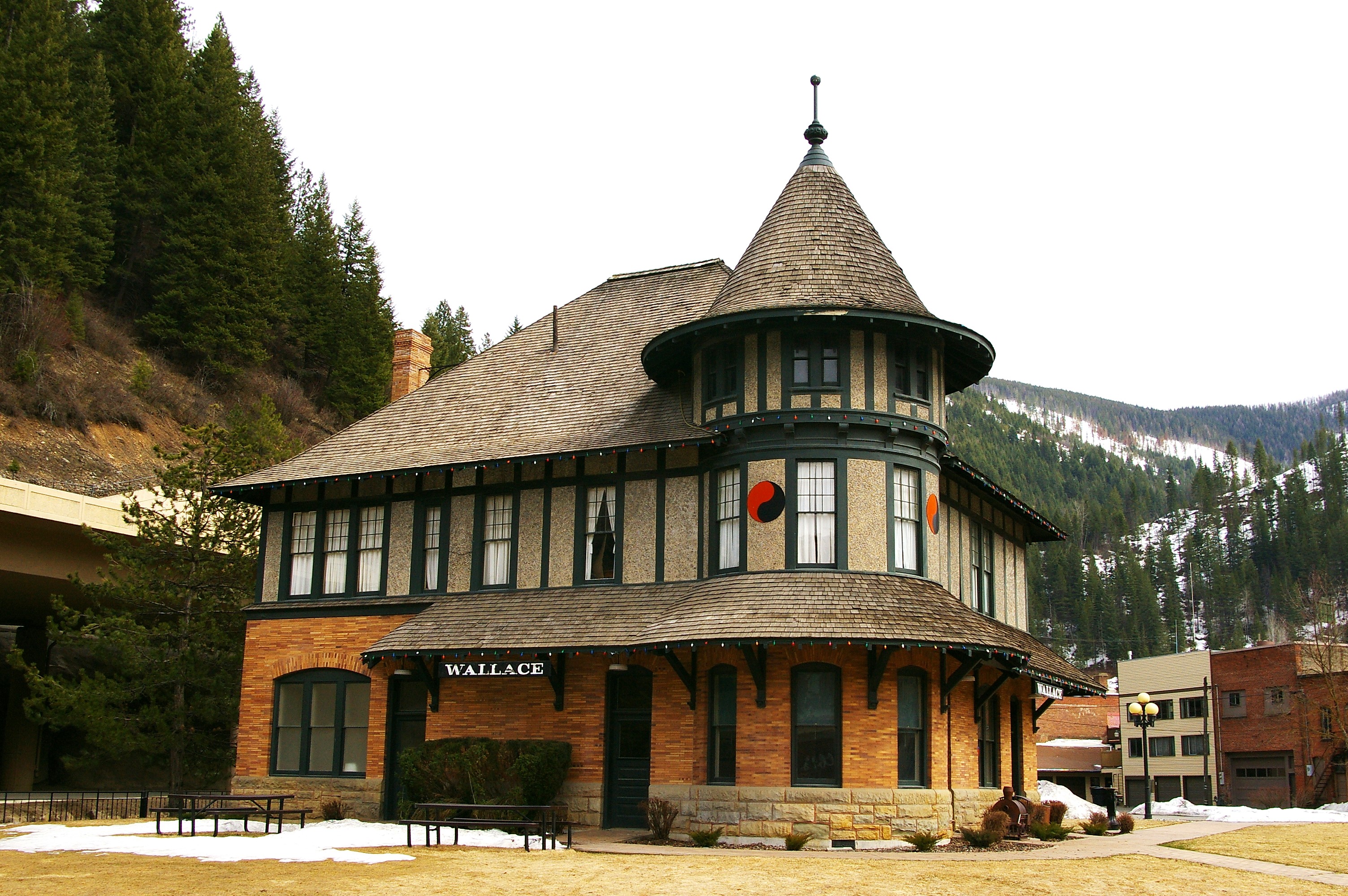
In 1967, the federal highway department announced plans to build Interstate 90 through Wallace. The route would have demolished downtown and most residential neighborhoods - standard practice for freeway construction through small towns in that era. Wallace refused. The city filed lawsuits that delayed construction for nearly twenty years. Meanwhile, the Wallace Historic Preservation Society - mostly grandmothers, by some accounts - went building by building through downtown, filing the paperwork to register each structure as historically significant. When the federal government couldn't build through registered historic buildings, the society registered more buildings. Eventually they registered the entire town, making Wallace the only city in America where every building falls under the National Register of Historic Places. The freeway had to go around. The bypass, completed in 1991 at a cost of $43 million, runs on a viaduct high above downtown, leaving Wallace's brick streets untouched below.
The Center of the Universe
At the corner of Bank and Sixth Streets stands a manhole cover marked with a plaque declaring this spot the Center of the Universe. The designation came in 2004, when the mayor made it official. No one has successfully challenged the claim. This is Wallace's sense of humor - the ability to declare itself the center of everything with just enough irony to forestall objection. The town hosts annual events that embrace its quirky identity: a huckleberry festival, a Center of the Universe rededication ceremony, and an Under the Freeway Flea Market that makes use of the space beneath the bypass. The Oasis Bordello Museum preserves the town's less respectable history, offering tours of a building that operated as a brothel until 1988. Wallace doesn't hide its past. It charges admission.
Trails Through History
The Route of the Hiawatha begins near Wallace, following an abandoned railroad grade through ten tunnels and over seven trestles on a fifteen-mile descent through the Bitterroot Mountains. The longest tunnel stretches nearly two miles through St. Paul Pass. The trail descends on a gentle 1.6 percent grade, making it accessible to casual cyclists - the kind of adventure that doesn't require technical skill, just willingness to pedal through darkness into the forest beyond. Another trail leads to the mine where ranger Ed Pulaski saved forty of his men during the Big Burn, sheltering them in the tunnel as fire consumed the world outside. Pulaski survived, though badly burned, and later invented the combination axe-and-hoe firefighting tool that still bears his name. The trail to that mine tunnel is a pilgrimage route of sorts, a walk through forest that has regrown in the century since it burned, ending at a portal where desperate men once huddled against the inferno.
From the Air
Located at 47.47N, 115.92W in a narrow east-west valley along I-90, approximately 5nm east of Kellogg and 40nm east of Spokane. The I-90 viaduct is clearly visible crossing high above the historic downtown. The surrounding peaks rise steeply to 5,000-6,000 feet; the valley floor sits at approximately 2,730 feet. St. Paul Pass (elevation 4,500') marks the Idaho-Montana border 12nm east, with the Route of the Hiawatha bike trail following the old railroad grade through this terrain. No commercial airport - Spokane (GEG) at 83nm is the nearest scheduled service. The town is visible as a compact cluster of historic buildings beneath the freeway span. Lookout Pass ski area is 12nm east on I-90 at the state line.