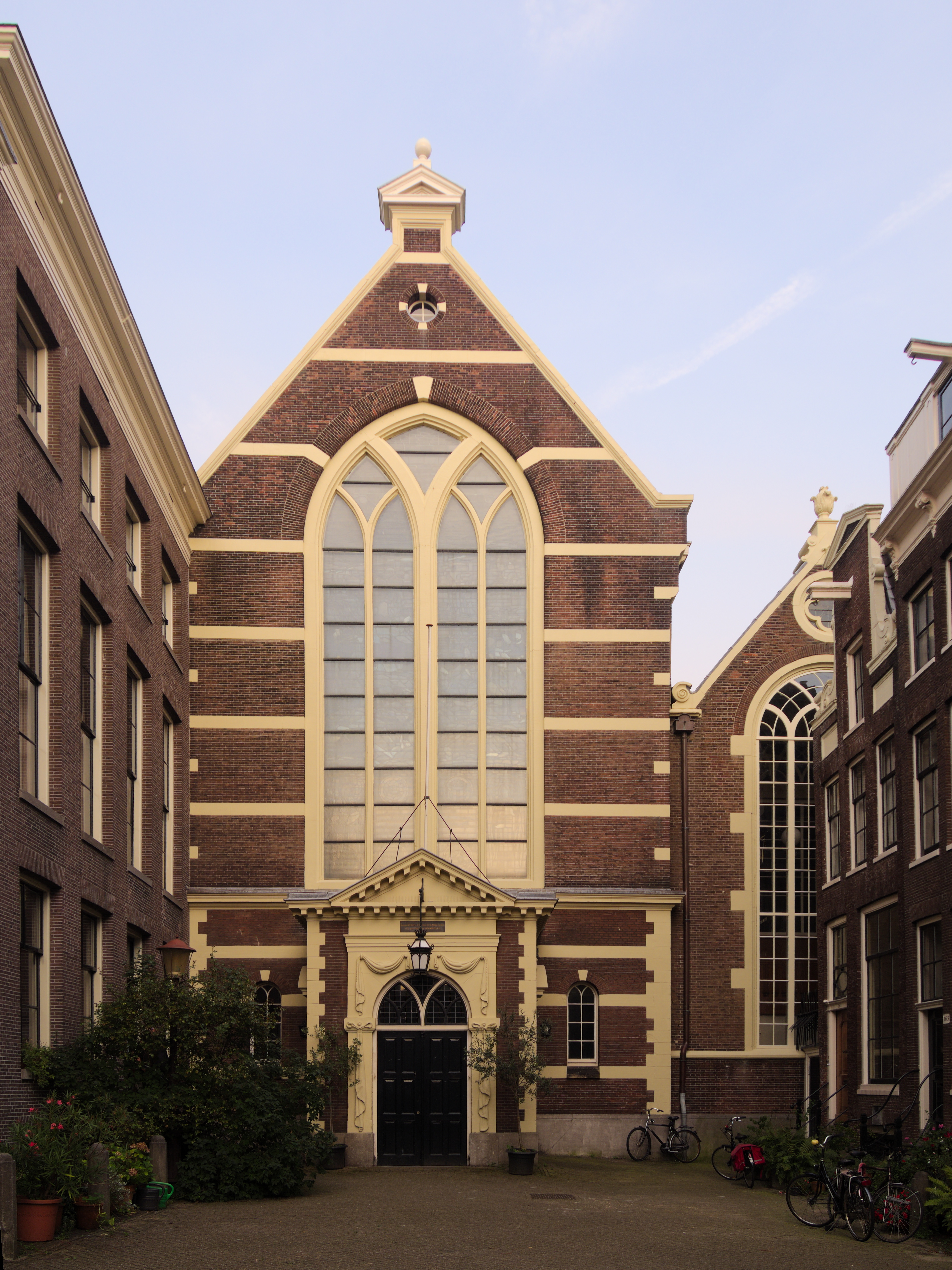
Walloon Church, Amsterdam
Every Sunday at 11 a.m., a service begins in French in a small medieval church off the Oudezijds Achterburgwal canal. It has been doing so since 1586. The Waalse Kerk - Walloon Church, Eglise Wallonne - is not a missionary post and not a tourist phenomenon. It is the surviving liturgical home of the French-speaking Calvinists who fled their homelands and came to Amsterdam, century after century, looking for a place where their faith would not get them killed. They built a community here. The community kept its language. The community is still here.
From Monastery to Refuge
The building began as the chapel of the Sint-Paulusbroederklooster, a Catholic monastery whose first chapel went up on this spot in 1409. That chapel almost certainly burned in the great Amsterdam fire of 1452. In 1493 the monks received permission to rebuild, and three years later they had their new chapel. It stood for less than a century before the world changed underneath it. In 1578 Amsterdam swung to the Protestant side of the Dutch Revolt - the moment Dutch historians call the Alteratie - and the city confiscated the monastery's buildings. For eight years the chapel was used as a storeroom. Then, in 1586, the city handed it over to a group of newcomers: Walloon Reformed refugees, French-speaking Calvinists who had fled persecution in the Southern Netherlands and France. At least fifteen Walloon churches were founded across the Dutch Republic between 1571 and 1590. The Amsterdam congregation got this building.
The Gate of Skulls
In 1616 the city architect Hendrick de Keyser - the same man who would later design the Zuiderkerk and the Westerkerk - was commissioned to build a new north gate for the church, opening onto the Oude Hoogstraat. He decorated it with skulls. The gate was used for funeral processions, and de Keyser's iconography was simply honest about the purpose of the door. The front gate, in a more dignified Classical style, was added in 1647. The church itself grew with the community: a southern semitransept was added in 1661 to match the existing northern one. When Louis XIV revoked the Edict of Nantes in 1685, a second great wave of French Protestants - the Huguenots - poured into Amsterdam, and the Walloon community swelled again. Galleries were inserted on three walls to fit everyone in. The building still proved too small, so a second Walloon church opened in 1716 inside a former bell foundry on the Prinsengracht. From then on this one was known as the Oude Waalse Kerk - the Old Walloon Church - or simply the Grande Eglise.
Notable Worshippers
The painter Bartholomeus van der Helst, the great portraitist of the Dutch Golden Age, is buried in the church. So is Jan Swammerdam, the 17th-century microscopist whose drawings of insect anatomy reshaped how Europeans understood the natural world. Elizabeth Timothy - the first woman to publish and edit an American newspaper, eventually running the South Carolina Gazette in Charleston from 1739 - was very likely christened in this church before her family emigrated. In the 1870s a young Vincent van Gogh, then living in Amsterdam and trying without success to enter the ministry, came here regularly to hear his uncle Johannes Paulus Stricker preach. The walls have absorbed Dutch, French, painters, scientists, and at least one future newspaper publisher of the American colonies.
Gunshots and Foundations
On 12 October 1755 a French baker's assistant walked into the church during services and fired several rifle shots at the vicar. The young man had fallen in love with a wealthy merchant's daughter, and the merchant had asked the vicar to break the romance off. The vicar was grazed by a bullet, stumbled backward, and - because the pulpit door was open - fell down the steps and was badly concussed. He survived. The baker's assistant was caught and sentenced to years in the Rasphuis prison, where convicts rasped Brazilian wood into dye powder. The bullet holes stayed in the pulpit and the adjoining pillar for two centuries until a 1990 restoration covered them. That restoration had a more serious purpose - the church was sinking, pulled down by a heavy front facade installed in 1885. Workers underpinned the foundations and laid a new self-supporting floor over so many recovered tombstones that they had to invent a method of installing it. The restoration finished in 1992.
Mueller's Organ
The church's pipe organ was built in 1734 by Christian Mueller, the German organ builder who would later construct the great organ at St Bavo's in Haarlem. The Amsterdam Mueller is now considered the best-preserved instrument the man ever made. In 1965, after a careful restoration by Ahrend and Brunzema, it was returned to its 18th-century voice. Walloon services are still held every Sunday in French. Concerts and recordings happen often, because the church is renowned for its acoustics - musicians come here for sound that has been refined by five centuries of stonework, three rounds of restoration, and one accidental fall down a pulpit staircase.
From the Air
Coordinates 52.371 N, 4.897 E. The Walloon Church is embedded in the dense canal block on the southern stretch of the Oudezijds Achterburgwal, between Nes and Oude Hoogstraat, a short walk south of the Oude Kerk. From the air it reads as a long pitched roof inside the central canal grid, near Dam Square. Recommended viewing altitude 1000-2000 feet AGL to make out the radial canals. Nearest airport: Amsterdam Schiphol (EHAM), about 12 km southwest. Low cloud and haze are routine; clear evening light is the best moment for the centre.