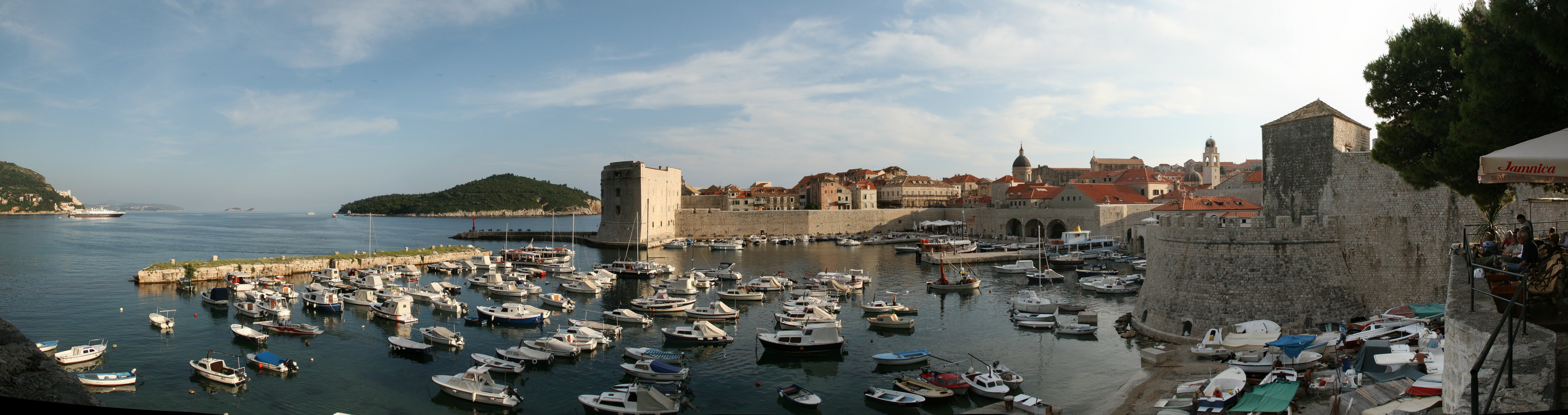
Walls of Dubrovnik
Carved into the limestone above the entrance to Fort Lovrijenac is a Latin inscription: "Non Bene Pro Toto Libertas Venditur Auro" -- Freedom is not to be sold for all the treasures in the world. For a city-state that spent centuries surrounded by Ottoman, Venetian, and Hungarian empires, the motto was not poetry. It was policy. The Walls of Dubrovnik are the physical expression of that defiance -- 1,940 meters of unbroken stone encircling the old city, reaching heights of 25 meters, armed at their peak with more than 120 cannons. They are among the most complete medieval fortification systems in Europe, and the reason Dubrovnik's old town survived to become a UNESCO World Heritage Site in 1979.
A Refuge Built in Stone
Dubrovnik began as a refuge. When the Roman colony of Epidaurus fell, survivors fled to a rocky peninsula on the Dalmatian coast and began building. The first limestone fortifications appeared toward the end of the 8th century, though chronicles suggest some kind of defensive structure existed on the Lave peninsula well before that. The Arab geographer Muhammad al-Idrisi, writing in 1154, described Dubrovnik as the southernmost city of "the country of Croatia and Dalmatia." By then, the walls were already old. The system that visitors walk today took its primary form between the 13th and 17th centuries, a Renaissance collaboration between Italian and Croatian architects working during the golden age of the independent Republic of Ragusa. Three circular towers, 14 quadrangular towers, five bastions, two angular fortifications, and the massive St. John's Fortress -- the sheer redundancy of the defenses reveals how seriously the republic took its survival.
Gates, Moats, and Midnight Ceremonies
Only two land gates pierced the walls, one on the western side at Pile and one to the east at Ploce. Both were designed so that no one could approach the city directly. Visitors passed through multiple doors and wound through crooked passageways -- a deliberate architectural maze meant to slow any attacker who breached the outer defenses. During the republican era, the wooden drawbridge at the Pile Gate was raised each evening with considerable ceremony, and the keys to the city were formally delivered to the Ragusan rector. It was theater, but it was also real. Today, the dry moat beneath the bridge holds a quiet garden, a strange peace filling a space designed for war. Above the arch of the principal gateway, a statue of Saint Blaise, the city's patron, holds a model of the Renaissance city in his hand -- as if to say, this is what all that stone was for.
Twelve Centuries Under Fire
The walls have been tested repeatedly. In 866, a Saracen fleet besieged Dubrovnik for fifteen months before a Byzantine relief force of over a hundred ships broke the siege. In 1185, Stefan Nemanja, Grand Prince of Raska, attacked the city but was driven back by a Ragusan counterattack. A devastating earthquake in 1667 leveled much of the city behind the walls, but the walls themselves, solidly constructed, stood largely unscathed. In 1806, Napoleon's forces deceived their way inside by requesting rest and provisions, then occupied the city outright. Russian and Montenegrin forces besieged the French-held Dubrovnik, raining 3,000 cannonballs onto the ancient stone. The republic was abolished in 1808, its centuries of independence ended not by breach but by betrayal.
The 1991 Test
The walls faced their most recent siege in 1991, when the Yugoslav People's Army bombarded the city during the Croatian War of Independence. Of 824 buildings in the Old Town, 563 were struck by projectiles -- 68 percent of the structures within the walls. Nine buildings were completely destroyed by fire. The bombardment provoked international condemnation and became a public relations catastrophe for Serbia and Montenegro. UNESCO and the Institute for the Rehabilitation of Dubrovnik estimated restoration costs at nearly $9.7 million. By 1999, over $7 million had been spent. The ancient walls, it turned out, were more effective at resisting modern weaponry than the contemporary structures in the city's outskirts. Stone that had been standing since the Middle Ages absorbed blows that shattered concrete.
Walking the Circuit
Today, more than 1.2 million visitors walk the walls annually. The circuit takes roughly an hour, tracing the full perimeter from the cylindrical Fort Bokar -- begun by Michelozzo in 1461 and completed in 1570 after more than a century of construction, considered one of the finest examples of functional fortification architecture -- to the Minceta Tower dominating the northwestern heights. The sea walls stretch from Fort Bokar to St. John's Fortress, their thickness varying with strategic importance. Below, the old harbor still functions, its three enormous arches dating from a 12th-century arsenal. Beyond the city walls, the republic extended its defensive thinking to the Peljesac peninsula, where a 5.5-kilometer wall connecting Ston to Mali Ston protected the salt pans that funded Dubrovnik's wealth. Those salt pans are still worked today, as the walls still stand -- monuments to a small republic that traded freedom for nothing.
From the Air
Located at 42.64N, 18.108E on Croatia's southern Adriatic coast. The walled Old Town is instantly recognizable from altitude as a compact peninsula jutting into the sea, its terracotta roofs enclosed by a clear ring of pale stone. Best viewed from 2,000-4,000 feet. Dubrovnik Airport (LDDU) is 15 km southeast. Fort Lovrijenac and the Minceta Tower are prominent landmarks. The Peljesac peninsula with the Ston walls is visible to the northwest.