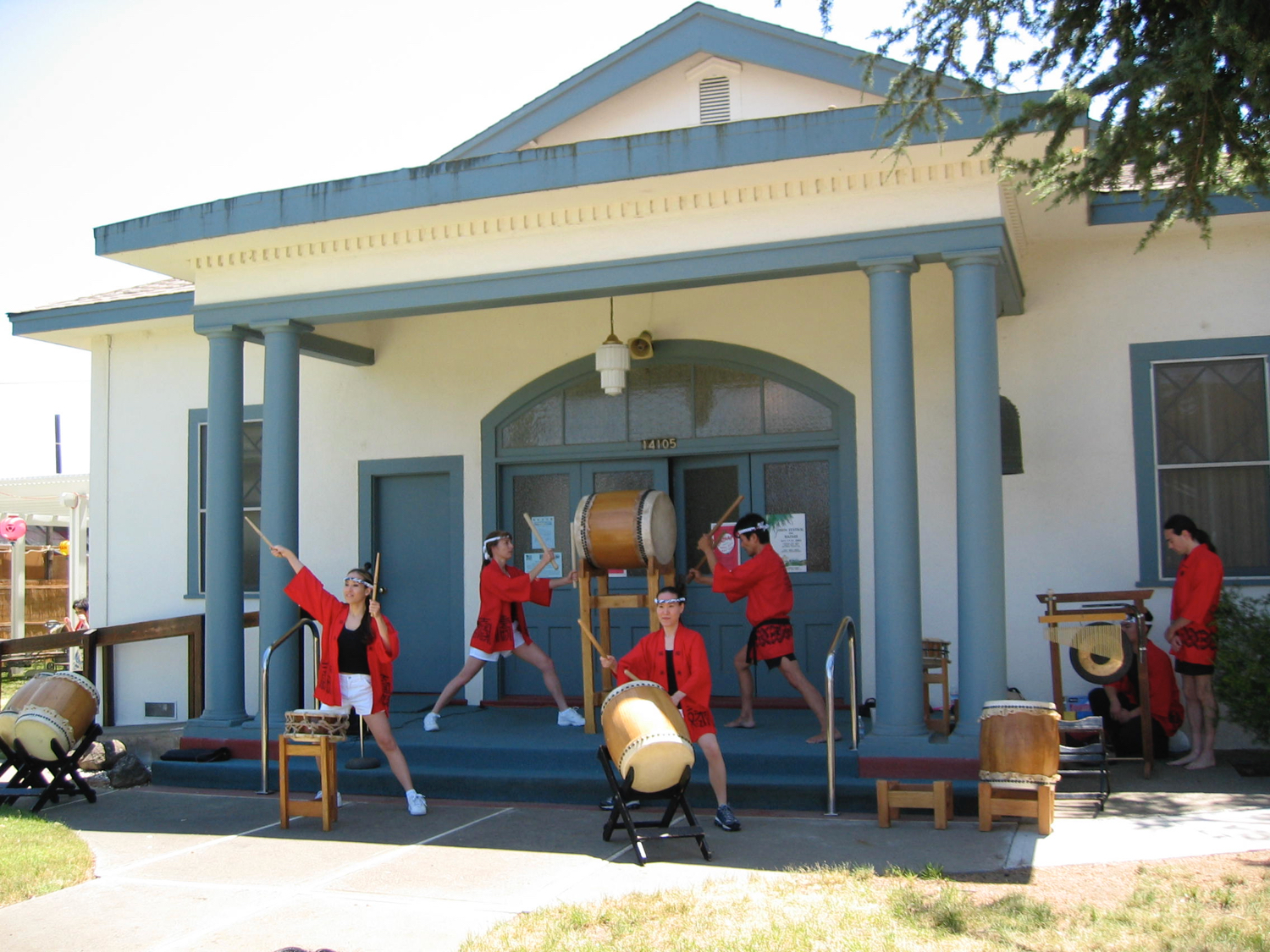
Walnut Grove Buddhist Church: Kawashimo's Anchor
The tables and benches are still in Tome Yoshida's house. In 1924, she gathered about fifteen children and started a Buddhist Sunday School in the Japanese farming community of Walnut Grove, California -- a place the first-generation Issei immigrants called Kawashimo. There was no temple yet, just homes where ministers from the Buddhist Church of Sacramento traveled 25 miles to deliver Dharma talks. Two years later, the community built a church of their own. Nearly a century on, the Walnut Grove Buddhist Church still stands in the Sacramento Delta, an affiliate of the Buddhist Churches of America and one of the most quietly enduring institutions in the region. Its story is the story of a community that was uprooted, scattered, and slowly diminished -- but never quite dissolved.
From Living Rooms to a Church of Their Own
Japanese immigrants began settling Walnut Grove in the early twentieth century, drawn by the asparagus farms that lined the Sacramento River Delta. By the end of World War I, enough families had established themselves that the need for organized religious life became pressing. Around 1923, Dharma talks -- hōwakai -- became a regular practice, held in the cramped quarters of private homes. When funerals required a proper service, families made the long trip to Sacramento. The church was formally established in 1926 and its building completed the following year, initially recognized as a branch of the Buddhist Church of Sacramento. By February 1, 1931, the congregation had grown confident enough to break away and become independent, with 130 members on its rolls. Community organizations proliferated: a medical health club started by ten teenage girls in 1926, a Young Men's Buddhist Association in 1928, a Young Girls Buddhist Association in 1930, the Buddhist Women's Association in 1932. By 1938, the youth groups had merged into the Young Buddhist Association. The church had become the social heart of Kawashimo.
The Emptying
Then the war came, and the church emptied. Executive Order 9066 forced the evacuation of Japanese Americans from the West Coast. Families who had farmed the delta for decades were sent first to assembly centers in Merced and Turlock, then to incarceration camps at Amache in Colorado and Gila River in Arizona. The temple closed. The community that had built it was scattered across the interior of a country that had decided they could not be trusted. Meanwhile, the Buddhist temple in nearby Isleton fared worse -- it was looted and damaged during the war. When the conflict ended, that building was sold, its remaining funds donated to the Walnut Grove Buddhist Church and the New York Buddhist Academy. Isleton's congregation folded into Walnut Grove's, a merger born not of growth but of shared loss.
The Return
Shigeo Kato and his family arrived back in Walnut Grove on July 27, 1945 -- among the very first to return. With Tomio Matsuoka, Methodist minister Reverend Takeo Agatsuma, and Ralph Sugimoto, Kato prepared the town to receive the others who would follow. The church building itself became a hostel, sheltering returning families who had lost their homes. On December 16, 1945, Reverend Takuyu Shirakawa returned and the church held a combined memorial service and Hōonkō for members who had died during the war years. The Women's Association and the Young Buddhist Association were reactivated. Life resumed, but the contours had shifted. Reverend Shirakawa's successor, Reverend Seikaku Mizutani, served as Rinban for 22 years, from 1950 to 1972 -- the longest tenure in the church's history and a period that saw the community stabilize before beginning its long decline.
The Slow Thinning
By the 1970s, the pattern was unmistakable. The children and grandchildren of the original congregants were leaving Walnut Grove. Sacramento offered professional careers. The Bay Area offered universities. The delta offered asparagus farming, and fewer young people wanted that life. Church membership fell steadily through the 1980s and 1990s as the older generation died. The arithmetic was merciless: each funeral subtracted from a congregation that baptisms and confirmations could no longer replenish. And yet the church did not close. Many of those who had moved away still considered the Walnut Grove Buddhist Church their ancestral home. Each summer they returned for the annual Bazaar and Obon festival -- the Buddhist celebration honoring the spirits of one's ancestors -- providing income the church coffers needed and continuity the community craved. The festival became the church's heartbeat, a yearly gathering that proved the community still existed even as its daily life had thinned to a handful of aging members.
Anchor in the Delta
The Walnut Grove Buddhist Church occupies a modest building in what was once the Japanese district of a small delta town. It holds no architectural superlatives, commands no dramatic views. Its significance is quieter than that. For a century, it has been the fixed point around which a community orbited -- first tightly, as families worshipped and organized and raised their children within walking distance, then in ever-wider arcs as generations dispersed across California and beyond. The church survived because it served a purpose no other institution could fill. It was the place where Dharma talks happened in living rooms before there were walls to contain them. It was the hostel that received families returning from internment with nowhere else to go. It was the building where memorial services honored the dead of a war that had torn the congregation from its home. And it remains the place where descendants return each summer, drawn back by something older than obligation. In the delta's flat landscape of levees and fields, the church is a small, stubborn anchor.
From the Air
Located at 38.24°N, 121.51°W in the small community of Walnut Grove along the Sacramento River, approximately 30 miles south of Sacramento. The church itself is not individually visible from altitude, but Walnut Grove is identifiable as a small cluster of development along the river's east bank on State Route 160. The massive broadcast towers nearby (up to 2,048 feet tall) are the dominant visual landmark and a significant hazard to aviation. Nearest airports include Sacramento Executive Airport (KSAC) about 25 nm north. Best viewed at low altitude (1,000-2,000 feet AGL) following the Sacramento River south through the delta landscape.