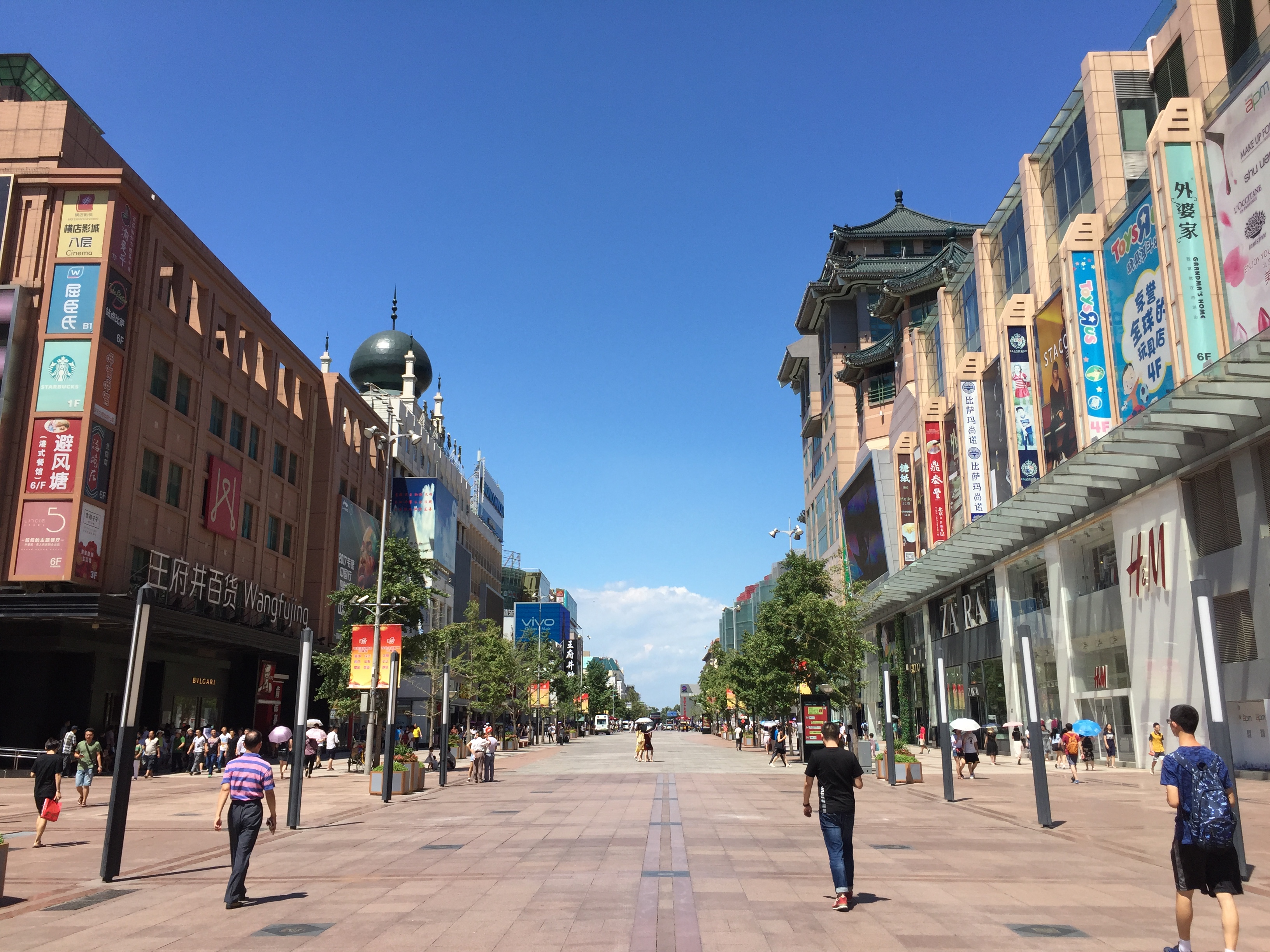
Wangfujing
The name tells a compressed history. Wang means prince. Fu means residence. Jing means well. During the Qing dynasty, ten aristocratic estates and a princess's residence were built along this stretch of eastern Beijing, and when a well of unusually sweet water was discovered among them, the street acquired its name: Wangfujing, the Well of the Princely Residences. The princes are long gone. The well is a footnote. But the street endures as Beijing's most recognizable commercial boulevard, a pedestrian promenade where the smell of lamb kebabs drifts past the doors of international luxury brands.
Five Centuries of Commerce
Commercial activity has flowed through this strip since the middle of the Ming dynasty, when it served as a passage for traders entering Beijing from the southwest. Restaurants and shops grew up to serve the merchants, and as the western part of the city became home to government officials, Wangfujing evolved into a commercial district that served them. The street was once known in English as Morrison Street, after George Ernest Morrison, the Australian journalist who served as political adviser to the Republic of China and lived nearby. Through the upheavals of the twentieth century, Wangfujing's commercial identity proved remarkably durable. By the 1970s, it had become one of Beijing's three major shopping districts, alongside Qianmen and Xidan.
The Pedestrian Transformation
Until the late 1990s, Wangfujing was open to automobile traffic. Modifications in 1999 and 2000 converted much of the street into a pedestrian zone, with through traffic rerouted to the east. The change transformed the street's character. Today, roughly 280 shops line the boulevard, which stretches from the Oriental Plaza and the Beijing Hotel at its southern entrance northward past the Wangfujing Bookstore and Beijing Department Store to the Beijing apm shopping center and St. Joseph's Church at its terminus. A tour trolley provides transport for those disinclined to walk. The intersection with Chang'an Avenue, where the Wangfujing subway station connects Lines 1 and 8, marks the street's busiest node.
Scorpions on a Stick
West of the main boulevard lies Wangfujing Snack Street, a gauntlet of food stalls that has become one of Beijing's most photographed attractions. Vendors sell chuanr -- lamb kebabs seasoned with cumin and chili -- alongside tanghulu, the traditional candied fruit on a stick that turns hawthorn berries into crunching spheres of caramelized sugar. The more adventurous options have made the snack street internationally famous: scorpions, sea horses, and starfish skewered and deep-fried, more spectacle than sustenance. Whether the exotic offerings represent authentic Beijing street food or tourist theater is a debate locals enjoy having, usually while eating a lamb kebab from one of the less photogenic stalls.
Where Shopping Met Protest
Wangfujing's commercial identity has not insulated it from political currents. In 2011, during a wave of Chinese pro-democracy protests inspired by the Arab Spring, organizers designated Wangfujing as a gathering point. The demonstrations brought clashes between police and foreign journalists to the shopping street, a jarring collision of commerce and dissent. The episode was brief but revealing: in a city where public space is tightly controlled, even a shopping boulevard can become a stage for political expression. Wangfujing has absorbed this episode as it has absorbed everything else -- the princes, the wells, the foreign journalist whose name once adorned the street -- folding it into the continuous, commercial present.
From the Air
Located at 39.91°N, 116.41°E in Beijing's Dongcheng District. The pedestrian boulevard runs north-south approximately 800 meters east of the Forbidden City and is crossed by Chang'an Avenue. Beijing Capital International Airport (ZBAA/PEK) lies 25 km to the northeast. The street is best appreciated in context at 2,000-4,000 feet, where its relationship to the Forbidden City and Tiananmen Square is visible.