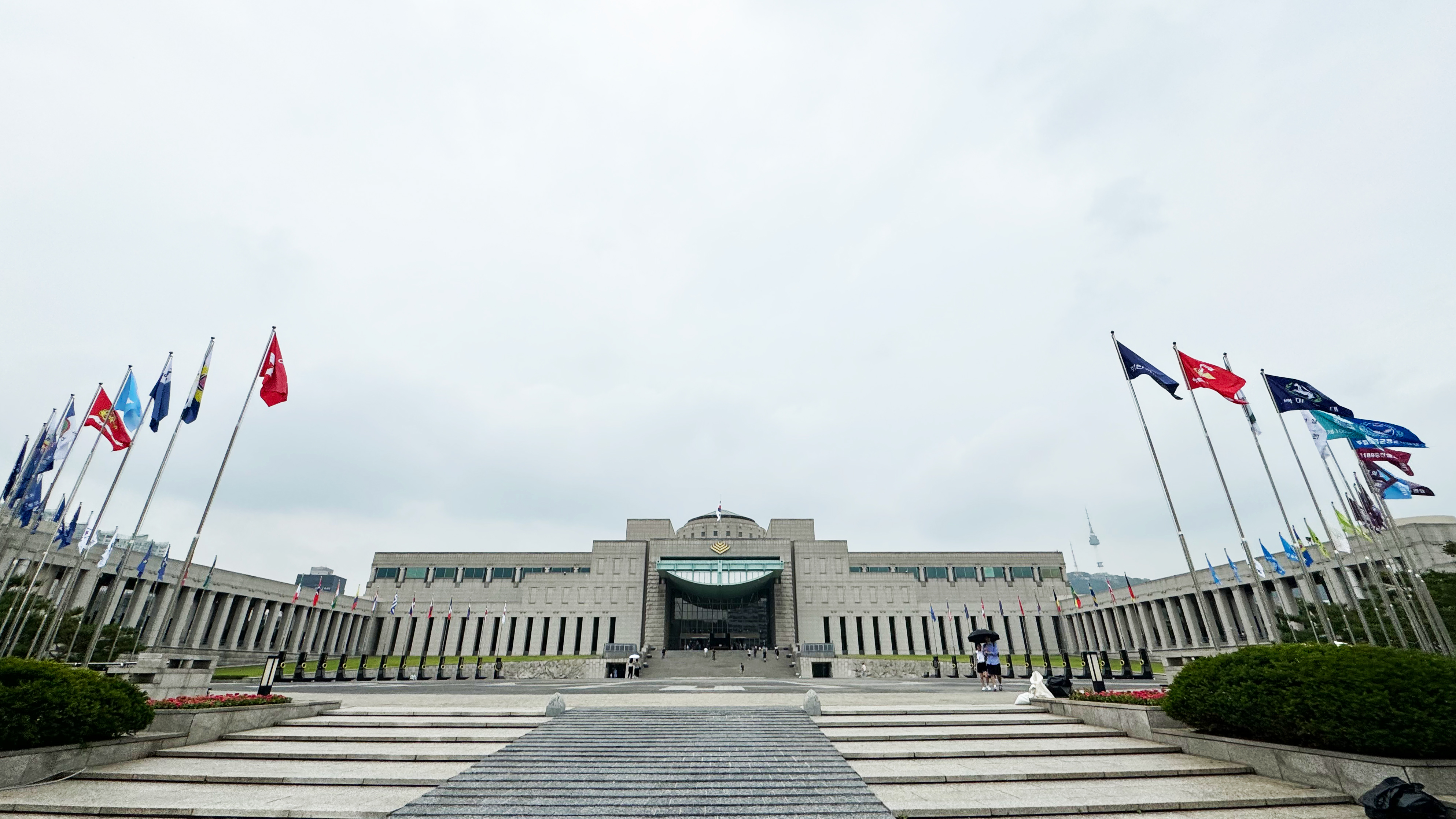
War Memorial of Korea
Two bronze soldiers embrace in the center of the plaza. The elder wears the uniform of the South Korean army; the younger, that of the North. Their reunion is fictional, but the longing it represents is not. The Statue of Brothers stands at the heart of the War Memorial of Korea, a museum that opened in 1994 on the former grounds of the army headquarters in Yongsan. It was built, according to its founders, for the purpose of preventing war through the lessons of the Korean War. Whether that war has truly ended remains an open question: the 1953 armistice was never replaced by a peace treaty.
Names Carved in Stone
Flanking the main building, cloistered galleries hold rows of black marble monuments inscribed with the names of those who died during the Korean War, the Vietnam War, border clashes with North Korea, and police officers killed on duty. The scale of the listing is its own argument. More than 137,000 South Korean soldiers died in the Korean War alone, alongside casualties from twenty other nations that fought under the United Nations flag. Walking the length of these galleries takes time, and that is the point. An artificial waterfall and rest areas surround the plaza, creating a space where families picnic on weekends a few meters from memorials to the dead. The juxtaposition is not jarring. It feels, in the Korean context, like continuity.
From Turtle Ships to MiGs
The museum's 6,300 items span the full arc of Korean military history, from medieval to modern. Inside, a full-sized replica of a geobukseon, the armored turtle ship that Admiral Yi Sun-sin used to repel Japanese naval invasions in the 1590s, dominates one gallery. Nearby sits the Cadillac Fleetwood 62 that carried South Korea's first president, Syngman Rhee, alongside the ZIL ZIS-110 limousine once used by North Korea's Kim Il Sung. The Cold War's absurdities are on display in miniature: the two leaders' cars, parked side by side, from nations that could not be further apart. A Shenyang J-6, a Chinese-made MiG-19, has its own story: North Korean pilot Captain Lee Ung-Pyeong defected in it to South Korea on February 25, 1983.
An Outdoor Arsenal
The lawns surrounding the museum hold roughly 100 large weapons and vehicles, creating what amounts to an open-air textbook of twentieth-century military technology. A Boeing B-52D Stratofortress, one of only three displayed outside the United States, sits among M48 Patton tanks, Soviet T-34s, a Grumman S-2 Tracker, and a Bell UH-1B Iroquois helicopter that served as a gunship with the U.S. Navy Seawolves in Vietnam before being transferred to South Korea. An Aerospatiale Alouette III helicopter bears a kill marking from August 13, 1983, when it sank a North Korean infiltration craft disguised as a fishing vessel with AS.11 missiles. Each aircraft and vehicle carries its serial number and provenance, turning a walk across the grass into a forensic history of alliance, conflict, and arms transfer.
The War That Hasn't Ended
A Chamsuri-class patrol boat sits in the outdoor exhibition, painted with faux battle damage to resemble PKM-357, a South Korean vessel sunk during the Second Battle of Yeonpyeong in 2002. Nearby, a captured North Korean submersible infiltration landing craft, seized near Busan in 1983, offers tangible evidence that the conflict did not stop with the armistice. The memorial's Korean War Room covers the period from June 25, 1950, to July 27, 1953, but the exhibits that follow, documenting border clashes, infiltration attempts, and naval skirmishes, make clear that hostilities continued in forms that fell short of declared war. The Expeditionary Forces Room chronicles South Korea's participation in the Vietnam War, where over 300,000 Korean troops served between 1964 and 1973, a chapter that remains contentious both domestically and internationally.
The Hope in Bronze
The War Memorial was built for a specific aspiration: peaceful reunification. That hope suffuses the Statue of Brothers, where the cracked dome beneath the two soldiers represents the division of the peninsula and their embrace symbolizes the possibility of healing. Whether that possibility has grown closer or more remote since 1994 depends on the decade. The April 2018 summit between Moon Jae-in and Kim Jong Un at Panmunjom briefly rekindled optimism. The subsequent years have complicated it. The memorial does not resolve the contradiction of hoping for peace while meticulously documenting war. It simply holds both, in marble and bronze, on the grounds where soldiers once drilled.
From the Air
Located at 37.537N, 126.977E in Seoul's Yongsan District, the War Memorial complex is identifiable from the air by the large outdoor display of military aircraft and vehicles on its grounds. It sits near the Yongsan Garrison area and the National Museum of Korea. Nearest airports: Gimpo International (RKSS) approximately 14 km west, Incheon International (RKSI) approximately 52 km west. Samgakji Station on Subway Lines 4 and 6 is adjacent.