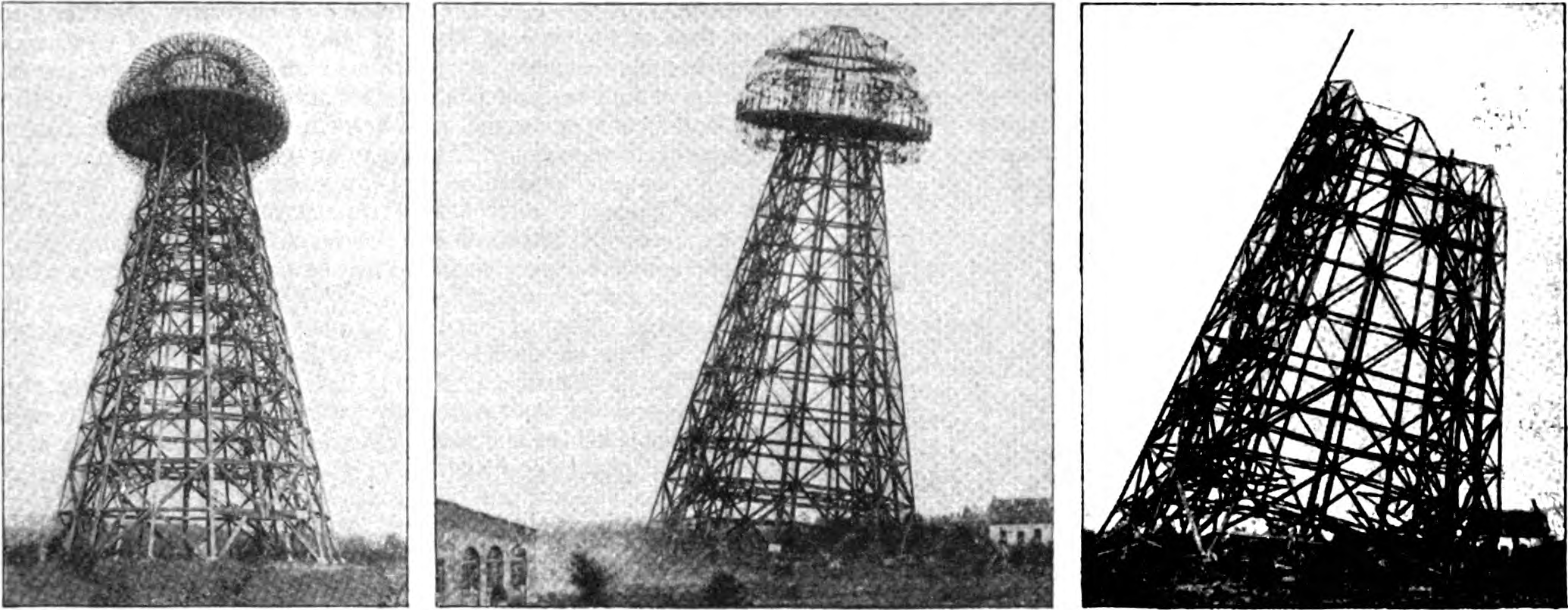
Wardenclyffe Tower
On several nights in July 1903, the tower at Wardenclyffe lit up the Long Island sky. Bright flashes crackled from the 187-foot wooden structure topped with its 55-ton steel cupola, and newspapers reported the spectacle with a mixture of wonder and confusion. Nikola Tesla offered no explanation. Neither did any of his workers. The display came just days after J. P. Morgan's final refusal to invest another dollar in the project, and Wardenclyffe never seemed to operate again. What had happened in those flashing moments -- a last defiant experiment, a fit of frustration, a theatrical plea for attention -- remains unknown. What is certain is that Tesla's grand vision of a global wireless transmission system, one that would send messages, telephone calls, even facsimile images across the Atlantic and deliver electrical power without wires to any point on Earth, died in those nights on a quiet stretch of Long Island shoreline in the village of Shoreham, New York.
The Earth as a Conductor
Tesla's idea was breathtaking in its ambition and rooted in 19th-century physics rather than the emerging science of radio waves. Beginning with experiments in the early 1890s and culminating in large-scale tests at Colorado Springs, Colorado, in 1899, Tesla developed a theory that electric current injected into the Earth at just the right frequency could harness the planet's own electrical charge, creating standing waves that could be tapped anywhere on the globe to power devices or carry signals. He envisioned a charged conductive layer in the upper atmosphere serving as the return path, and believed the power flowing through it would even make the sky glow, providing nighttime illumination for cities and shipping lanes. He discarded radio waves entirely, doubting their existence and following the scientific assumption of the era that they would travel in straight lines like visible light, shooting uselessly into space. Tesla demonstrated wireless power transmission at Colorado Springs, lighting electric bulbs mounted outside his laboratory building, but he never scientifically tested his broader theories. He simply believed Earth resonance would work at any distance.
Wining and Dining at the Waldorf
Tesla returned to New York in January 1900 and began courting investors with the showmanship that had made him famous. He wined and dined potential backers at the Waldorf-Astoria's Palm Garden, The Players Club, and Delmonico's. His article "The Problem of Increasing Human Energy" in The Century Magazine that June was supposed to explain his Colorado Springs work but read more like a philosophical treatise on harnessing solar energy, controlling weather, and making war impossible. George Westinghouse declined to buy in but lent Tesla $6,000 and suggested he approach wealthy venture capitalists. John Jacob Astor bought 500 shares in Tesla's company. Tesla even sent a cabochon sapphire ring to sugar magnate Henry O. Havemeyer -- no investment followed. In November 1900, Tesla finally gained the attention of J. P. Morgan, who signed a contract in March 1901 for $150,000 to develop and build a wireless station. Morgan was impressed by Marconi's radio reports from the America's Cup yacht races but remained dubious about Tesla's grander claims. It was enough to begin construction.
The Tower Rises, the Money Vanishes
Construction started in September 1901 on a site in Shoreham provided by landowner James Warden, who expected the project to attract thousands of employees and boost local real estate. The architect Stanford White, one of America's most celebrated designers, created the main laboratory building in Italian Renaissance style. The tower itself, designed by W.D. Crow, reached its full height of 187 feet by the end of 1902, crowned by a hemispherical cupola weighing 55 tons. Beneath the tower, Tesla's workers sank a ten-by-twelve-foot shaft deep into the earth, with iron pipes driven 300 feet into the ground. Tesla described the purpose: "to have a grip on the earth so the whole of this globe can quiver." But the money was disintegrating. Tesla had read about Marconi's advances and radically scaled up his design beyond what Morgan had agreed to fund, envisioning not just wireless telegraphy but power transmission and image delivery. Morgan, confronting what amounted to a breach of contract, refused any additional investment. In December 1901, Marconi announced he had transmitted a wireless signal across the Atlantic. Wall Street money flowed to Marconi's proven system while Tesla's unfinished tower stood silent on Long Island.
A Slow Unraveling
Tesla pleaded with Morgan for years. In a July 1903 letter he wrote, "Will you help me or let my great work -- almost complete -- go to pots?" Morgan's reply was unequivocal: "I should not feel disposed at present to make any further advances." Then came the mysterious night flashes, and then silence. In 1905, Tesla's patents on alternating current motors expired, halting the royalty payments that had been his financial lifeline. In 1906, Stanford White was murdered in one of the era's most sensational crimes. Longtime investor William Rankine died of a heart attack. Tesla's chief manager George Scherff left to find paying work. The people of Shoreham noticed the plant had been abandoned without notice. A 1916 magazine article described the eerie scene: "There everything seemed left as for a day -- chairs, desks, and papers in businesslike array. The great wheels seemed only awaiting Monday life. But the magic word has not been spoken, and the spell still rests on the great plant." Tesla had taken out mortgages against the property with George C. Boldt, proprietor of the Waldorf-Astoria, just to cover his hotel bills.
Dynamite, Silver, and Crowdfunding
On July 4, 1917, the Smiley Steel Company dynamited the tower for scrap. Wartime rumors claimed the government ordered its demolition because German spies were using it, but the truth was simpler: Boldt had foreclosed, and the scrap was all the value that remained. The property passed through various owners until Peerless Photo Products and later AGFA Corporation used it for decades as a photographic processing facility, leaving behind silver and cadmium contamination that cost $5 million to clean up. Tesla's original brick laboratory building, designed by Stanford White, survived it all. In 2012, cartoonist Matthew Inman of The Oatmeal and Jane Alcorn of the Tesla Science Center at Wardenclyffe launched a crowdfunding campaign on Indiegogo called "Let's Build a Goddamn Tesla Museum." They raised over $1.7 million in six days. A matching grant from New York State brought the total past $2.2 million, enough to purchase the 15.69-acre site from AGFA in 2013. Elon Musk donated $1 million and pledged a Tesla Motors supercharging station on the grounds. A groundbreaking ceremony took place in April 2023, though a fire in November of that year damaged the historic building. Much of the original brick structure survived. The site was listed on the National Register of Historic Places in 2018, and the dream of a Tesla museum endures -- a fitting tribute to a man whose own dreams always outran his funding.
From the Air
Located at 40.95N, 72.90W in the village of Shoreham on Long Island's North Shore, New York. The site sits along Route 25A near the Shoreham Post Office and Fire House. From the air, look for the historic Stanford White brick laboratory building -- the only surviving structure from Tesla's original facility. The tower foundation site is behind the main building. Long Island Sound is visible to the north. Recommended viewing altitude: 1,000-2,500 feet AGL. Nearest airports: Francis S. Gabreski Airport (KFOK) approximately 25nm southeast, Long Island MacArthur Airport (KISP) approximately 20nm south-southwest, Calverton Executive Airpark (KCTO) approximately 10nm east. The North Shore of Long Island provides good visual reference with its distinctive coastline. Standard coastal weather considerations apply.