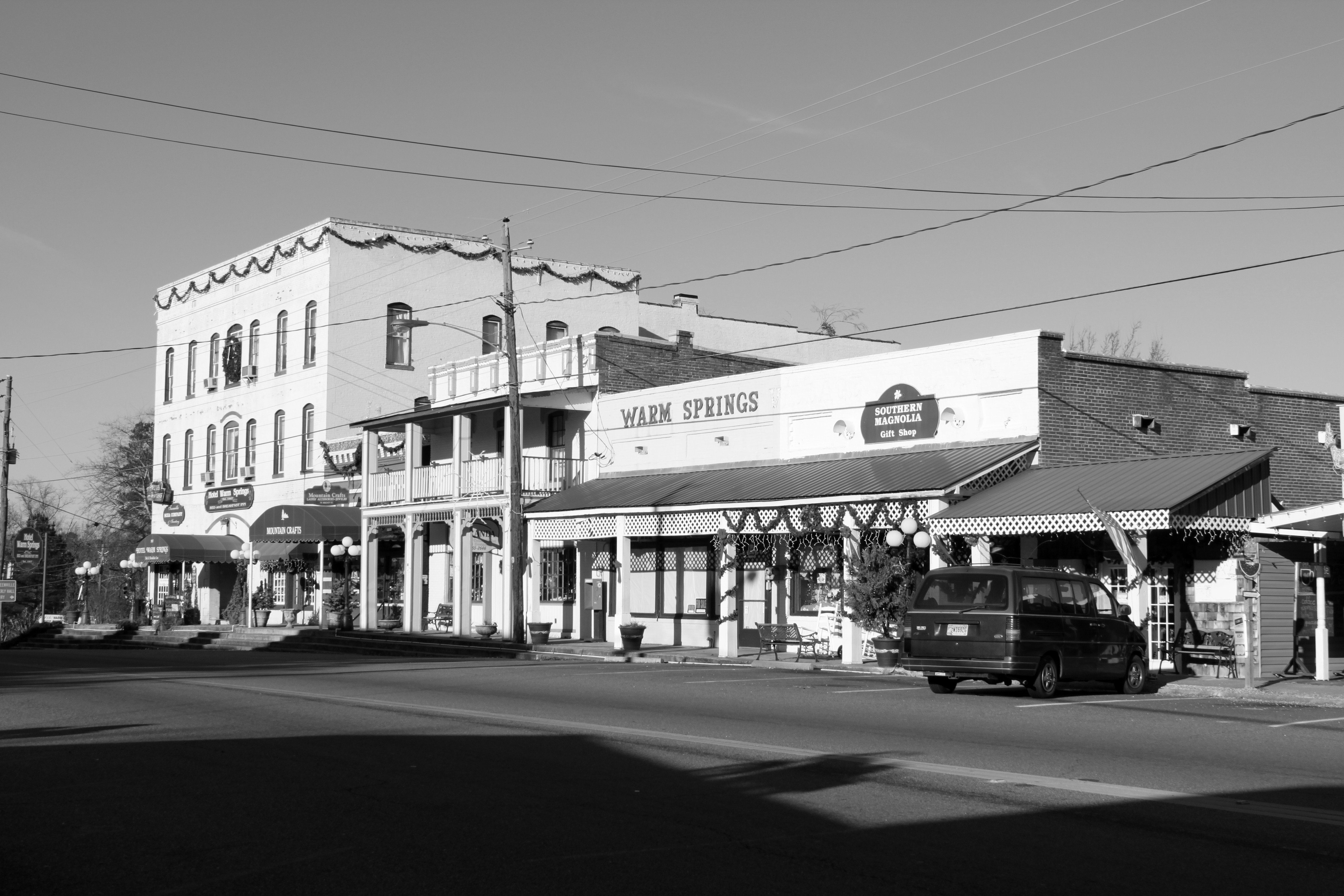
Warm Springs, Georgia
Rain falls on Pine Mountain, seeps through cracks in the rock, and descends nearly 3,000 feet into the earth, warming one degree for every hundred feet of depth. It resurfaces in Meriwether County, Georgia, at a steady 88 degrees Fahrenheit, pushing 914 gallons per minute into pools that Native Americans used for healing long before Europeans arrived. This geological curiosity -- Georgia's largest warm spring -- gave a small town its name, drew a future president to its waters, and turned a quiet corner of the rural South into one of the most significant sites in American political history. Warm Springs, Georgia, population barely 400 in most decades, has carried a weight far beyond its size.
Bullochville Before Roosevelt
The town was not always called Warm Springs. In the early 1890s, Benjamin F. Bulloch founded the community of Bullochville just across the Southern Railway tracks from the springs. Residents of Savannah began vacationing there in the late 18th century to escape yellow fever, and by the 1880s, prosperous Atlantans were making the trip by rail to Durand and then onward to the springs. The Meriwether Inn hosted the fashionable visitors. But when the automobile arrived in the early 20th century, tourists discovered more exotic destinations, and the inn fell into decline. Bullochville might have faded entirely into the Georgia piedmont had it not been for a desperate politician looking for relief from a disease that had stolen the use of his legs.
A President Finds His Refuge
Franklin Roosevelt arrived in October 1924, a 42-year-old former vice-presidential candidate three years into his battle with polio. The warm, buoyant water let him move his legs in ways he could not on land. He was captivated. Roosevelt bought the resort and its surrounding acreage in 1927 and incorporated the Georgia Warm Springs Foundation to treat polio patients. He renamed the town Warm Springs. When he won the presidency in 1932, he built a six-room cottage of Georgia pine on the property -- the Little White House -- and made 16 trips there during his time in office. The town's population swelled from 400 to 608 between 1930 and 1940, buoyed by the stream of staff, Secret Service agents, journalists, and polio patients who followed Roosevelt south.
Healing Waters, Historic Halls
Roosevelt's foundation turned Warm Springs into a nationally recognized rehabilitation center. Georgia Hall, the institute's main building, was completed in 1933, and Roosevelt hosted Thanksgiving dinners in its dining hall for patients using the springs. For much of its history, the facility was the only one in America exclusively devoted to polio patients. The Polio Hall of Fame on the outside wall of Founder's Hall features sculptured busts of fifteen scientists and two laymen who made major contributions to understanding and treating poliomyelitis. Nearby, the Eleanor Roosevelt School, built in 1936 and opened in 1937, holds its own distinction: it was the last Rosenwald school constructed in the United States using funds from the Julius Rosenwald Fund, which built thousands of schools for African American students across the South.
The Town That Remembers
Roosevelt died at the Little White House on April 12, 1945. After his death, the town's population returned to its pre-1930 level, but his imprint never faded. The Little White House opened as a museum in 1948. The Benjamin F. Bulloch House, a Queen Anne-style home built in 1893 by the town's co-founder and added to the National Register of Historic Places in 1994, served for years as the Bulloch House Restaurant before a fire destroyed it on June 10, 2015. The Oakland Plantation Inn, dating to 1829 and also on the National Register, still stands. The historic district of Old Bullochville anchors the center of town and hosts the annual Watermelon Festival. Broad Street downtown carries the quiet rhythm of a place that once hosted the most powerful man in the world.
Small Town, Long Shadow
Warm Springs produced more than presidential history. George W. Jenkins, founder of the Publix supermarket chain, was born here. Philanthropist George Foster Peabody retired to the town. Corporal Maoma L. Ridings, a member of the Women's Army Corps who had served as a nurse to Roosevelt during his Warm Springs visits, was murdered in 1943 at the Claypool Hotel in Indianapolis -- a case that made national headlines and was never solved. Even the town's airport bears Roosevelt's name: Roosevelt Memorial Airport, designated 5A9, sits just east of town. From its healing springs to its presidential cottage to its place in the story of American public health, Warm Springs remains a town where the personal and the national intersect in ways that few communities of any size can claim.
From the Air
Located at 32.889N, 84.680W in Meriwether County, Georgia. Warm Springs is a small town visible from altitude as a compact cluster of buildings along the Southern Railway line. The Little White House complex is on Pine Mountain to the south of town. Roosevelt Memorial Airport (5A9) is located just east of town and serves as the closest landing option. Columbus Metropolitan Airport (KCSG) is approximately 35 nm to the southwest, and Peach State Airport (K6A2) is about 30 nm to the east. The Flint River corridor runs a few miles west of town and provides good visual navigation. Pine Mountain ridge, running east-west, is the dominant terrain feature in the area.