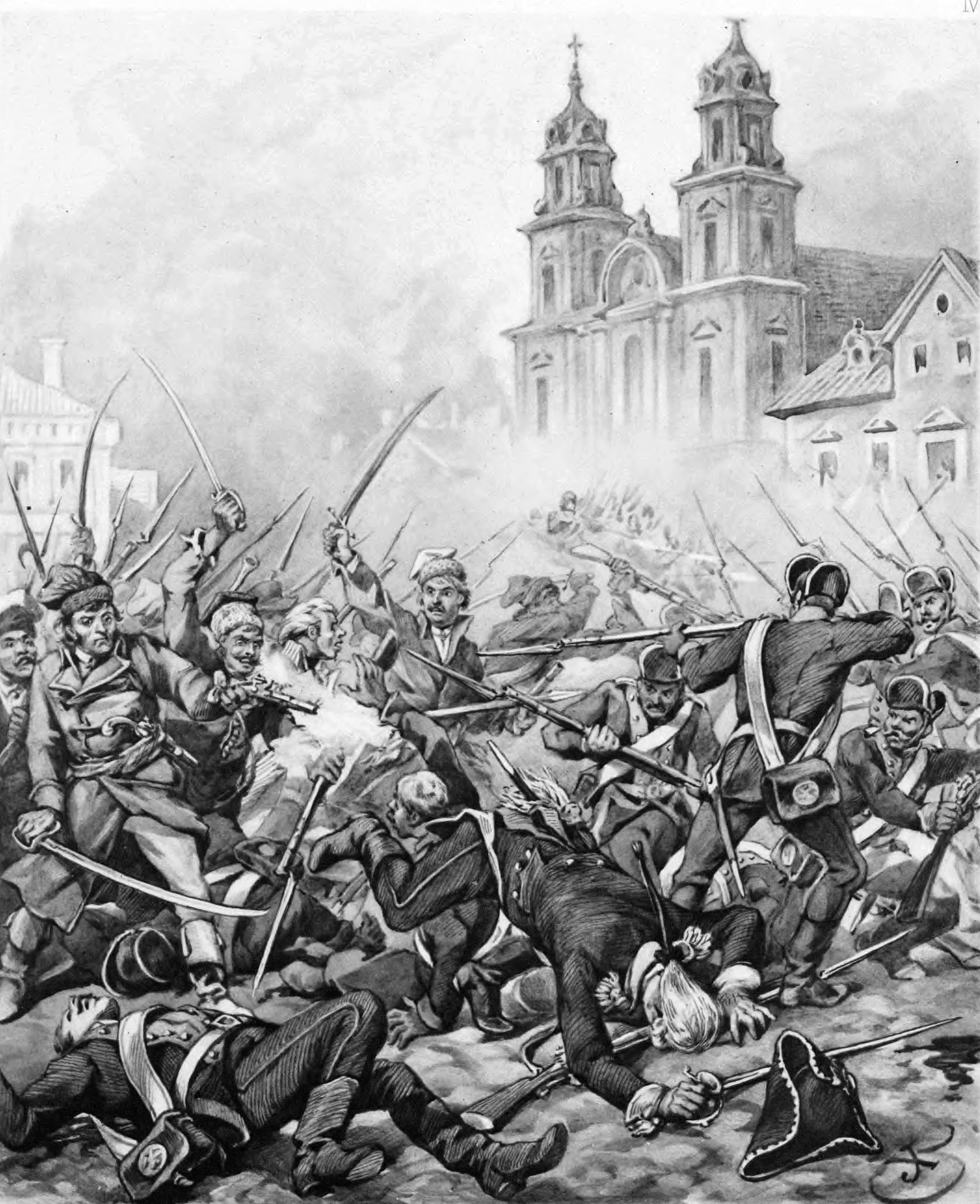
Warsaw Uprising of 1794
Holy Wednesday, 16 April 1794. Overnight in Warsaw, Polish dragoons received their ammunition allotments and were quietly dispatched to positions across the city. The Russians knew something was coming, and they had distributed extra cartridges of their own. At 3:30 in the morning, twenty Polish horsemen left the Mirów barracks, headed toward the Saxon Garden, encountered a small Russian force at the Iron Gate, charged it, and captured its two cannons. By dawn, the city was at war. The Warsaw Uprising of 1794 lasted three days and ended in stunning Polish victory — and in the unraveling that would lead, seven months later, to one of the worst civilian massacres of the eighteenth century.
Why Warsaw Was Already Under Occupation
The Second Partition of Poland in 1793 had already torn away most of what remained of the Polish-Lithuanian Commonwealth, dividing it between Prussia and Russia. The rump Polish state was occupied by Russian and Prussian garrisons. Russian ambassador Nikolai Repnin and his successor Iosif Igelström dictated policy from the Russian embassy on Miodowa Street. After the lost Polish-Russian War of 1792, Russia forced the Permanent Council to cut the Polish Army in half and conscript the demobilized soldiers into Russian and Prussian service. The disbanded units' arms went into Warsaw warehouses — and many of their officers were quietly waiting. When Tadeusz Kościuszko proclaimed his uprising at Kraków on 24 March 1794 and won the Battle of Racławice on 4 April, Warsaw began to plan. King Stanisław August Poniatowski tried to prevent the rising. The shoemaker Jan Kiliński and the agent Tomasz Maruszewski organized it anyway.
The Three-Day Battle
Igelström had roughly 7,948 men, 1,041 horses, and 34 guns spread across Warsaw — supplemented by Prussian troops camped at Powązki. Polish regulars numbered about 3,000, with 150 horses; militia volunteers added perhaps 2,000 more. The Russians outnumbered and outgunned the Poles, but they were dispersed in small detachments guarding warehouses and officers' residences. When the fighting began at the Arsenal at five in the morning on 17 April, the Polish defenders began handing out weapons to civilian volunteers. The 10th Regiment of Foot under Colonel Filip Hauman marched up from Ujazdów, was nearly destroyed in a battle on Krakowskie Przedmieście Street, regrouped, and turned the tide. By midday, General Tishchev was dead — a cannonball had taken off his leg — and his Russian column had surrendered. By the next morning Igelström's headquarters at Miodowa Street was surrounded. He fled to the Prussian camp on 18 April with perhaps 300 to 400 men. The Russian secret archive, covering thirty years of operations in Poland since 1763, fell into Polish hands.
The Costs and the Aftermath
The Russian forces lost 2,265 dead, around 2,000 wounded, and 1,926 taken prisoner. Polish regular losses ran 800 to 1,000 dead and wounded; civilian and militia losses did not exceed 700. Ignacy Wyssogota Zakrzewski became Warsaw's mayor and commander, and the National Militia eventually grew to over 20,000 men. On 9 May an Insurrectionary Court hanged four leaders of the Targowica Confederation — the Polish noblemen who had invited Russian intervention against the 1791 May Constitution. On 28 June a mob stormed the prisons and lynched several more, including Bishop Ignacy Massalski. Kościuszko himself condemned the lynchings: 'What happened in Warsaw yesterday filled my heart with bitterness and sorrow. Those who do not obey the laws are not worthy of liberty.' But the uprising was now national, and it would not be contained.
The Massacre of Praga
The triumph of April 1794 ended in catastrophe in November. Russian Empress Catherine II sent General Alexander Suvorov with a force of approximately 22,000 men to retake the city. On 4 November 1794, Suvorov's troops stormed Praga, the eastern bank suburb of Warsaw across the Vistula. What followed has gone into Polish memory as the rzeź Pragi, the Praga massacre. The Russian troops killed somewhere between 10,000 and 20,000 civilians — figures vary, but the lower end is generally accepted as conservative. Witnesses described the burning of houses with people still inside, the killing of women and children, the bodies floating in the Vistula. Whether Suvorov ordered or merely failed to stop the killing is still debated by historians. The massacre broke the will of Warsaw to resist. The city surrendered the next day. The Third Partition of 1795 erased Poland from the map of Europe for 123 years. The Warsaw Uprising of 1794 is commemorated on the Tomb of the Unknown Soldier in Warsaw with the dates: WARSZAWA 17 IV — 4 XI 1794. April 17 was the triumph. November 4 was the price.
From the Air
The 1794 uprising took place across the historic center of Warsaw at 52.24°N, 21.00°E, on the west bank of the Vistula. Key sites — the Royal Castle, the Arsenal at Miodowa Street, the Saxon Garden, Krakowskie Przedmieście — all sit within the Old Town and Śródmieście districts, easy to spot from the air. The November 1794 Praga massacre took place on the east bank, in what is now the Praga-Północ and Praga-Południe districts. Nearest airport is Warsaw Chopin (EPWA), 8 km southwest. Recommended viewing altitude 2,000-4,000 ft. The Vistula bisects the city and the historic battle geography clearly.