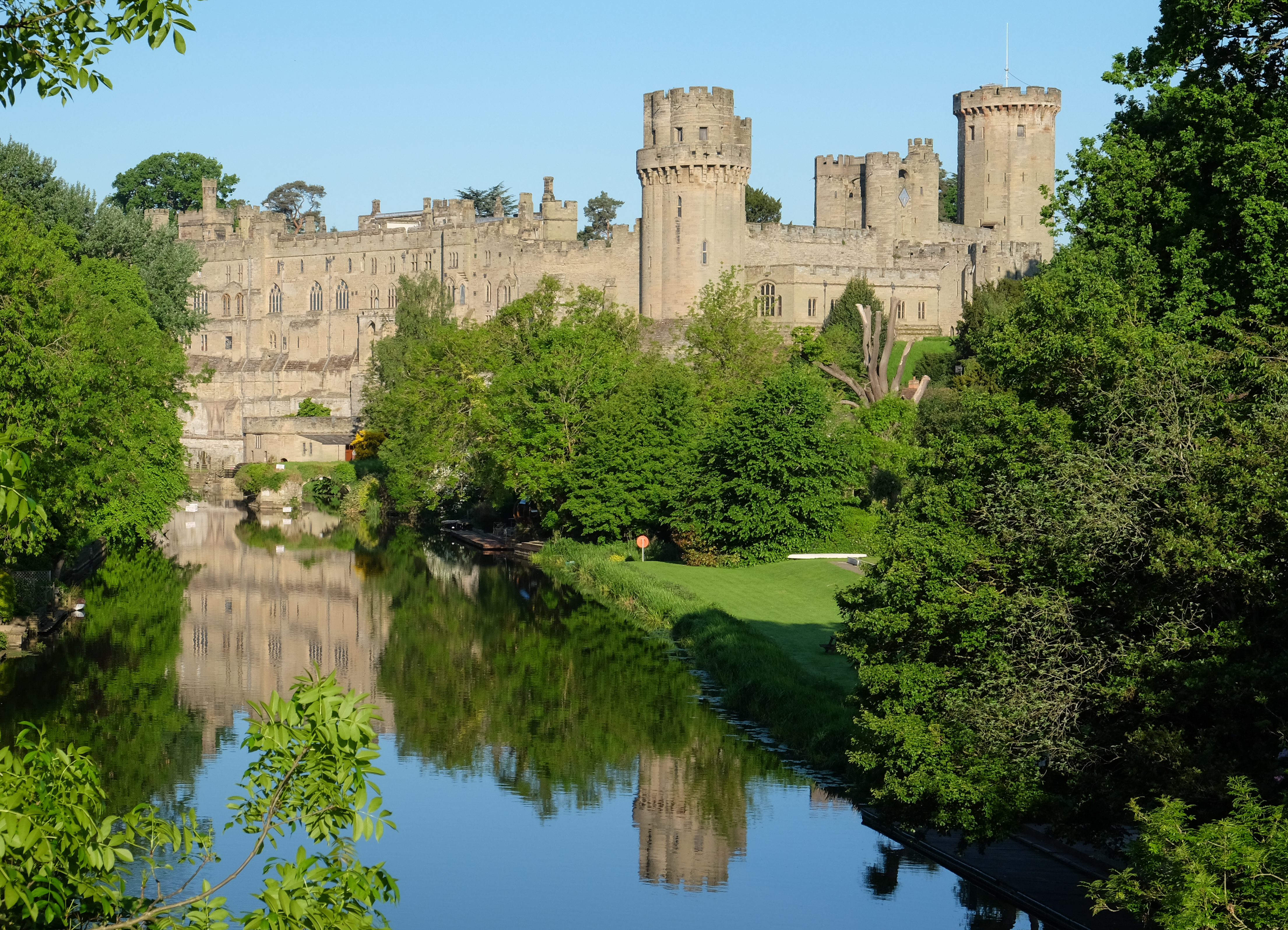
Warwick Castle
William the Conqueror chose the spot in 1068, just two years after Hastings. A bend in the River Avon, high ground with natural defenses, a strategic position in the heart of England -- the site practically demanded a castle. What he built was a timber motte-and-bailey fortification, a statement of Norman authority planted in Saxon soil. Over the next nine centuries, successive owners rebuilt it in stone, fortified it with towers, beautified it with gardens, imprisoned enemies within its walls, and ultimately turned it into a spectacle. Today Warwick Castle receives more than half a million visitors a year, but beneath the theme-park veneer lies a fortress that shaped English history.
Towers and Power
The stone castle that replaced William's timber original took shape over centuries. The Beauchamp family, who held the earldom from 1268, built the domestic range and the mighty Caesar's Tower and Guy's Tower -- both still standing, both designed to impress as much as defend. Guy's Tower rises 128 feet, a twelve-sided structure that dominates the town's skyline. The castle withstood a siege in 1264 during the Barons' War and was besieged again at the start of the English Civil War in 1642, when Parliamentarian forces held it against a Royalist assault. The garrison was relieved on August 23 by the Earl of Essex's forces, just weeks before the Battle of Edgehill. After Edgehill -- the first pitched battle of the Civil War -- prisoners from both that engagement and later from the Battle of Worcester in 1651 were held in Caesar's and Guy's Towers. A garrison of up to 302 soldiers was maintained from 1643 to 1660.
From Fortress to Stately Home
When the English Council of State ordered the garrison disbanded in 1660, the Greville family -- who had held the castle since 1604 -- found the state apartments outmoded and in poor repair. They undertook extensive modernization between 1669 and 1678 under the master carpenters Roger and William Hurlbutt of Warwick. To ensure the interiors would be fashionable, William Hurlbutt was sent to Dorset to study the recently finished rooms at Kingston Lacy. Francis Greville, 8th Baron Brooke, launched another round of improvements and was rewarded with the title Earl of Warwick in 1759. He hired Lancelot 'Capability' Brown to landscape the grounds, transforming the medieval castle's surroundings into the sweeping parkland visible today. The result was a peculiarly English hybrid: a medieval fortress wrapped in 18th-century elegance, military architecture softened by landscaped gardens and state rooms filled with Old Masters.
The Great Fire and the Showman's Castle
On December 3, 1871, fire swept through the castle's private apartments in the Great Hall range, destroying much of the interior. The damage was extensive but not total, and the 4th Earl of Warwick undertook a thorough restoration. By the early 20th century, however, the castle's upkeep had become an unsustainable financial burden. In 1978, the Greville family sold Warwick Castle to the Tussauds Group, which later became part of Merlin Entertainments. The new owners installed wax figures in the state rooms, added medieval-themed attractions, and marketed the castle as an immersive experience. The transformation was controversial -- purists mourned the loss of an aristocratic household -- but it ensured the castle's survival. The medieval fabric remains intact beneath the entertainment, and the castle's Grade I listing and status as a scheduled monument protect its historic character.
The River and the Rock
Warwick Castle's strength has always derived from its geography. The River Avon curves around its southern and eastern walls, providing a natural moat. The castle sits on a sandstone bluff that gives it height over potential attackers from the town side. Walking the curtain walls, you can trace the defensive logic: Guy's Tower commands the northeast approach, Caesar's Tower guards the southeast corner, and the 14th-century gatehouse with its barbican controls the only land entrance. Below the walls, Capability Brown's grounds slope down to the river where peacocks strut across manicured lawns -- a jarring contrast to the arrow loops and murder holes above. It is this combination of genuine medieval menace and carefully composed beauty that makes Warwick Castle compelling: a place where you can stand in an 800-year-old tower and look out over landscaping designed to make warfare feel like a distant memory.
From the Air
Located at 52.28N, 1.59W on the River Avon in Warwickshire. The castle is prominently visible as a large medieval complex with distinctive towers adjacent to the town center. The river curves around the castle's southern wall. Nearest airports: EGBW (Wellesbourne Mountford, 4nm S), EGBE (Coventry, 12nm E), EGBB (Birmingham, 20nm NW). Best viewed at 1,500-2,500 ft AGL.