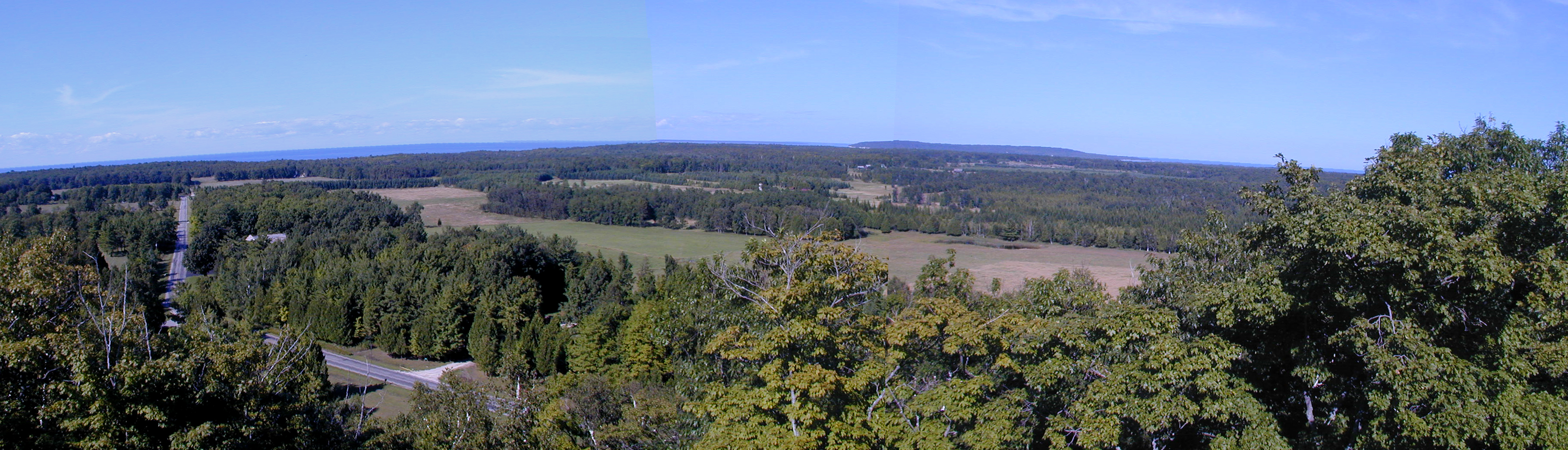
Washington Island
The schooner Washington was the largest vessel on the Great Lakes when it anchored in an unnamed harbor on an unnamed island in July 1816. Colonel John Miller's fleet of four ships had been separated en route to garrison Fort Howard at the head of Green Bay, and the flagship dropped anchor to wait. Officers explored the island during two idle days, and -- assuming they were the first ship to shelter there -- named the harbor after their vessel and, by extension, after the president. They named surrounding islands for members of their party: Chambers Island for Major Talbot Chambers, Keans Island and Fallons Island for other officers. The main island they called Millers Island. None of these names fully stuck. Mapmakers continued labeling the archipelago the Potawatomi Islands, a name in use since 1650, or used the French translation l'Isle des Poux. But the fishermen and craftsmen who settled around Washington Harbor in the 1830s called their home by the harbor's name, and by the 1850 census, Washington Island was official.
Beyond the Door of the Dead
Washington Island sits just northeast of the Door Peninsula's tip, separated by the strait the French named Porte des Morts -- Death's Door. The passage connecting Green Bay to Lake Michigan is littered with shipwrecks, its crosscurrents and shoals treacherous enough to give both Door County and the Door Peninsula their names. The island is part of a string of outcroppings of the Niagara Escarpment stretching from Wisconsin to Michigan's Garden Peninsula. The Ojibwa called it Wassekiganeso, meaning "his breast is shining," a reference to sunlight glinting off the limestone cliffs. Another name, Me-she-ne-mah-ke-ming, translates to Leader Island. The Potawatomi first arrived around 1641 and remained long enough to stamp their name on the islands for nearly two centuries. Before them, the Jesuit Records of 1670 to 1672 refer to the Huron Islands; Jonathan Carver called them the Islands of the Grand Traverse. Every culture that passed through left a name. The island kept accumulating them like sediment.
The Icelandic Shore
A large non-Native American presence did not arrive until the 1830s, when settlers bound for Green Bay heard rumors of enormous trout in the surrounding waters. Most were Icelandic and Irish. The Icelanders came in numbers sufficient to establish one of the oldest Icelandic communities in the United States, a distinction the island holds to this day. Washington Island remains among the largest Icelandic settlements outside Iceland itself. The cultural imprint runs deep. From 1896 to 1926, the economist Thorstein Veblen -- the man who coined the phrase "conspicuous consumption" -- spent his summers in a study cabin on the island. Surrounded by Icelandic neighbors, Veblen taught himself their language well enough to write articles accepted by an Icelandic newspaper and to translate the medieval Laxdaela saga into English. The island's Scandinavian heritage now coexists with lavender: Washington Island hosts the Midwest's largest lavender farm, drawing visitors to a biennial summer festival where purple fields meet Lake Michigan horizons.
Island Time, Island Law
With a year-round population of about 700, Washington Island operates on its own rhythms. There is one commercial fisherman left, hauling nets from the same waters that first attracted settlers nearly two centuries ago. The Sievers School of Fiber Arts offers weaving and textile classes. Two town parks, a county park, two beaches, a public boat ramp, and three State Natural Areas provide outdoor space on an island of just over 23 square miles. Getting there requires crossing Death's Door by ferry -- a 30-minute ride from Northport Pier on the mainland to Detroit Harbor, or a 20-minute passenger-only run from Gills Rock. The island also has its own airport, Washington Island Airport, a small public field with two grass runways. The border between Wisconsin and Michigan once ran through these waters ambiguously -- the original definition relied on "the most usual ship channel" into Green Bay, but commercial routes existed on both sides of the island. In 1936, the U.S. Supreme Court settled the matter in Wisconsin v. Michigan, awarding Washington Island and its neighbors to Wisconsin.
The Weight of Names
Washington Island's history is a palimpsest of names layered over names. The Potawatomi Islands became the Huron Islands, became the Noquet Islands, became Millers Island, became Washington Island. When a lighthouse was built on nearby Rock Island, it was called Pottawatomie Light -- and that name has held, a fossil from an older era embedded in the present. Some maps charted Mellens Island, a possible corruption of Miller. At times the main island disappeared from maps altogether. The naming confusion reflects deeper tides: the Potawatomi who arrived around 1641, left, returned, and were eventually displaced. The French explorers who charted these waters without consistent spelling. The American military officers who assumed they were first and named everything after themselves. Each wave of arrivals overwrote what came before, but not completely. The island's Lake Michigan climate moderates its seasons -- summers cooler, winters less brutal than the Wisconsin mainland at the same latitude. Time moves differently here, as it does on all islands, each day shaped more by water and weather than by the calendars of the mainland.
From the Air
Located at 45.38N, 86.90W in northern Lake Michigan, Washington Island is clearly visible from altitude as the largest island in the chain extending north from the Door Peninsula. Washington Island Airport (2P2) has two grass runways (2,250 ft and 2,232 ft) at 653 ft elevation. Door County Cherryland Airport (KSUE) at Sturgeon Bay is the nearest paved field on the mainland. Austin Straubel International (KGRB) in Green Bay is the closest commercial airport. From above, look for the strait of Death's Door separating the island from the peninsula's tip, Detroit Harbor on the south side, and the chain of smaller islands (Plum, Detroit, Hog, Pilot, Rock) extending between the island and the mainland. The Niagara Escarpment limestone cliffs are visible along the shoreline.