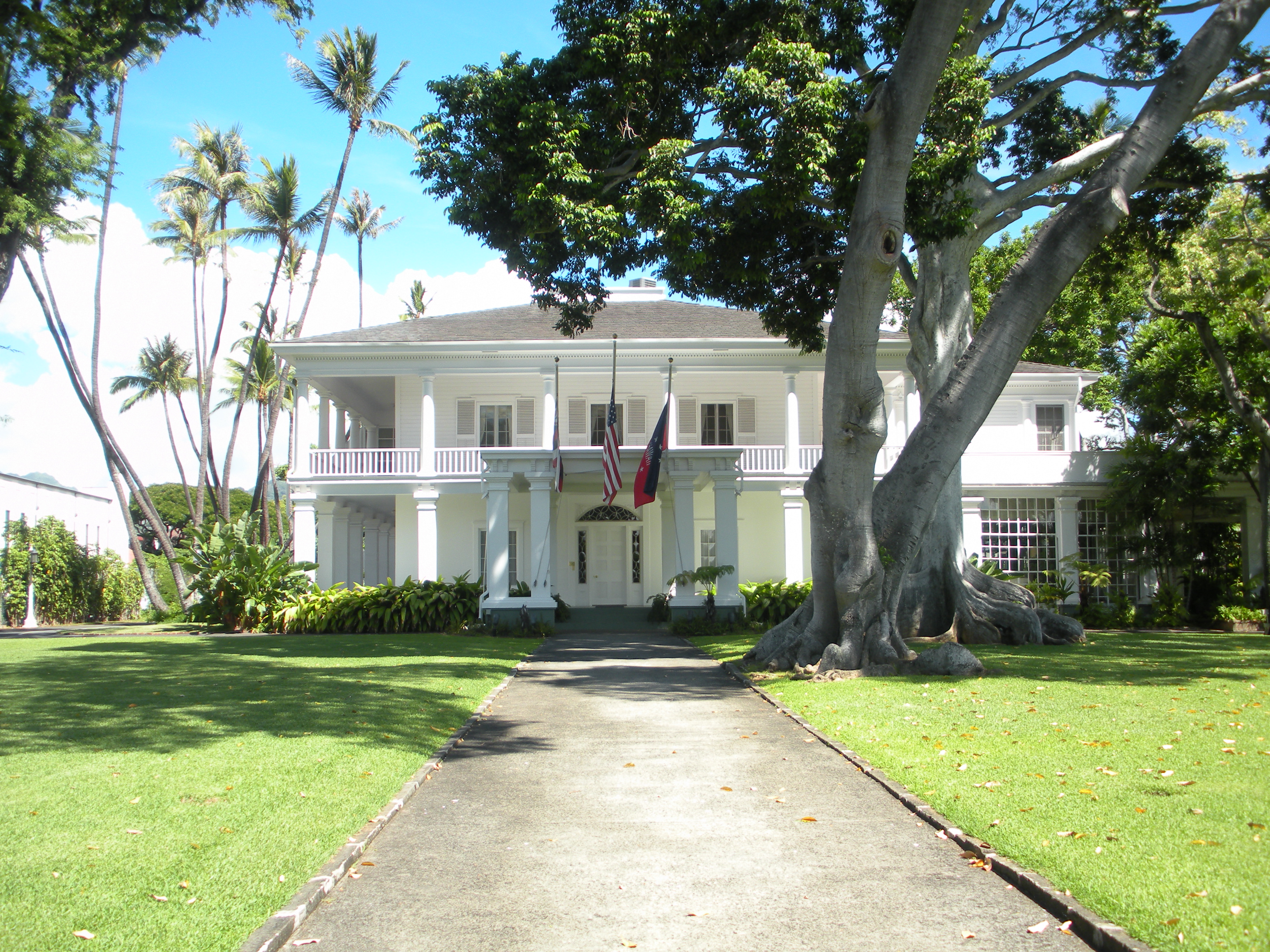
Washington Place
Mary Dominis never stopped waiting. Her husband, Captain John Dominis, sailed for China in 1846 aboard the brig William Neilson, intending to buy furniture for the house they were building in Honolulu. The ship was lost at sea. Decades later, a Massachusetts lawyer renting a room in the finished house described Mary as still expecting the captain to walk through the door. The house she kept ready for his return would witness events far larger than any homecoming: a royal marriage, the overthrow of a kingdom, the arrest of a queen, and the quiet passing of Hawaiian sovereignty into American hands. Washington Place has stood in the heart of Honolulu since 1847, absorbing history the way its coral-stone foundation absorbs the island heat.
Built on Coral and Lawsuit Money
Captain John Dominis relocated from New York to Hawaii in 1837 with Mary and their young son, John Owen Dominis. In 1842, the captain received a parcel of land as settlement of a lawsuit with the British Consul Richard Charlton. He began building a house in the Greek Revival style then fashionable along the Gulf Coast of the American South. Master carpenter Isaac Hart, who had helped construct the first Iolani Palace, designed the structure. Daniel Jenner, an Italian master mason, laid the coral-stone foundation and lower walls. The painter Israel Wright finished the interiors. Native Hawaiians worked alongside them, though archival records do not preserve their individual names. The result was a two-story house with Tuscan columns, a peristyle of open verandahs on all sides, and a Georgian floor plan of four parlors downstairs and four bedchambers above. In style, it more closely resembled a French Creole plantation house from Louisiana than anything typical of the Pacific.
A Princess Moves In
Washington Place's transformation from private residence to seat of Hawaiian history began in 1862, when Lydia Kamakaeha Paki married John Owen Dominis, the captain's son. She would become Queen Liliuokalani, the last reigning monarch of the Kingdom of Hawaii. Before the wedding, the house had already hosted William Little Lee, the Massachusetts lawyer who authored the Great Mahele of 1848 -- the land reform act that introduced private property ownership into Hawaiian culture. Lee lived at Washington Place from 1849 to 1854 while reshaping the legal foundations of the kingdom. Mary Dominis died on April 25, 1889. Her son John Owen followed on August 27, 1891, leaving the property to Liliuokalani, who had just become queen after the death of her brother, King Kalakaua. For a brief moment, Washington Place was both a queen's private residence and the emotional center of Hawaiian royalty.
The Overthrow
That moment ended violently. In January 1893, a group of American and European businessmen, backed by a detachment of United States Marines, overthrew the Hawaiian monarchy. Washington Place became the site of Queen Liliuokalani's arrest. She was tried before a military tribunal and charged with concealment of treason against the newly established Republic of Hawaii. After her conviction and imprisonment at Iolani Palace, she was confined for several months at Washington Place. The queen never left. She remained at Washington Place for the rest of her life, writing her memoir, Hawaii's Story by Hawaii's Queen, in which she called the house "a palatial dwelling" and "a choice tropical retreat in the midst of the chief city of the Hawaiian islands." In 1917, near the end of her life, she raised the American flag at Washington Place to honor five Hawaiian sailors who had died in the sinking of the SS Aztec by German submarines. Many interpreted the gesture as her symbolic acceptance of American sovereignty. She died in a downstairs bedroom on November 11, 1917.
From Queen's Home to Governor's Mansion
On May 14, 1921, the territorial legislature of Hawaii purchased Washington Place for $55,000 from Liliuokalani's estate to serve as the official residence of the Territorial Governor. Governor Wallace Rider Farrington remodeled the house in 1922. Over the following eight decades, twelve territorial and state governors lived within its coral-stone walls -- thirteen if you count John Owen Dominis, who served as Governor of Oahu from 1868 to 1891 while the house was still a private residence. Washington Place was listed on the National Register of Historic Places on June 18, 1973, and designated a National Historic Landmark in 2007. In 2002, a new governor's residence was constructed behind the historic house on the same grounds, and Washington Place was converted into a museum. Today it stands across the street from Iolani Palace, two buildings that together tell the story of Hawaiian sovereignty -- one where it was exercised, the other where it ended.
From the Air
Located at 21.309N, 157.857W in the Hawaii Capital Historic District of downtown Honolulu, Oahu. Washington Place is a white Greek Revival structure visible at low altitude, situated just north of Iolani Palace and the Hawaii State Capitol. The cluster of government buildings in this district forms a recognizable civic center from the air. Nearest airport: Daniel K. Inouye International (PHNL), approximately 5 nm northwest. Best viewed at 1,500-2,500 ft AGL approaching from the south or east.