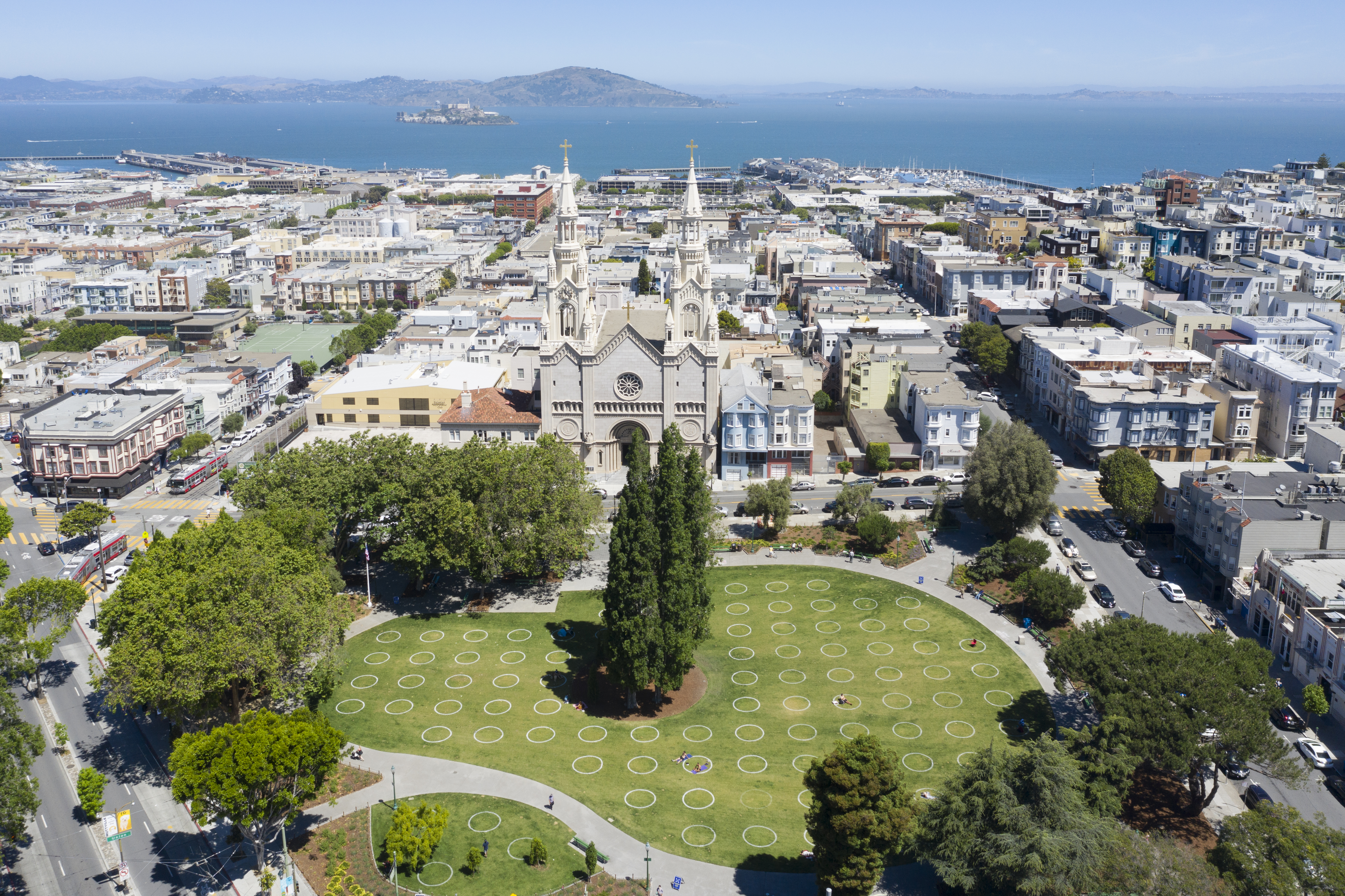
Washington Square (San Francisco)
Before it was a park, it was a potato field. In the nineteenth century, Mexican rancher Juana Briones grew potatoes and raised cattle on the land where Washington Square now sits. In 1847, surveyor Jasper O'Farrell laid out San Francisco's street grid and designated this rectangle in North Beach as public space -- making it one of the city's first parks. Since then, it has been a refuge from earthquakes, a backdrop for Hollywood gunfights, and the quiet green heart of a neighborhood that has reinvented itself from Italian enclave to Beat literary capital to tourist destination, without ever quite losing its soul.
Cut in Half by Commerce
Washington Square was originally a complete rectangle extending all the way to Powell Street. That changed between 1873 and 1875, when the city built Columbus Avenue -- then called Montgomery -- slicing through the square at an angle. The reason was straightforward: banking and business interests in the Financial District wanted better access to North Beach, which was geographically isolated by Telegraph Hill, the Barbary Coast, and Chinatown. The avenue carved Marini Plaza, a tiny triangular park at Union and Powell, off from the main square. The park's current design dates to the 1950s, when a community coalition hired landscape architects to replace the crisscrossing paths with a grassy expanse circled by benches and lined with Lombardy poplars.
Shelter from the Storm
Twice in the late nineteenth century -- in 1894 and 1901 -- Washington Square served as a place of refuge for people fleeing fires on Telegraph Hill. After the catastrophic 1906 earthquake and fire, it became home for roughly 600 displaced people who lived in wooden barracks and Army tents for an entire year. The park's other monument to civic duty is a statue of Benjamin Franklin, sitting atop a temperance fountain donated in 1879 by temperance crusader Henry D. Cogswell, who believed that if people had access to free water, they would stop drinking alcohol. The experiment's success can be evaluated by the number of bars currently surrounding the park.
Hollywood and Poetry
Washington Square has had a rich cultural afterlife. Director Don Siegel used Saints Peter and Paul Church and the nearby Dante Building as settings for the Scorpio Killer's sniper attacks in the 1971 film Dirty Harry. Richard Brautigan set several chapters of his 1967 novel Trout Fishing in America in the square. Lawrence Ferlinghetti -- who could see the park from City Lights Bookstore -- wrote his 1979 poem 'The Old Italians Dying' about the elderly Italian men who spent their final years on the park's benches, watching a neighborhood that had been theirs slowly change around them. The poem is an elegy for a North Beach that was already fading, and the park remains the place where that fading is most visible and most beautiful.
The Square Today
Washington Square is bordered by Saints Peter and Paul Church, Mama's restaurant, Tony's Pizza Napoletana, the Liguria Bakery, and Park Tavern -- an inventory of North Beach institutions that captures the neighborhood's Italian roots and contemporary appetite. On weekday mornings, elderly residents practice tai chi on the grass. On weekends, tourists photograph the church towers with Coit Tower rising behind them. The park received landmark status in 2000, defeating a recurring proposal to build a parking garage beneath it. Juana Briones' potato field has become, against all reasonable odds, one of the most beautiful and culturally layered public spaces in San Francisco.
From the Air
Located at 37.801N, 122.410W in San Francisco's North Beach district. The green rectangle is visible from the air, bordered by Columbus Avenue and flanked by Saints Peter and Paul Church. Nearest airports: KSFO (11nm south), KOAK (10nm east). Best viewed at 1,500-3,000 ft AGL.