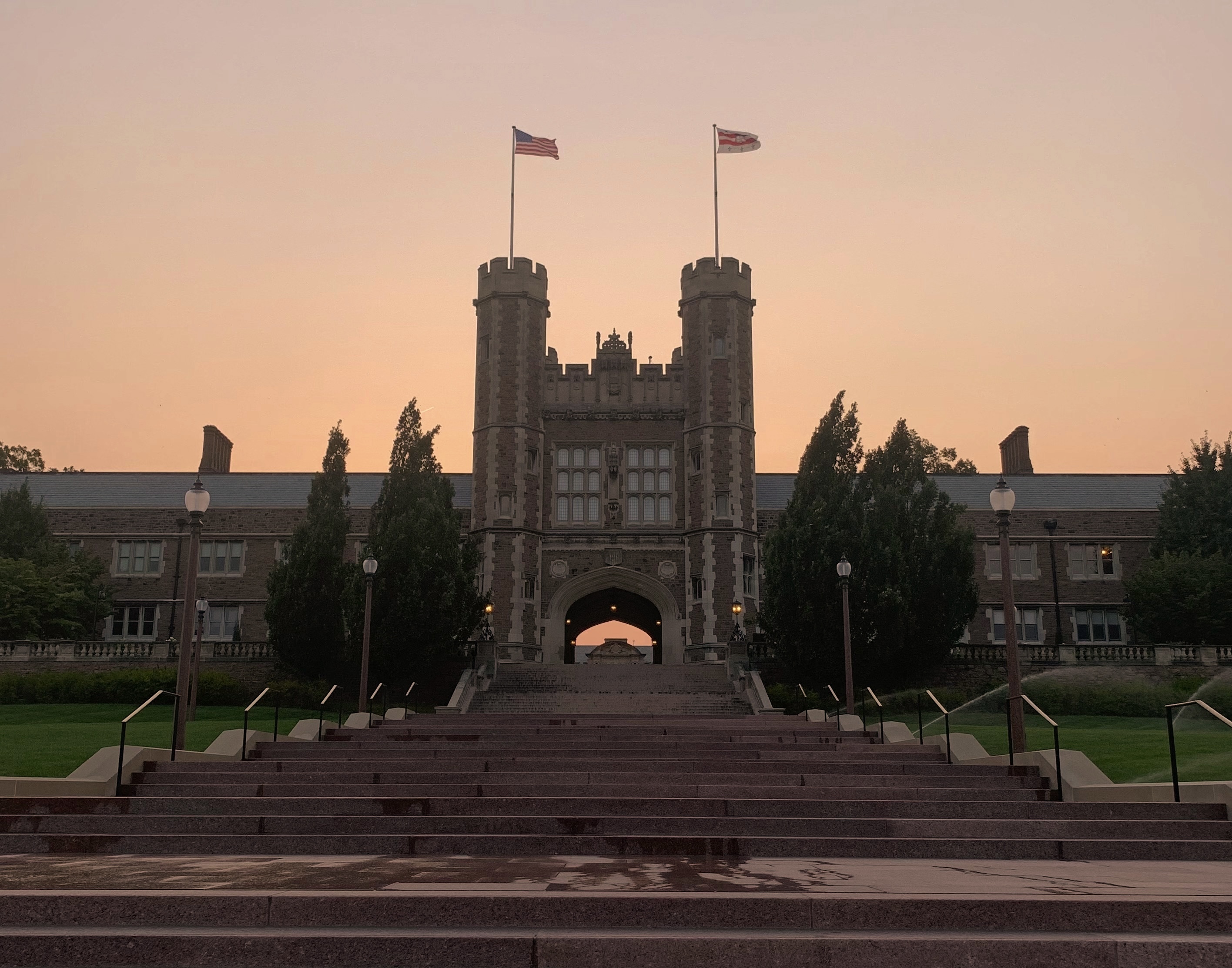
Washington University in St. Louis
The notification letter said 'E. Saarinen,' but this time nobody confused father and son -- that was the Gateway Arch story. Washington University has its own identity problem. Founded in 1853 as Eliot Seminary, the school was immediately renamed because its founder, Unitarian minister William Greenleaf Eliot, refused to have a university bear his name, fearing it would seem sectarian. The subcommittee he appointed chose 'Washington Institute' because the charter had been granted on George Washington's birthday. In 1976, the board of trustees added 'in St. Louis' to distinguish the school from the dozen other institutions named after Washington. It is the only elite research university in America that has spent its entire existence trying to tell people who it is.
Eighty-Year-Old Students and Night School
Washington University held its first classes on October 22, 1854, in the Benton Schoolhouse, a facility loaned by the public school board. Tuition was free. Students ranged from 8 years old to 46. The university had no buildings, no faculty, and no established course offerings -- it was essentially a night school that a group of 17 civic leaders had willed into existence out of concern that the Midwest lacked institutions of higher learning. State Senator Wayman Crow secured the charter; William Greenleaf Eliot became president of the board of trustees. Unlike most American universities of the era, Washington University had no endowment, no religious backing, and no wealthy patron. By the end of its first year, 270 students had enrolled, and four teachers borrowed from the public school system taught the courses.
Olympic Fields and Gothic Quadrangles
In 1899, the university held a national design competition for a new campus. The Philadelphia firm Cope and Stewardson won with a Collegiate Gothic plan inspired by Oxford and Cambridge. Construction of the first building, Busch Hall, began in 1900, but none of the new buildings were occupied until 1905 -- because the campus had been leased to the 1904 World's Fair and the third Olympic Games. Francis Olympic Field served as a venue for those Olympics, the first Games held outside Europe, and the Olympic flame has passed through the field three more times during torch relays in 1984, 1996, and 2004. The revenue from leasing the campus to the fair funded construction of four additional buildings. The 169-acre Danforth Campus is now recognized as a National Historic Landmark district.
From Commuter School to Global University
For much of the 20th century, Washington University was a respected regional institution -- good, but not transcendent. The transformation came under Chancellor William Henry Danforth, appointed in 1971, who over 24 years established 70 new endowed professorships, constructed dozens of buildings, built the endowment to $1.72 billion, and tripled scholarships. The New York Times credited Danforth with transforming a commuter school into a world-renowned institution. By 1964, more than two-thirds of incoming students came from outside the St. Louis area. Today, 26 Nobel laureates have been affiliated with the university. Arthur Holly Compton conducted his Nobel Prize-winning experiments on electromagnetic radiation in the basement of Eads Hall in 1922. The university's endowment stands at $12 billion, ranking among the fifteen largest in the nation.
Debates and Desegregation
Washington University has hosted four presidential debates and one vice-presidential debate, more than almost any venue in America. The campus served as the stage for the 1992, 2000, 2004, and 2016 presidential debates, and the 2008 vice-presidential debate between Joe Biden and Sarah Palin. But the university's most consequential political moment may have been quieter. In 1945, four African American students were denied summer school admission, prompting an NAACP lawsuit challenging the university's tax-exempt status. Though the suit failed, it forced the board to address segregation publicly. Individual deans began admitting Black students. In 1948, the George Warren Brown School of Social Work became the first school at Washington University to formally admit Black students, making it one of the earliest private universities in a former slave state to desegregate.
From the Air
Located at 38.648°N, 90.305°W, with the 169-acre Danforth Campus bordering the western edge of Forest Park. The Collegiate Gothic architecture is distinctive from altitude -- red-roofed stone buildings arranged around quadrangles. Francis Olympic Field is visible on the eastern edge of campus. The Medical Campus is 2 nm east in the Central West End. Nearest airports: KSTL (St. Louis Lambert International, 9 nm NW), KCPS (St. Louis Downtown, 9 nm SE). Forest Park's green expanse provides an unmistakable eastern boundary.