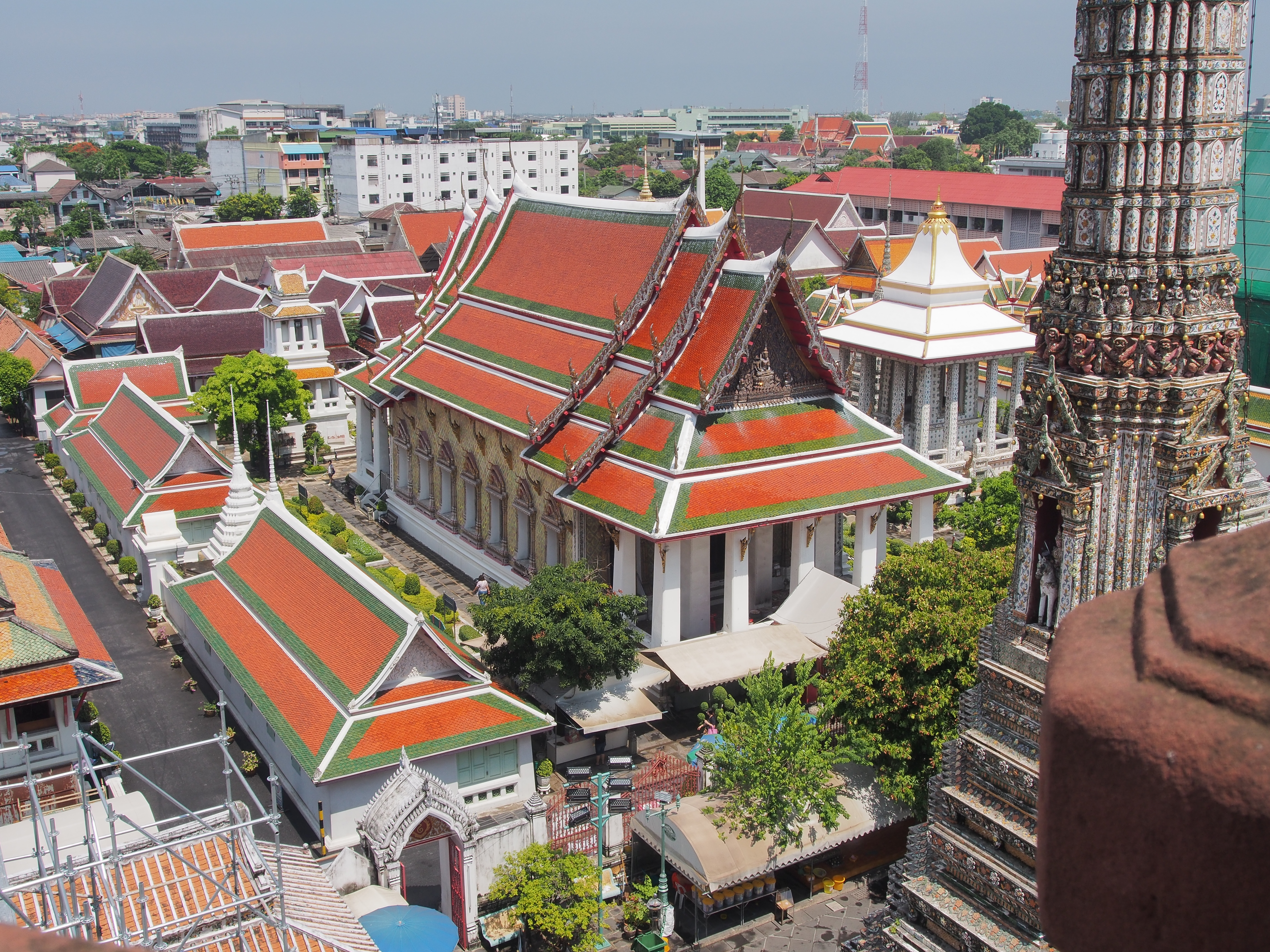
Wat Arun
King Taksin was running out of country. In 1767, Burmese armies had destroyed Ayutthaya, the Siamese capital, and Taksin -- a military commander who would soon declare himself king -- was leading his forces south along the Chao Phraya River. At dawn, his boats passed a small temple on the western bank called Wat Makok. The rising sun hit the tower, and Taksin, so the story goes, took it as a sign. He established his new capital of Thonburi on this stretch of river and made the temple his royal chapel, renaming it Wat Chaeng -- the Temple of Dawn. The name eventually became Wat Arun, after Aruna, the Hindu god who personifies the first light of morning.
From Refuge to Royal Chapel
A temple had stood on the site since at least the late sixteenth century, but it had no particular significance until Taksin arrived. After establishing Thonburi as his capital, he housed the Emerald Buddha at Wat Arun -- the sacred image he had brought from Vientiane in Laos. For several years, from 1779 to 1785, this was the most important temple in the kingdom. Then Rama I founded the Chakri dynasty, moved the capital across the river to Bangkok, and transferred the Emerald Buddha to the Grand Palace's Wat Phra Kaew. Wat Arun lost its political centrality but not its spiritual weight. It remained a royal temple, and subsequent kings would pour resources into transforming it from a modest riverside chapel into the porcelain-encrusted landmark that defines the Bangkok skyline.
Porcelain from the Bilge
The central prang -- the Khmer-style tower that dominates the temple -- was largely the work of Rama II and Rama III. Rama II ordered the restoration of the temple and began plans to raise the main pagoda to approximately 70 meters. Construction commenced under Rama III and was completed around 1851, after nine years of work. The tower's surface is covered with a mosaic of colorful porcelain shards and shells of Mauritia mauritiana cowries. The porcelain was not imported for decoration; it had arrived in Bangkok as ballast in the holds of Chinese trading ships. What had been dead weight in a ship's bilge became, in the hands of Thai craftsmen, a shimmering skin that catches light differently at every hour of the day. Prince Narisara Nuwattiwong noted that both the prang and the vihara -- the main hall -- preserved the original craftsmanship of the Department of Ten Crafts from the Ayutthaya period.
Three Realms in Stone
The central prang carries three levels of Buddhist meaning. The base represents Traiphum, encompassing all realms of existence. The middle section symbolizes Tavatimsa, the Tusita Heaven where all desires find satisfaction. The peak denotes Devaphum, the six heavens within seven realms of happiness. At the top sits a seven-pronged trident, widely called the Trident of Shiva. Around the base, figures of ancient Chinese soldiers and animals stand guard. On the second terrace, four statues depict the Hindu god Indra riding Erawan, the three-headed elephant. Four smaller satellite prangs mark the corners, each a miniature echo of the central tower. The blend of Hindu and Buddhist iconography is characteristic of Thai religious architecture, where the two traditions have coexisted for centuries without contradiction.
Dawn and Dusk on the Chao Phraya
Wat Arun is named for dawn, but the temple is arguably more beautiful at sunset. Standing on the eastern bank of the Chao Phraya, looking west, the prang catches the last light and glows amber against the darkening sky -- the porcelain fragments that looked merely decorative at noon suddenly flaring with color. At night, the entire structure is illuminated, its silhouette reflected in the black water of the river. Major restorations took place during the reign of Chulalongkorn, Rama V, and again in 1980, ahead of Bangkok's bicentennial. A more controversial renovation in 2017 drew mixed reactions when the restored surfaces appeared brighter and more uniform than the weathered originals. The temple endures these debates because it must. Wat Arun is not just a place of worship -- it appears on the ten-baht coin and functions as the architectural symbol of the Thai capital, the tower that Taksin saw at sunrise and that millions of visitors now photograph at dusk.
From the Air
Located at 13.744N, 100.489E on the west bank of the Chao Phraya River in Bangkok Yai district. The tall central prang is a distinctive visual landmark visible from considerable altitude, rising prominently above the surrounding riverbank. Best viewed at 2,000-4,000 feet. The Grand Palace and Wat Phra Kaew are directly across the river to the east. Nearest airports: Don Mueang (VTBD) approximately 15 nm north, Suvarnabhumi (VTBS) approximately 18 nm east-southeast.