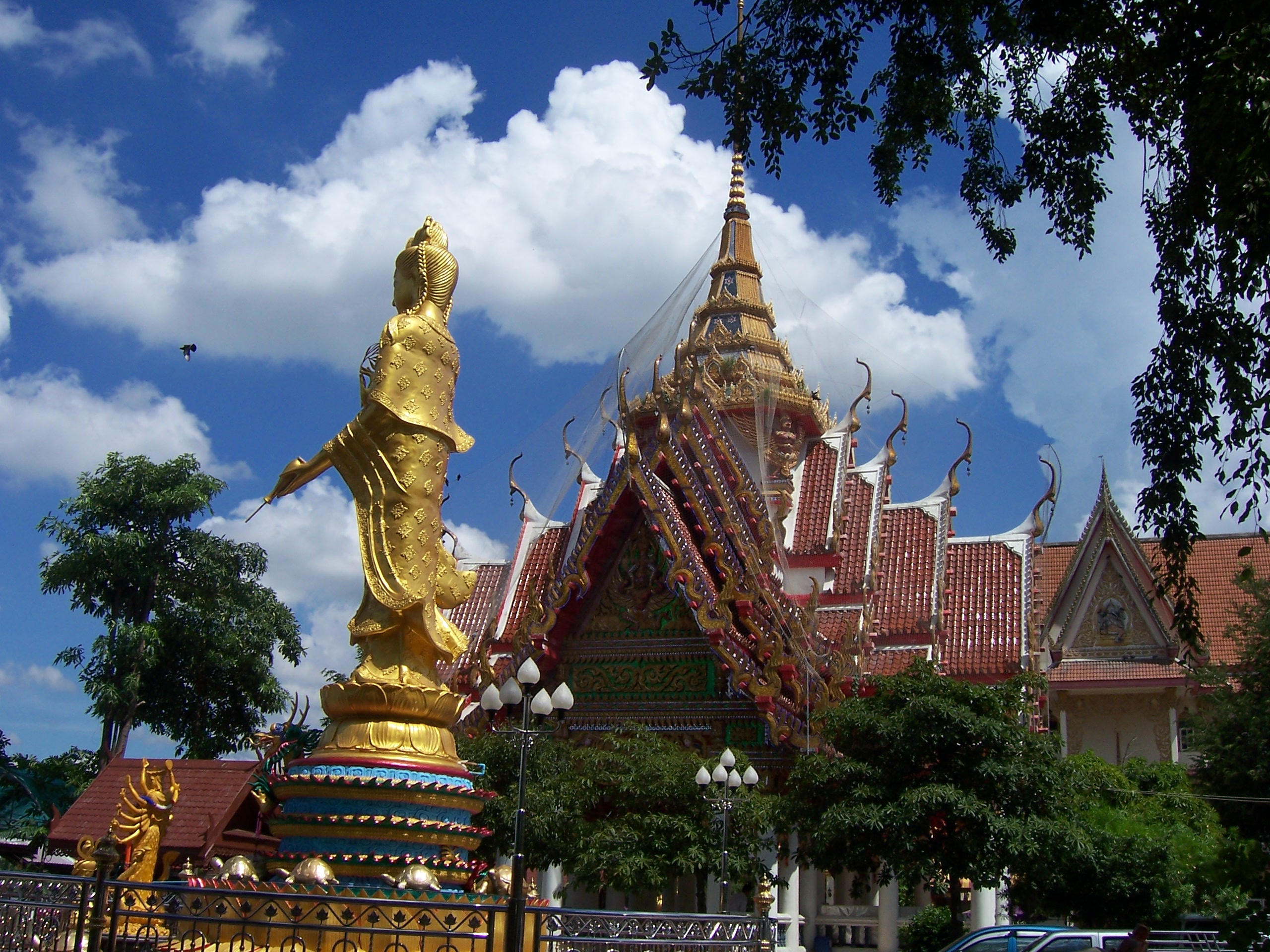
Wat Bang Phra
The monk has never been tattooed. That was true of Luang Phor Pern, the most famous sak yant master in Thailand's history, and it remains one of the great ironies of Wat Bang Phra: the monastery that became the world's most renowned center for sacred tattooing was led for decades by a man whose own skin was unmarked. He learned the art at the feet of his abbot, Luang Pu Him Inthasoto, and carried it forward after Luang Pu Him's death -- a master of the needle who understood its power without ever receiving its mark. Fifty kilometers west of Bangkok, in Nakhon Pathom Province, this monastery draws thousands each year who come not for the architecture or the history but for what the monks will inscribe on their bodies.
Rescued from the River
The monastery's name tells its origin story. Wat Bang Phra translates to 'Monastery of the Riverbank Buddha Image,' a reference to the two Buddha statues -- Luang Pho Sit Chaiyamongkon and Luang Pho Kai Sitmongkhon -- that were being transported downriver from Ayutthaya when the Burmese invasion threatened the old capital in the late 18th century. The boat carrying them capsized in the Nakhon Chaisi River. When the images were later pulled from the water, they were kept in the monastery that grew up around their resting place. A small, elegant ordination chapel from the original foundation still stands today, its interior decorated with murals from the reigns of Rama III and Rama IV. Inside sit the two rescued Buddhas, the monastery's founding relics, quieter presences than the tradition that made the temple famous.
The Tiger Monk
Luang Phor Pern ordained at Wat Bang Phra at twenty-five and studied sak yant under Luang Pu Him Inthasoto, an accomplished master. After Luang Pu Him died four years later, the younger monk continued the tradition. In 1953, seeking deeper withdrawal and meditation, he wandered into the forests of Kanchanaburi Province on the Myanmar-Thailand border. Villagers in the remote area were living in fear of wild tigers that had mauled and killed several people. Luang Phor Pern offered them katha -- sacred incantations -- and sak yant tattoos for protection. He taught them that tiger yantras could ward off attacks. According to local tradition, from that point forward, no one who received the monk's protection was ever attacked by a tiger or other wild animal. The story cemented his reputation as a master of protective magic, and devotees from across Thailand and eventually the world sought him out at Wat Bang Phra.
Three Thousand Strikes
The traditional tattooing process at Wat Bang Phra is deliberate and ritualistic. The monk uses a single needle about eighteen inches long and four millimeters wide, its tip split into two points like a split cane, so each strike produces two dots of ink. There are about eight needles in a pot of cleaning solution, and the monk may sharpen one with fine sandpaper before beginning. He selects a rubber template, presses it in ink, then transfers the design onto the recipient's back. The needle is dipped into a mixture of palm oil, Chinese charcoal ink, and -- according to tradition -- possibly snake venom. A typical tattoo requires about 3,000 strikes, with the needle re-dipped roughly every thirty seconds. When the design is complete, the monk blesses it and blows a sacred kata over the fresh ink to infuse it with protective power. For women, transparent ink is used and the monk wears a glove to avoid physical contact. The first tattoo is almost always the Gao Yord -- Nine Spires -- placed at the center of the upper back.
Ink and Intention
What distinguishes Wat Bang Phra from any commercial tattoo studio is the relationship between intention and design. Recipients do not choose their tattoos in the way a customer selects from a parlor's flash sheets. The first tattoo, the Gao Yord, is given to nearly everyone as a foundational blessing. The second, the Yeesib Gao Yord or Twenty-Nine Spires, extends across the shoulders. After these initial designs, the body is considered blessed and open to receive the power of subsequent yantras -- and those are chosen not by the recipient but by the monk, based on what he believes will most benefit the person's spirit. Modern sessions at Wat Bang Phra often use electric tattoo guns with changed needles and printed stencils, but the traditional custom of two people staying behind after their tattoo to hold down the next recipient and stretch the skin remains observed. The ancient and the contemporary coexist here without conflict, as they do throughout Thai Buddhism.
From the Air
Wat Bang Phra sits at 13.8976N, 100.2126E in Nakhon Chaisi district, Nakhon Pathom Province, approximately 50 km west of central Bangkok. The monastery is in a semi-rural area along the Nakhon Chaisi River. From the air, look for the temple compound amid green agricultural land west of Bangkok's sprawl. Best viewed at 2,000-4,000 feet AGL. The nearest major airport is Suvarnabhumi (VTBS), about 65 km to the east-southeast. Don Mueang (VTBD) is approximately 55 km to the northeast. The Nakhon Chaisi River provides a useful visual reference for locating the temple.