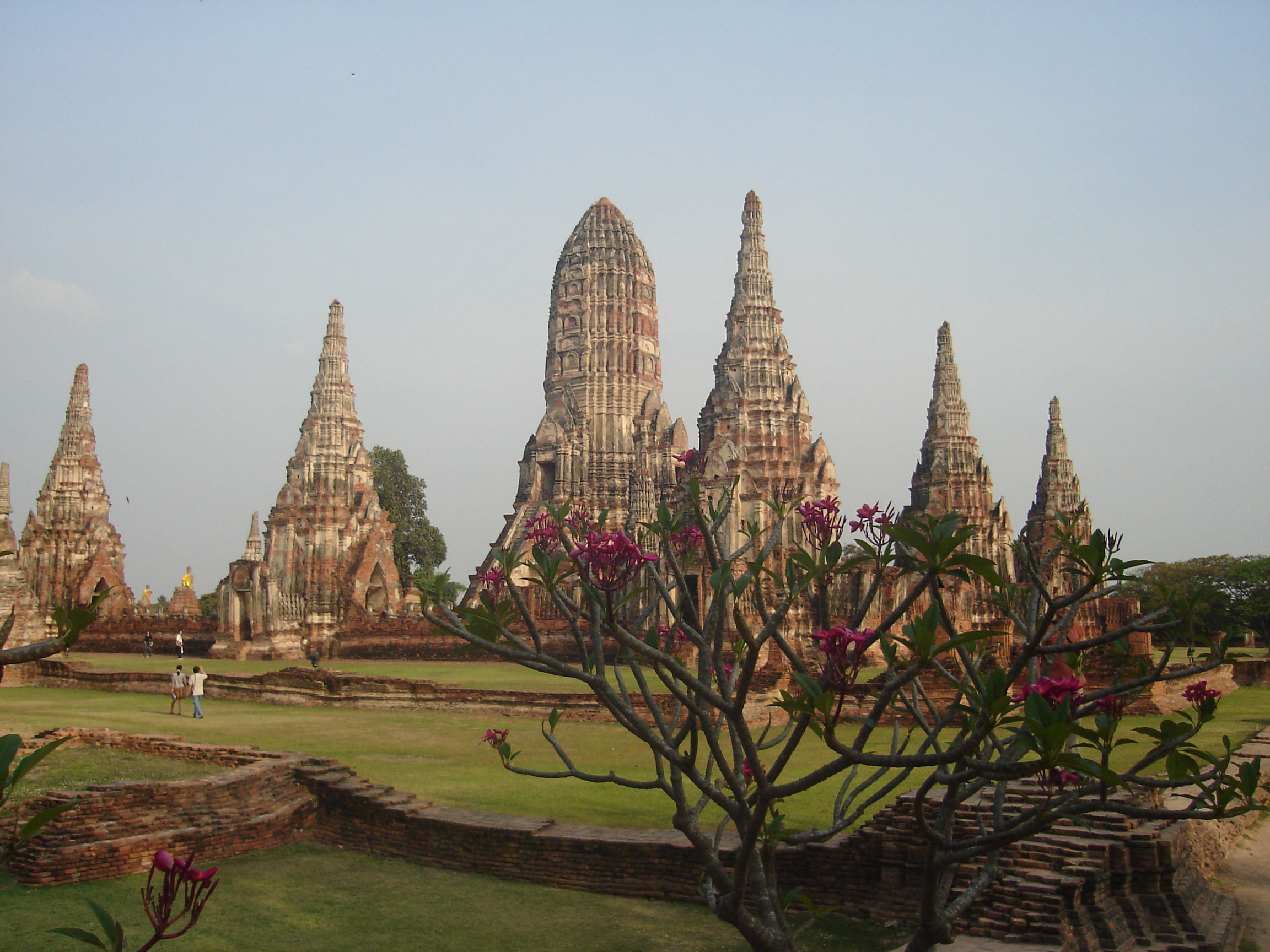
Wat Chaiwatthanaram
The ceiling was wood, painted black, scattered with golden stars. Below it sat Buddha statues lacquered in black and gold, row after row of them, 120 along the walls alone. That was Wat Chaiwatthanaram in its prime, a royal temple on the west bank of the Chao Phraya River where Ayutthaya's kings performed ceremonies and cremated their princes. When the Burmese destroyed the city in 1767, they did not spare it. For two centuries the ruins sat abandoned, their bricks looted, their Buddha statues beheaded. It was not until 1987 that restoration began, and not until 1992 that the temple opened to a public that could finally see what remained of a king's monument to his mother.
A Son's Devotion in Stone
King Prasat Thong built Wat Chaiwatthanaram in 1630 as the first temple of his reign. The name translates to 'Temple of Long Reign and Glorious Era,' an ambitious declaration from a ruler who chose the site because it was where his mother had lived. The memorial intention is certain, though the historian Prince Damrong proposed an additional motive: that the temple celebrated the Ayutthaya Kingdom's military victory over Longvek, the Cambodian capital. Whatever combination of filial piety and political statement drove its construction, the result was a temple designed in Khmer style, its architecture a deliberate echo of the Cambodian empire's great monuments. That a Siamese king would honor his mother by building in the style of a rival kingdom speaks to the complex cultural currents flowing through 17th-century Southeast Asia, where conquest and admiration were not contradictions.
A Model of the Buddhist Universe
The temple's layout is not merely decorative. It is a physical map of Buddhist cosmology as described in the Traiphum Phra Ruang, a 14th-century text outlining the 'three worlds of King Ruang.' The central prang, rising 35 meters, represents Mount Meru, the axis of the traditional Buddhist world. Four smaller prangs surround it, symbolizing the four continents floating in the world sea. Eight chedi-shaped chapels encircle the central platform, connected by a rectangular cross-shaped passage that represents the Iron Mountains at the outer border of the universe. On one of those symbolic continents, the Chomphutawip, humanity lives. The passage was originally roofed and open on its inner side, with 120 seated Buddha figures lining its walls. Each of the eight chapels contained paintings on interior walls and 12 exterior reliefs depicting scenes from the Jataka tales, the stories of the Buddha's previous lives, meant to be read clockwise. Only fragments of these paintings and reliefs survive.
Destruction and the Long Silence
In 1767, Burmese forces sacked Ayutthaya with a thoroughness that ended an empire. Wat Chaiwatthanaram was not spared. The destruction was total enough that the temple was simply abandoned afterward, left to the elements and to scavengers. Local people sold bricks from the ruins. The heads of Buddha statues were chiseled off, either for sale or as deliberate desecration. For 220 years, the temple sat in this condition, a ruin slowly being dismantled by the same population it had once served. The statues that remain are headless, their stumps weathered smooth. The ordination hall on the east side, near the river, is gone but for its foundations. The two chedis with twelve indented corners that once held the ashes of Prasat Thong's mother stand diminished. What survives is impressive precisely because of how much was lost.
Water Rising, Again
Restoration by the Thai Department of Fine Arts began in 1987 and the site opened to visitors in 1992, joining the broader Ayutthaya Historical Park though remaining technically separate from the UNESCO-listed Historic City of Ayutthaya. For two decades, the temple became one of the most photographed ruins in Thailand, its prangs silhouetted against sunset over the Chao Phraya. Then, in 2011, the river that had shaped the temple's history returned with force. Thailand's worst flooding in decades submerged Wat Chaiwatthanaram under two meters of water, causing significant damage to structures that had already survived centuries of neglect. The Department of Fine Arts undertook another round of restoration under a budget of 200 million baht. The cycle of destruction and restoration that has defined this temple, Burmese invasion, two centuries of abandonment, modern conservation, catastrophic flooding, renewed repair, mirrors the broader story of Ayutthaya itself: a place that keeps being rebuilt because what it represents is too important to lose.
Twilight on the River
Wat Chaiwatthanaram sits on the west bank of the Chao Phraya, southwest of Ayutthaya's old city, reachable by road or by river. Late afternoon is when the temple reveals itself most completely. The warm light catches the laterite and stucco surfaces of the prangs, casting long shadows through the ruined passage where monks once walked beneath golden stars on black lacquer. This was a royal temple where kings performed religious ceremonies, where princes and princesses were cremated, where Prasat Thong's son Chaofa Thammathibet was given to the flames. The ceremonial function is gone but the architecture still communicates its original purpose: to make the Buddhist cosmos visible, to render the invisible world in stone, and to honor a mother who lived on this riverbank before her son became king.
From the Air
Wat Chaiwatthanaram is located at 14.343N, 100.542E on the west bank of the Chao Phraya River in Ayutthaya, Thailand, approximately 80 km north of Bangkok. From altitude, the Ayutthaya Historical Park is identifiable by the island formed by the confluence of three rivers, with the temple compound visible on the west bank. The nearest major airports are Don Mueang International Airport (VTBD) and Suvarnabhumi Airport (VTBS) in Bangkok. The terrain is flat river delta. The temple's distinctive Khmer-style prangs may be visible at lower altitudes.