Wat Chiang Man
A stone stele standing in front of the ordination hall records a precise detail: Chiang Mai was founded on the 12th of April, 1296 CE, at four o'clock in the morning. That this exact moment survives at all is remarkable. That it survives here, at Wat Chiang Man, is fitting - because this temple was the first thing King Mangrai built when he began constructing his new capital in the hills of northern Thailand. Before Chiang Mai had streets or markets or city walls, it had this temple, raised on the site of Wiang Nopburi, a fortified settlement of the Lawa people that Mangrai had used as his base camp during the city's construction.
Elephants Bearing Heaven
The oldest structure in the complex is the Chedi Chang Lom, the Elephant Chedi, and it announces itself with a visual trick that has not lost its power in seven centuries. Fifteen life-sized elephants, sculpted in brick and stucco, emerge from the chedi's second level as though pushing through the wall from some hidden interior. Only their front halves are visible - heads, trunks, forelegs - and together they appear to carry the gilded upper levels of the building on their backs. The effect is architectural theater: the sacred relic chamber at the pinnacle, shaped like a bell, seems to float on the strength of these stone animals. The square base anchors the composition in geometric order, while the elephants introduce the organic and the mythic. It is one of Chiang Mai's most recognizable silhouettes, and it established a template - elephant-supported chedis - that would appear across the Lanna Kingdom for centuries.
Two Buddhas, Two Powers
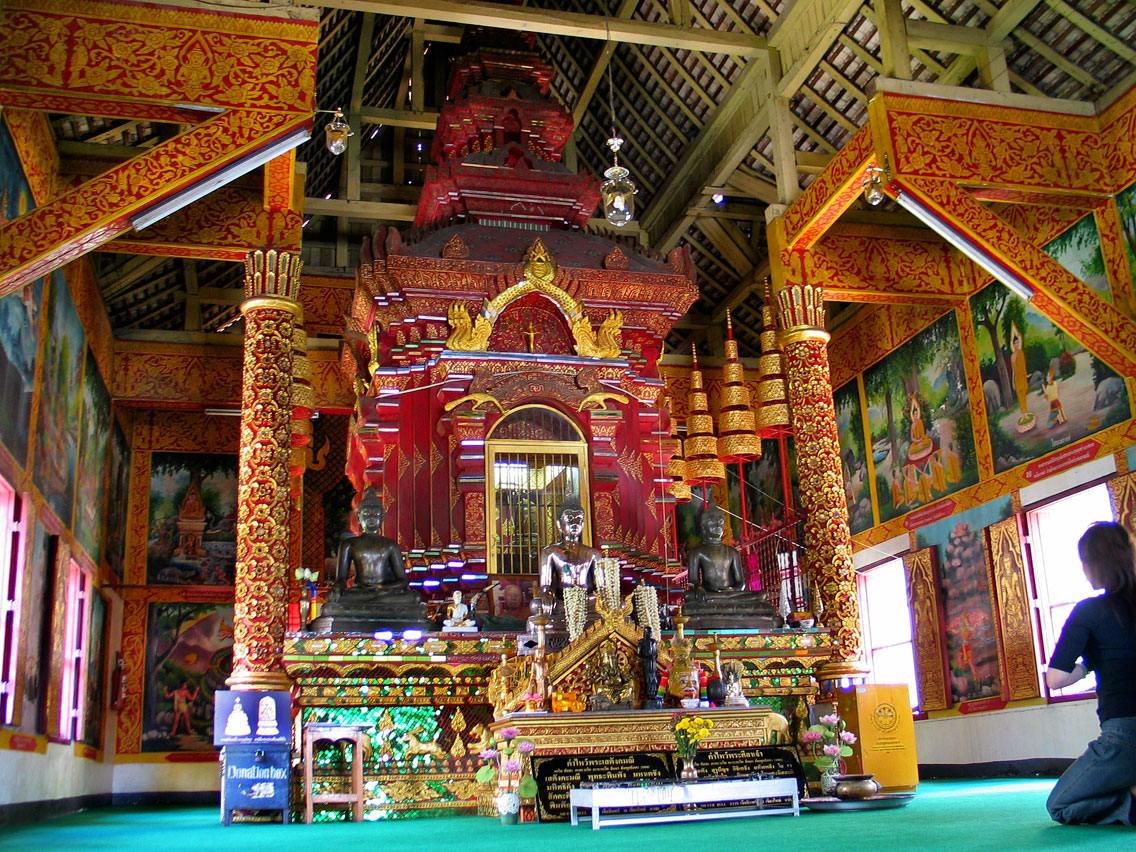
The smaller of the temple's two wihan houses a pair of Buddha images considered the palladium of Chiang Mai - sacred objects believed to protect the city itself. The Phra Sae Tang Khamani, also known as the Crystal Buddha, stands only ten centimeters tall, carved from clear quartz crystal. One account traces its creation to around 200 CE for King Ramraj of Lopburi, with Queen Jamadevi bringing it to the Hariphunchai Kingdom in 662 CE. Mangrai claimed it after conquering Lamphun in 1296. The art historian Carol Stratton dates it instead to the fifteenth century based on style, but the debate does not diminish the statue's significance: it survived the pillaging of Lamphun, and the people of Chiang Mai believe it protects against disasters. King Inthawichayanon donated its gold-covered wooden base and golden canopy in 1874 - together containing more than six kilograms of gold. Beside it, the Phra Sila is a stone bas-relief depicting the Buddha taming the elephant Nalagiri. Believed to possess rain-giving powers, this statue takes center stage during the Songkran festival each April, when the dry season finally breaks.
Layers of Lanna Devotion
The larger wihan was renovated in the 1920s by Khru Ba Srivichai, a revered monk sometimes called the patron saint of northern Thailand for his tireless work restoring Lanna-era temples. Inside, Buddha statues surround a large altar structure. One standing Buddha bears the year 1465 CE on its base, making it the oldest known statue of the Lanna Kingdom and the oldest Thai Buddha depicted holding an alms bowl. The facade carries gilded carvings of Kirtimukha - the fearsome 'face of glory' from Hindu-Buddhist iconography - interspersed with floral motifs. These decorative layers accumulate across centuries: a thirteenth-century foundation, fifteenth-century statuary, 1920s renovation, each generation adding to rather than replacing what came before. The temple functions as a living archaeological record, its architecture a timeline of Lanna artistic traditions read from the ground up.
Books, Water, and the Things Most Temples Lack
Two features distinguish Wat Chiang Man from most Chiang Mai temples: its Ho Trai and its lotus pond. The Ho Trai, a scripture library, is a wooden building set on a high plastered brick base - modest compared to the ornate Ho Trai at Wat Phra Singh, but significant simply for existing. Most temples in the old city do not have one. Similarly, temple ponds are rare in Chiang Mai, making the lotus pond here an unusual survival. The ubosot, or ordination hall, was rebuilt in the nineteenth century, but the 1581 stele in front of it remains the oldest written record of Chiang Mai's founding date. That a single stone monument preserves the city's birth certificate - complete with the hour - speaks to the reverence Wat Chiang Man has commanded across eight centuries. Mangrai commissioned the original ubosot; Phya Saen Luang restored it in 1571. The cycle of destruction and renewal continues, but the temple endures.
From the Air
Located at 18.79N, 98.99E inside the old walled city of Chiang Mai, northern Thailand. The temple sits within the distinctive square moat visible from altitude. Nearest airport is Chiang Mai International Airport (VTCC), approximately 4 km southwest. From the air, the old city's square moat and walls are unmistakable - Wat Chiang Man is in the northeastern quadrant. The gilded Elephant Chedi is visible in clear conditions. Doi Suthep mountain and its temple rise to the west of the city at 1,676 meters.