Wat Pho
The soles of the Buddha's feet tell you everything. Three meters high and four and a half meters long, inlaid with mother-of-pearl in 108 panels, they display the auspicious symbols by which the Enlightened One can be identified: flowers, dancers, white elephants, tigers, altar accessories. But these are not merely devotional art. They are a diagram of the body's pressure points, part of a vast medical encyclopedia carved into granite and marble throughout Wat Pho's grounds. This temple is many things at once -- the oldest in Bangkok, the largest, the most richly decorated -- but its deepest identity is as a place where sacred knowledge was made public. Long before Thailand had universities, Wat Pho was teaching.
A Kingdom Rebuilt in Stone
The temple's story begins in catastrophe. When the Burmese sacked Ayutthaya in 1767, they destroyed not just a capital but a civilization's accumulated sacred art. King Taksin moved the Siamese court to Thonburi, across the Chao Phraya River from what would become Bangkok, and the modest temple already standing on the Wat Pho site gained royal status simply by being close to his palace. In 1782, Rama I moved the capital once more, this time to Bangkok's eastern bank, and built the Grand Palace adjacent to Wat Pho. He ordered the old temple entirely rebuilt. Workers incorporated remnants of an enormous Buddha image from Ayutthaya's Wat Phra Si Sanphet -- destroyed by the Burmese -- into a chedi within the new complex. The reconstruction took seven years. When it was finished in 1801, the king renamed it Wat Phra Chetuphon Vimolmangklavas, after the legendary Buddhist monastery of Jetavana. It became his principal temple, and some of his ashes rest there today.
The Open-Air Encyclopedia
Rama III transformed the temple from a place of worship into something unprecedented: a public university carved in stone. Beginning in 1832, he spent sixteen years and seven months expanding and rebuilding the complex, growing it to 80,000 square meters. About fifty scholars from his court, led by the Supreme Patriarch Prince Paramanuchitchinorot, inscribed a pictorial encyclopedia onto granite slabs covering eight subjects: history, medicine, health, customs, literature, proverbs, lexicography, and Buddhist religion. Diagrams of massage pressure points line the walls of pavilions. Drawings of constellations adorn the library. Twenty-four small rock gardens illustrate the geological formations of Thailand. One garden, called the Contorting Hermit Hill, features statues demonstrating massage techniques and yoga positions. In 2008, UNESCO recognized these inscriptions and illustrations under its Memory of the World Programme -- a testament to Rama III's vision that knowledge, once the province of the court, belonged to everyone.
The Reclining Giant
Rama III also built the structure that draws most visitors today: the Viharn Phranorn, housing a reclining Buddha 46 meters long and 15 meters high. The image represents the Buddha entering Nirvana, the end of all reincarnation, posed in what is called sihasaiyas -- the posture of a sleeping lion. The right arm supports the head, which rests on two box-pillows encrusted with glass mosaics. The sheer scale of the figure overwhelms the hall that contains it; you cannot step back far enough to take it all in at once. A corridor runs alongside the image where 108 bronze bowls are arranged in a row. Visitors drop coins into each -- one for every auspicious character of the Buddha -- a practice believed to bring good fortune. The clinking of coins falling into bronze is the temple's constant soundtrack, rhythmic and unhurried, the sound of accumulated hope.
Where Healing Became Sacred
Wat Pho is recognized as the birthplace of traditional Thai massage. Among the inscriptions Rama III commissioned are sixty plaques showing pressure points on the front and back of the human body, with explanations of the therapeutic pathways known as sen. A school for traditional medicine and massage was formally established at the temple in 1955, and it became the first institution of Thai medicine approved by the Ministry of Education. Today, the Wat Pho Thai Traditional Medical and Massage School offers courses in Thai pharmacy, medical practice, midwifery, and massage. More than 200,000 therapists have trained here, practicing in 145 countries around the world. In 2019, Nuad Thai -- the massage tradition taught at Wat Pho -- was inscribed on UNESCO's list of Intangible Cultural Heritage. Two pavilions at the compound's eastern edge still serve as working classrooms where visitors can receive a massage for a modest fee, making the temple one of the few places on earth where a living healing tradition operates within a UNESCO-recognized cultural site.
A Forest of Chedis
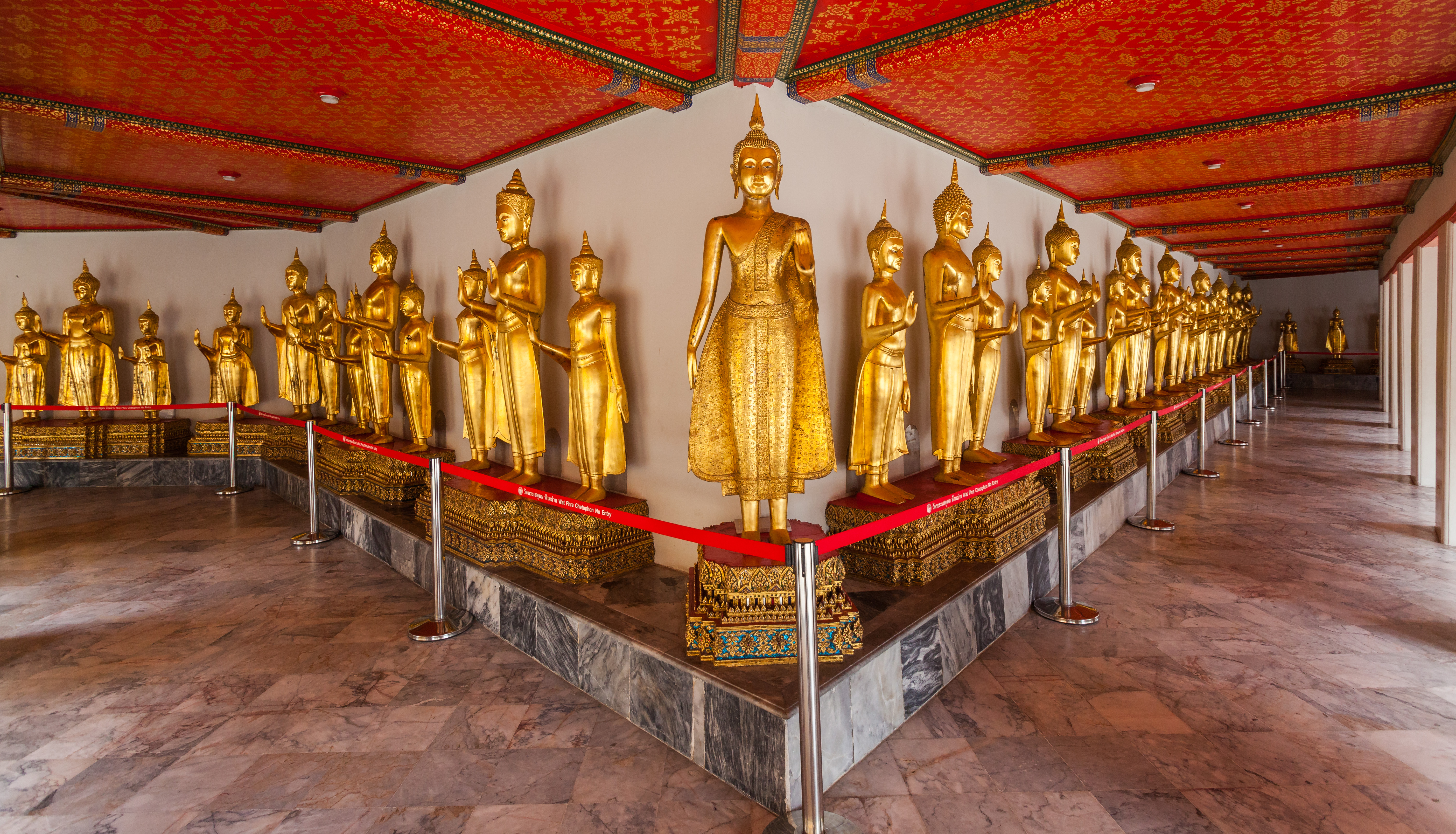
Beyond the reclining Buddha, Wat Pho reveals itself as a dense, labyrinthine complex of more than a thousand Buddha images -- the largest collection in Thailand. The double cloister called Phra Rabiang holds about 400 images selected from the 1,200 that Rama I brought from across the kingdom, spanning the Chiangsaen, Sukhothai, U-Thong, and Ayutthaya periods. All were covered in stucco and gold leaf to create visual unity across centuries of artistic tradition. Four great chedis, each 42 meters high, honor the first four Chakri kings. Surrounding them, 91 smaller chedis hold the ashes of the royal family and relics of the Buddha. Chinese stone statues -- originally imported as ballast on trading ships -- guard the perimeter gates, their presence a quiet reminder that Bangkok's sacred spaces have always been shaped by commerce as much as devotion.
From the Air
Wat Pho sits at 13.7464N, 100.4936E on Rattanakosin Island in Bangkok's historic center, directly south of the Grand Palace. From the air, the temple complex is identifiable by its four large colorful chedis and the extensive orange-and-green rooflines covering 80,000 square meters. Best viewed at 1,500-3,000 feet AGL for a clear perspective of the complex layout. The nearest major airport is Suvarnabhumi (VTBS), about 25 km east. Don Mueang (VTBD) lies about 22 km north. The Chao Phraya River, running immediately west, provides an excellent visual reference for locating the temple alongside the Grand Palace and Wat Arun across the river.