Wat Phra Kaew
Three times a year, the King of Thailand climbs a ladder and changes the clothes on a statue no bigger than a house cat. The Emerald Buddha -- 66 centimeters of carved green jasper, dressed in gold -- sits atop a towering gilded pedestal in the most sacred temple in the kingdom, and no one but the monarch may touch it. This ritual, performed at the turning of each Thai season, has continued since Rama I installed the image here in 1785. Wat Phra Kaew exists because of this single figure. The entire Grand Palace compound, the capital city itself, was built around the need to house it properly. Bangkok's ceremonial name, so long it holds a Guinness record, mentions the temple and the Emerald Buddha by name.
A Capital Built for a Statue
When Rama I seized the throne in 1782, he needed to distance himself from the previous regime of King Taksin in Thonburi. The old royal palace there was small, sandwiched between two temples with no room to expand. The new king chose the eastern bank of the Chao Phraya River and established the Grand Palace within the fortified area now called Rattanakosin Island. Construction on the temple began in 1783, and it was the first building in the entire palace compound completed in masonry -- the king still lived in a wooden residence while his Buddha's house was built in stone. In 1785, the Emerald Buddha was transported with great ceremony from Wat Arun across the river. A year later, Rama I gave Bangkok its official name: a string of Pali and Sanskrit phrases that translate, in part, to 'the Residence of the Emerald Buddha, the Great City of God Indra.' The city was named for this temple. The temple was named for a statue smaller than most of the tourists who visit it.
One Hundred and Twelve Garudas
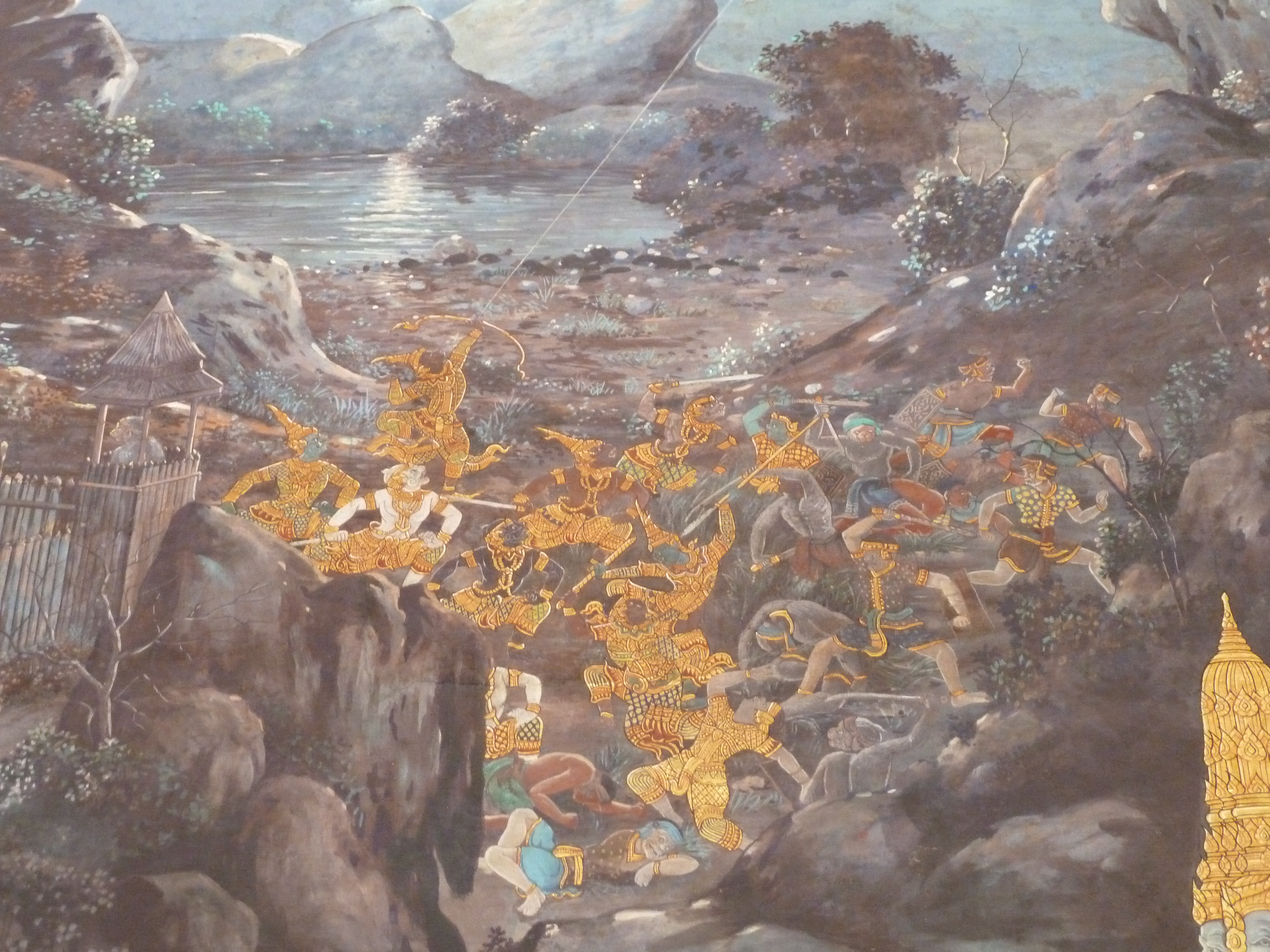
The ordination hall, or Ubosot, is where the Emerald Buddha sits, and its exterior is a catalog of mythological devotion. One hundred and twelve golden Garudas -- the eagle-god of Hindu and Buddhist tradition -- ring the building's base, each grasping two Naga serpents in its talons. Forty-eight square columns, their surfaces covered in glass mosaic and gilded edges, support the structure. The lowest layer of the base is decorated with floral tiles on pale blue backgrounds. Above that, lotus designs in colored glass. Above that, the Garudas. Six doors provide entry, their surfaces inlaid with mother-of-pearl depicting mythical beasts and foliage. The central door, slightly larger than the others, is reserved exclusively for the king. Twelve bronze lions flank the staircases -- some are originals brought from Cambodia by Rama I, others are copies cast by Rama III. Inside, murals cover every wall: the Buddha's defeat of the demon Mara on the east, Buddhist cosmology on the west, royal processions by land and water below the windows.
The Jade Traveler
The Emerald Buddha's journey to Bangkok was long and contested. The image is carved from green jasper -- often described as jade -- and its origins are debated, with traditions tracing it to India, Sri Lanka, or the workshops of ancient Chiang Rai. What is documented is that Rama I captured the statue from Vientiane, Laos, in 1779, ending a centuries-long chain of possession that had seen it moved between Chiang Rai, Chiang Mai, Luang Prabang, and Vientiane. The Buddha wears three seasonal costumes of gold, each corresponding to the hot season, the rainy season, and the cool season. The costume for the hot season features a pointed crown and jewelry, while the rainy season garment is gilded gold with a flared head piece. The changing ceremony, always performed by the king in person, is one of the most important royal rites in Thailand -- a personal act of devotion that connects the monarchy directly to the nation's spiritual life.
The Upper Terrace
North of the Ubosot, an elevated terrace holds the temple's most visually striking structures. The Phra Si Rattana Chedi, a golden stupa covered in gold mosaic tiles imported from Italy, was built by Rama IV in the Sri Lankan style to house a relic of the Buddha. Beside it stands the Phra Mondop, a scripture hall with doors and window frames inlaid with mother-of-pearl, its interior floor paved with silver tiles. The bookcases inside, shaped like tall stupas and inlaid in lacquer and gold, contain the Tripitaka -- the Buddhist canon -- written on palm-leaf manuscripts. Between these two buildings sits the Prasat Phra Thep Bidon, a cruciform royal pantheon housing life-size statues of the first eight Chakri kings. It opens to the public only once a year, on Chakri Day in April. At the terrace's northwest corner, a scale model of Angkor Wat -- built by Rama IV when Cambodia was still a Siamese vassal -- stands as a reminder of the empire's former reach.
Living Ceremony
Wat Phra Kaew is not a museum. No monks live here -- it is a royal chapel, not a monastery -- but the temple functions as the ceremonial heart of the Thai state. Important state and religious ceremonies are held here throughout the year, presided over by the king and attended by senior government officials. Each successive monarch has added to the complex as an act of religious merit and dynastic glorification, making the temple a physical record of the Chakri dynasty's 240-year reign. Rama III began the first major renovation for Bangkok's 50th anniversary in 1832. Rama V completed another for the centennial in 1882. Rama VII oversaw restoration for the 150th anniversary in 1932, and Rama IX for the bicentennial in 1982. The result is a compound where every generation has left its mark -- structures from the 18th century stand beside additions from the 21st, all unified by the same obsessive attention to gilded detail that the kingdom brought to its very first masonry building.
From the Air
Wat Phra Kaew sits at 13.7514N, 100.4928E within the Grand Palace compound on Rattanakosin Island, Bangkok's historic center. The temple's golden spires, glittering chedis, and orange-tiled roofs are highly visible from the air, clustered in the northeast corner of the Grand Palace grounds along the Chao Phraya River. Best viewed at 1,000-3,000 feet AGL. The nearest major airports are Suvarnabhumi (VTBS), 25 km east, and Don Mueang (VTBD), 22 km north. Wat Pho lies immediately to the south, and Wat Arun is directly across the river to the west -- the three temples form a triangle visible even from higher altitudes.