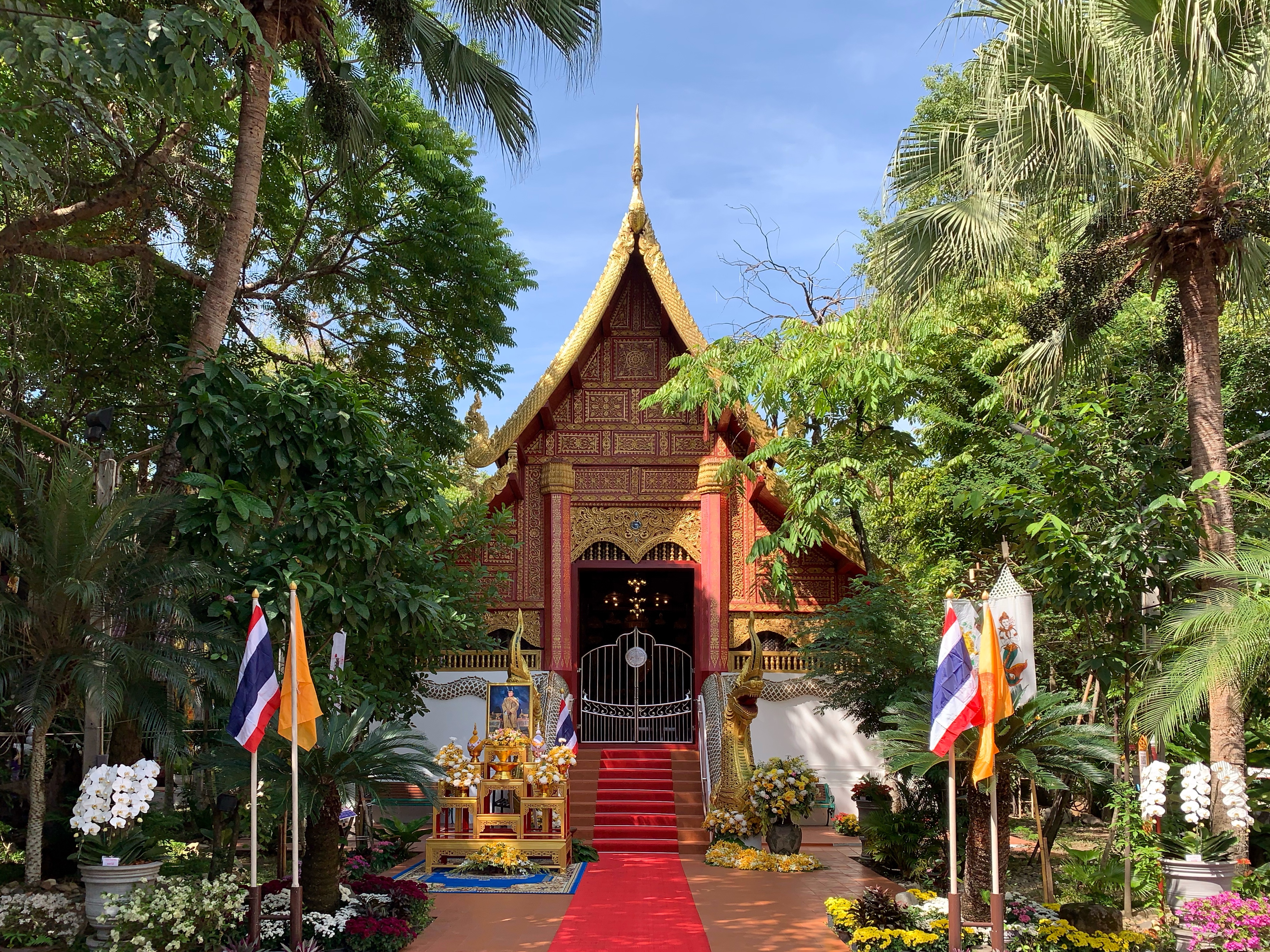
Wat Phra Kaew, Chiang Rai
Lightning does strange things in the tropics, but what struck the octagonal chedi of Wat Pa Ya in 1434 changed the course of Thai religious history. When the pagoda cracked apart, it exposed a Buddha image covered in stucco. The abbot brought it to his residence, where he noticed the plaster on the nose had flaked away to reveal something green underneath. He carefully removed the rest, uncovering a figure carved from translucent green semi-precious stone. The people called it Phra Kaew Morakot -- the Emerald Buddha -- though "emerald" in Thai simply means green-colored. The temple renamed itself Wat Phra Kaew in honor of the discovery, and so began a 350-year journey that would carry this small jade figure across kingdoms and centuries before it came to rest in Bangkok's Grand Palace, where it remains Thailand's most sacred religious object.
The Temple in the Golden Bamboo Forest
Before the lightning strike, the temple was known as Wat Pa Ya -- the Temple in the Golden Bamboo Forest -- for the dense groves of yellow bamboo, locally called Yeah, that surrounded it. No one knows exactly when it was founded, but it ranks among the oldest and most revered Buddhist temples in Chiang Rai. Situated on 10,640 square meters along Trairat Road in the Wiang sub-district, the temple was elevated to royal status by the King of Thailand on May 31, 1978. Its abbot holds the title of ecclesiastical head of all northern Thailand, making Wat Phra Kaew not only a historical landmark but the administrative center of Sangha governance for the entire region. Over the centuries, parishioners making merit have donated so many important religious artworks that the temple's storage rooms became a treasure trove requiring professional cataloging.
An Odyssey in Green Stone
Legend traces the Emerald Buddha's origins to around 500 BE, when it was supposedly sculpted by gods and presented to the sage Nagasena at Pataliputra in India. The chronicle Ratanabimbavamsa, written in Pali by Brahmarajapanna in the fifteenth century, tracks the image through Sri Lanka, Cambodia, Angkor Wat, and the old Thai capital of Ayutthaya before it arrived in Chiang Rai around 1391. After the 1434 discovery, the figure spent 32 years in Lampang starting in 1436, then 85 years in Chiang Mai beginning in 1468. In 1553 it crossed into Laos, where it remained for 225 years between Luang Prabang and Vientiane. The story turns from legend to documented history in 1778, when General Chakri -- the future King Rama I -- captured Vientiane and brought the image back to Thailand. On March 22, 1784, it was installed in the Temple of the Emerald Buddha within Bangkok's new Grand Palace, where it has served as the palladium of the Thai kingdom ever since.
A Jade Homecoming
For over two centuries after the Emerald Buddha left Chiang Rai, the temple carried the memory of its most famous resident without a physical replacement. That changed in 1990, when a new image was commissioned from Chinese carvers using Canadian jade, honoring the Princess Mother's ninetieth birthday. Called Phra Yok Chiang Rai -- the Chiang Rai Jade Buddha -- it was designed as an intentionally close but not exact replica of the original: 48.3 centimeters across the lap and 65.9 centimeters high, just one millimeter shorter than its Bangkok counterpart. A dedication ceremony took place in Bangkok on September 20, 1991, and on October 19 of that year, a grand procession installed the image in the Haw Phra Yok at Wat Phra Kaew. The jade Buddha gave Chiang Rai a tangible connection to the sacred history that lightning had revealed five and a half centuries earlier.
Lanna Craftsmanship in Wood and Brass
Beyond the jade Buddha, the temple houses Phra Jao Lan Thong, one of the largest and most beautiful Buddha images in Thailand. Made of brass and copper and believed to be 700 years old, the image was moved from its original home to Wat Ngam Muang and finally to Wat Phra Kaew in 1961. The ubosoth that shelters it was originally built in 1890 in Chiang Saen style -- a medium-sized wooden structure with uniquely carved doors, its architectural profile described as "incubating hen." At 9.5 meters wide and 21.85 meters long, it was renovated in 2001 with approval from the Department of Fine Arts. Since 2006, a team of museum professionals has been cataloging the temple's vast collection of donated religious art, mounting displays that illustrate centuries of Lanna artistic tradition with labels in Thai, English, and the Lanna script. The resulting community museum operates daily, free of charge.
From the Air
Located at 19.91N, 99.83E in the heart of Chiang Rai city in northern Thailand. The nearest airport is Chiang Rai International Airport (VTCT/CEI), approximately 8 kilometers northeast. The temple sits in the urban center along the Kok River valley, surrounded by the mountains of northern Thailand. From the air, Chiang Rai's grid pattern is visible with the temple grounds identifiable by their traditional multi-tiered rooflines amid the urban fabric. Best viewed at 3,000-5,000 feet for temple detail. The surrounding landscape of rice paddies and forested hills extends toward the Golden Triangle where Thailand meets Myanmar and Laos.