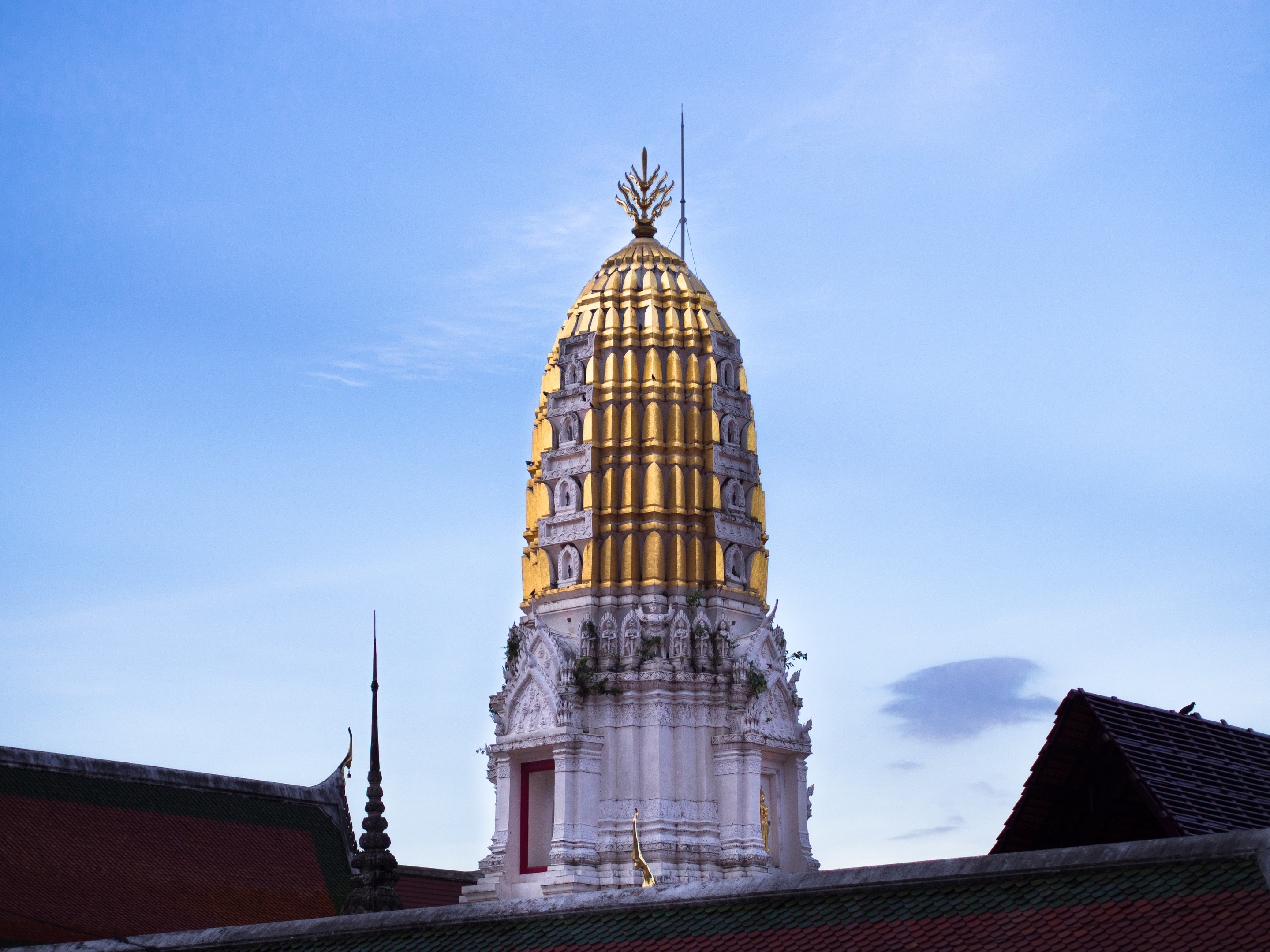
Wat Phra Si Rattana Mahathat
Ask a Thai person to name the most beautiful Buddha image in the country, and the answer will likely not be in Bangkok. It sits 337 kilometers to the north, in a temple on the east bank of the Nan River in Phitsanulok province. The Phra Phuttha Chinnarat, a gilded bronze statue in the Mara Vijaya posture, has been drawing pilgrims since the 14th century, and the temple built to house it, Wat Phra Si Rattana Mahathat, has been accumulating royal patronage for nearly as long. Locals simply call it Wat Yai, the Big Temple, which is both accurate and insufficient.
A King's Commission
In 1357, King Lithai of Sukhothai founded the temple and commissioned three bronze Buddha statues to serve as its principal images. The casting was not a casual affair. Lithai summoned five Brahmins, Ba Indra, Ba Brahm, Ba Vishnu, Ba Rachasingh, and Ba Rachakusol, along with the finest sculptors from Si Satchanalai (then called Sawankhalok) and master artisans from Chiang Saen and Hariphunchai. The collaboration produced three statues of graduating size, each in the Mara Vijaya posture that depicts the moment of the Buddha's enlightenment. The largest, the Phra Phuttha Chinnarat, would become the most revered of the three, though all were remarkable achievements of Sukhothai-era bronze casting.
Gilded by Ayutthaya, Restored by Rattanakosin
The temple's story did not end with Sukhothai. During the reign of King Ekathotsarot of Ayutthaya, the Phra Phuttha Chinnarat received its gold gilding, transforming the bronze statue into the luminous figure visitors see today. Centuries later, King Chulalongkorn, the great modernizer of the Rattanakosin period, invested in the temple's upkeep, and King Bhumibol Adulyadej continued that tradition. Each royal patron added layers of care without altering the fundamental character of the original. The temple compound covers 36 rai, roughly 57,600 square meters, of ground along the riverbank, a scale that reflects the sustained importance successive dynasties placed on this single site.
Pearl Doors and a Prang of Relics
The temple's main vihara announces its significance before you step inside. Its immense entrance doors feature mother-of-pearl inlay donated by King Boromakot in 1756, each panel a study in the painstaking craft tradition that Thai artisans maintained across centuries of political upheaval. Beyond the vihara rises a Khmer-style prang, its gilded upper section catching the sun above the treeline. A stairway leads inside the prang, which is said to enshrine relics of the Buddha himself. In front of the prang stands Phra Attharot, a standing Buddha image measuring 18 sok, approximately 9 meters in height, housed in a structure known as the Vihara Phra Attharot or Phra Vihara Kao Hong, the "nine halls sanctuary."
A Museum of Devotion
The Phuttha Chinnarat National Museum, located within the temple grounds, holds objects that map the cultural history of Phitsanulok and its surrounding towns. Buddha statues and votive tablets from excavations share gallery space with Sangkhalok ware from the Sukhothai kilns, Chinese blue-and-white ceramics, and Thai Benjarong pottery with its five-color glaze. Gold-painted enamel ware in the Lai Nam Thong style represents the peak of Thai decorative arts. Miniature trees with gold and silver leaves, presented by King Bhumibol Adulyadej and Queen Sirikit, connect the collection to living royal traditions. The museum was proclaimed a national institution in 1961 by the Fine Arts Department.
The River, the Fair, and the Dragon Boats
The Nan River is not backdrop at Wat Yai. It is participant. Each year, on the first weekend of October, the Phitsanulok Dragon Boat Races unfold on the water directly outside the temple, the long narrow boats surging past the prang's reflection. The annual Phra Phuttha Chinnarat Fair draws crowds to the temple grounds for a celebration that blends religious observance with the festive energy of a night market. Standing at the foot of Naresuan Bridge and looking across to the Phitsanulok Provincial Hall on the opposite bank, the temple occupies a position that is simultaneously sacred and civic, a place where the city's spiritual identity and its daily life share the same riverbank.
From the Air
Wat Phra Si Rattana Mahathat is located at 16.82°N, 100.26°E on the east bank of the Nan River in Phitsanulok city, central Thailand. The nearest airport is Phitsanulok Airport (VTPP), approximately 8 km south of the temple. The temple's gilded prang is a potential visual landmark near Naresuan Bridge. Best viewed at 1,500-3,000 ft AGL to see the temple compound along the river, with the bridge and provincial hall as orientation references. The Nan River runs roughly north-south through the city.