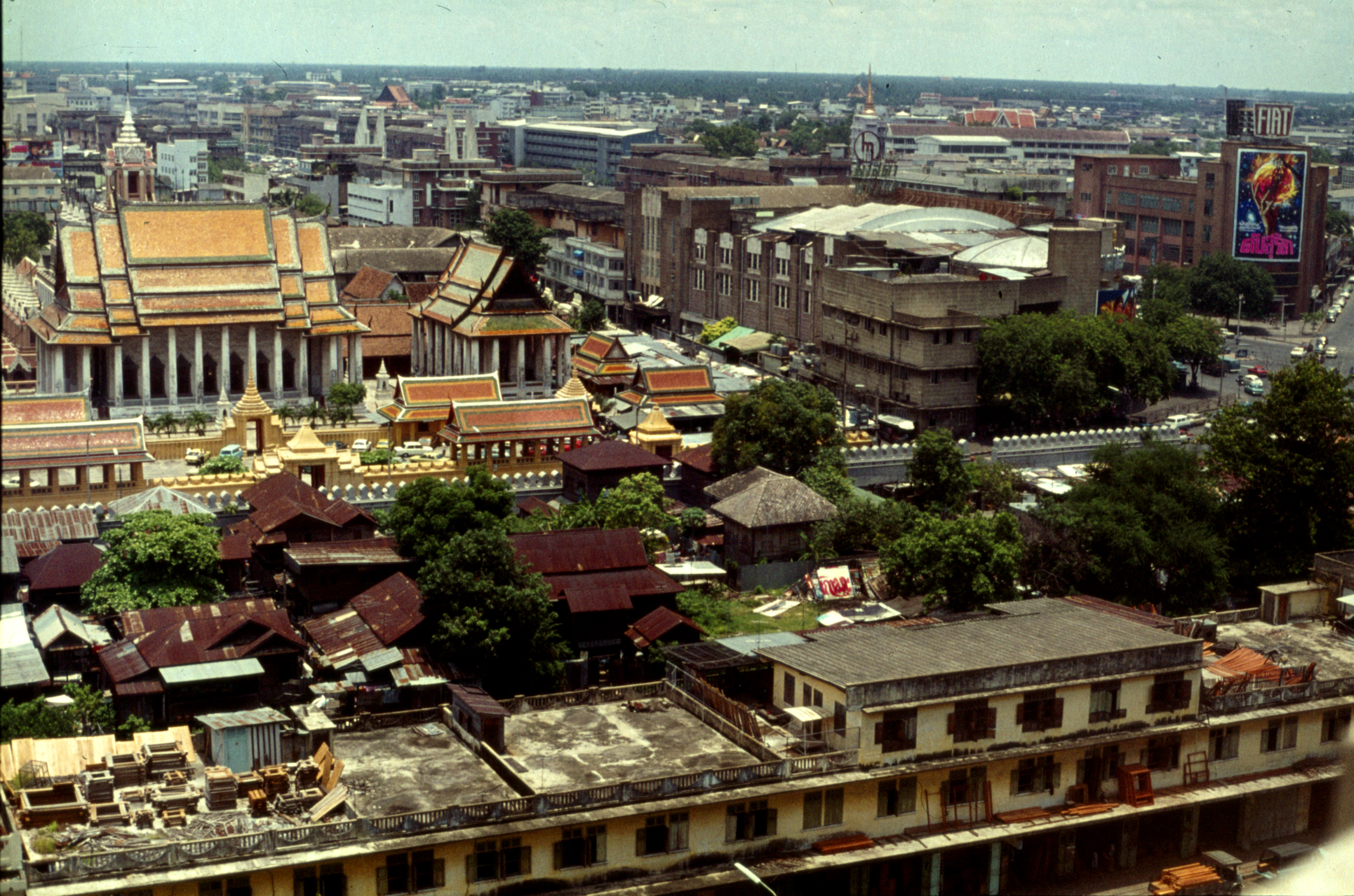
Wat Saket
Vultures once circled this hill in such numbers that their presence entered the Thai language as a proverb. The phrase Raeng Wat Saket -- 'vultures of Wat Saket' -- became shorthand for death itself, a grim reference to the cholera epidemics of the 19th century when the temple's open grounds were overwhelmed with bodies the cremation facilities could not process. Today, the same hill draws visitors for entirely different reasons: candlelight processions, Loi Krathong celebrations, and panoramic views of Bangkok from the golden chedi at the summit. Few places in the city contain such extremes of memory within a single compound.
The King Who Washed His Hair
The temple dates to the Ayutthaya period, when it was known simply as Wat Sakae. Its transformation began when Bangkok became the capital and King Rama I renovated the compound and bestowed its present name -- Wat Saket, meaning 'to wash the hair.' According to tradition, the king stopped at this temple to bathe and wash his hair upon returning from war, before entering the fortified inner city. The ritual was not vanity but purification: a soldier cleaning himself of battle before re-entering the sacred center of the kingdom. Located just outside the city walls, Wat Saket occupied a liminal space in Bangkok's geography -- close enough to matter, far enough to serve purposes the inner city preferred to keep at a distance.
The Mountain That Built Itself
Rama III had grand ambitions for the temple. He ordered the construction of a massive chedi inside the Wat Saket compound, but Bangkok's soft alluvial soil could not bear the weight. The structure collapsed during construction, and over the following decades the abandoned pile of mud and brick settled into the shape of a natural hill, overgrown with weeds. Locals began calling it phu khao -- 'the mountain' -- as if it had always been there. For a time, soldiers used it as a lookout tower, scanning the horizon for approaching armies. The accidental hill waited for someone with a more modest vision. During Rama IV's reign, construction began on a small chedi at the summit, completed under Rama V and covered in a layer of gold. Prince Pritsadang brought a relic of the Buddha from Sri Lanka and placed it in the new chedi. In the 1940s, concrete retaining walls were added to prevent erosion. The hill that ambition had built and gravity had reshaped was finally secured.
The Ghost Gate
In the early Rattanakosin period, the Siamese avoided cremations within the city walls, believing them to be inauspicious. Wat Saket, located outside the fortified area, became the city's primary cremation site. Corpses were carried through the Pratu Phi -- the 'ghost gate' -- to be burned at the temple. Then cholera arrived. In 1820, an outbreak spreading from Penang claimed over 30,000 lives in the capital. The cremation facilities could not keep up. Bodies accumulated in the monastery's open areas, drawing flocks of vultures that fed on the unburned dead. The epidemics recurred with terrible regularity through the dry season until the early reign of Rama V. The most severe struck in 1840 during Rama III's reign, when one in ten people in Siam and its surroundings perished. The final major outbreak came in 1881, with hundreds dying daily. The image of vultures circling above the golden hill became a haunting symbol of mortality.
Festival of Light
Every November, the temple hosts an annual festival that inverts its grim history into celebration. A candlelight procession winds up the steep path of Phu Khao Thong to the golden chedi, which is wrapped in a long red robe in a tradition observed since Rama V's reign. Devotees write their names and their family members' names on the fabric and pray, believing their wishes will be fulfilled. Simultaneously, a grand Loi Krathong festival fills the temple grounds with light and spectacle. Traditional sideshows once accompanied the celebration -- performances featuring ghost stories and folk tales that played on Bangkok's rich tradition of the supernatural. The nearby Fort Mahakan community was once a hub of the fireworks industry, and the festival was known for its pyrotechnics until the community's relocation led to a ban on fireworks trading. What remains is the procession itself: hundreds of candle flames ascending a hill that cholera victims once descended, light replacing the memory of darkness.
From the Air
Wat Saket sits at 13.7538N, 100.5068E in the Pom Prap Sattru Phai district of Bangkok. The Golden Mountain (Phu Khao Thong) is a distinctive elevated feature in an otherwise flat cityscape, topped by a golden chedi visible from the air. At approximately 80 meters elevation, it stands out among the low-rise buildings of Bangkok's old city. Best viewed at 1,500-3,000 feet AGL. The nearest major airports are Suvarnabhumi (VTBS), about 27 km east, and Don Mueang (VTBD), about 20 km north. The old city wall remnants and canal system provide useful visual navigation references. Wat Pho and the Grand Palace lie roughly 1 km to the southwest.