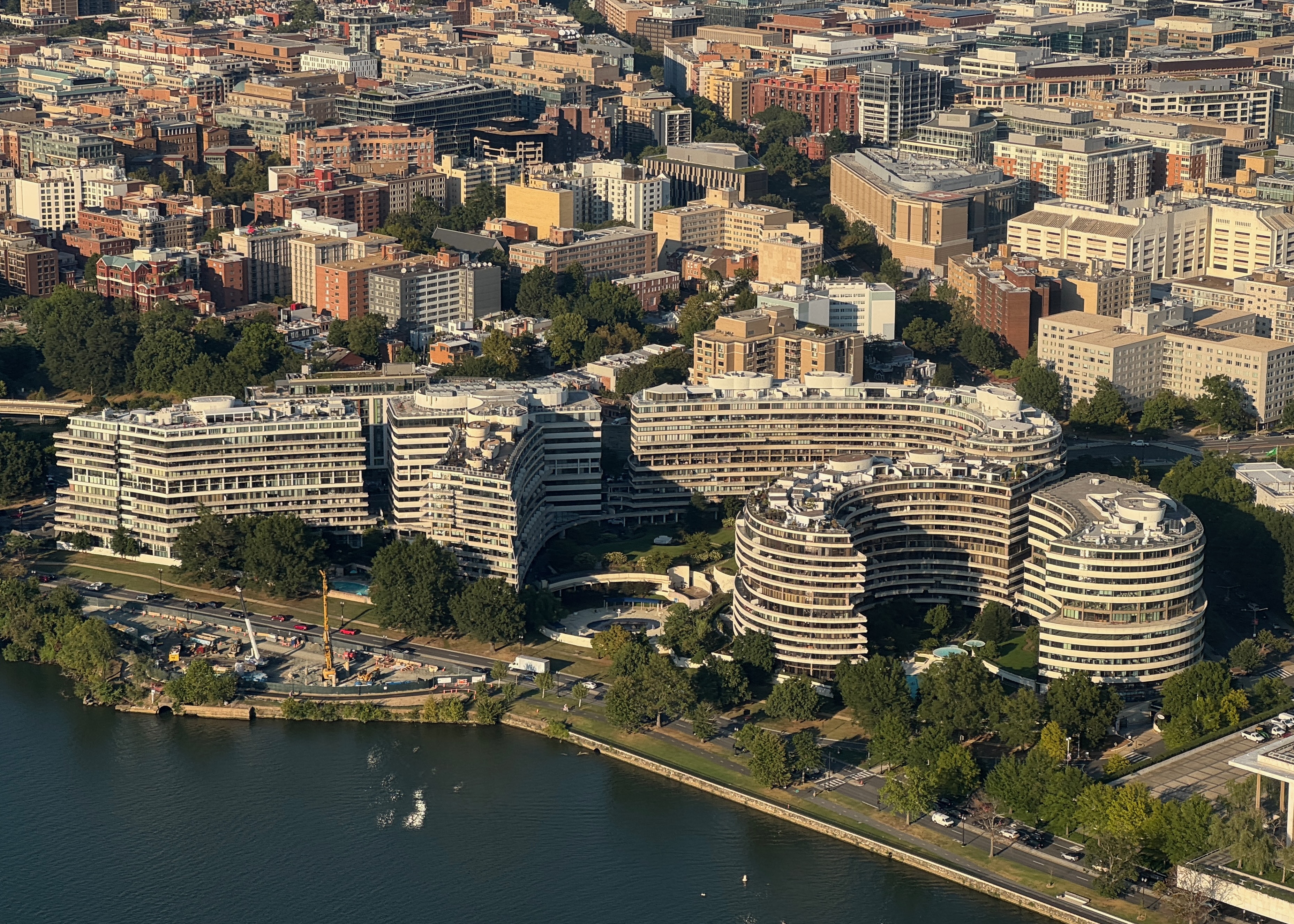
Watergate Complex
The word "Watergate" has become so thoroughly fused with scandal that most people forget it refers to an actual place: five curving buildings of textured concrete on the banks of the Potomac River in Washington's Foggy Bottom neighborhood. Before it became a synonym for presidential corruption, the Watergate complex was simply the most fashionable address in the capital. Ruth Bader Ginsburg lived there. So did Bob and Elizabeth Dole, Robert McNamara, Condoleezza Rice, and the cellist Mstislav Rostropovich. Efficiency apartments started at $17,000 when the first building opened in 1965; penthouses topped $250,000. The complex had a Safeway, a liquor store, a post office, a florist, and a high-end restaurant. It was, in every sense, a city within a city, until one June night in 1972, five men with burglary tools and bugging equipment were caught inside the Democratic National Committee headquarters on the sixth floor, and the address became history.
An Italian Architect's American Dream
The Watergate was an Italian production on American soil. Societa Generale Immobiliare, a Rome-based development firm, conceived the project in the early 1960s on an abandoned commercial site along the Potomac. The curvilinear design served both aesthetic and practical purposes: the sweeping curves would complement the nearby Kennedy Center, then in its planning stage with its own curvilinear design, and the rounded balconies would give every apartment dweller a view of the river. The approval process was a bureaucratic marathon. The National Capital Planning Commission worried the 16-story buildings would overshadow the Lincoln Memorial. The Commission of Fine Arts demanded some land be preserved as public space. The Kennedy administration pressured the developers to lower the height. By mid-November 1962, more than 2,000 protest letters had been sent to Congress and another 1,500 to the White House. After years of negotiation, the plan was reduced from four buildings to five shorter ones, with the tallest reaching 13 stories. Construction on the first building, Watergate East, began in August 1963.
The Break-In That Changed a Vocabulary
On June 17, 1972, five men were arrested inside the offices of the Democratic National Committee on the sixth floor of the Watergate office building. The phone taps they had planted were monitored from rooms in the Howard Johnson's Motor Lodge across the street at 2601 Virginia Avenue NW, first Room 419, then Room 723. But this was not even the first burglary at the Watergate. In 1969, a residential unit owned by Rose Mary Woods, President Nixon's personal secretary, had been broken into; the thieves took jewelry and personal items. The DNC break-in, however, unraveled into the most consequential political scandal in American history, leading to the resignation of President Richard Nixon on August 9, 1974. A plaque on the sixth floor of the office building now commemorates the event. The space, occupied by SAGE Publishing since 2015, houses a private exhibit about the break-in and the ensuing constitutional crisis. The suffix "-gate" has since been attached to scandals worldwide, a linguistic legacy no building's developers could have anticipated.
What's in a Name
The origin of the name "Watergate" has at least three competing stories. In his 2018 book The Watergate: Inside America's Most Infamous Address, Joseph Rodota traced three accounts from inside the development team. One credits author and playwright Warren Adler, who was working as a publicist for the developers. Another says financier Nicolas Salgo acquired the name from Marjory Hendricks, owner of the Water Gate Inn, a restaurant that operated on the site from 1942 to 1966. A third credits a trio of local executives who proposed the name to SGI's Rome office, partly inspired by the same inn. The earliest surviving use of "Watergate" in company files is a June 8, 1961, memorandum by Giuseppe Cecchi. There is also a more literal possibility: in 2009, William Noble wrote that the complex "got its name from overlooking the 'gate' that regulated the flow of water from the Potomac River into the Tidal Basin at flood tide," a structure near the Jefferson Memorial about a mile downriver. And west of the Lincoln Memorial, a set of ceremonial stairs called the "Water Gate" once served as a planned reception area for dignitaries arriving by water, though the steps never quite achieved that ceremonial purpose.
Power Brokers and Potomac Views
The three Watergate apartment buildings contain roughly 600 residential units, and the tenant rolls over the decades read like a who's who of Washington power. Senator Russell Long, Defense Secretary Caspar Weinberger, Federal Reserve Chairman Alan Greenspan, opera tenor Placido Domingo, and Supreme Court Justice Ruth Bader Ginsburg all called the Watergate home. Monica Lewinsky stayed briefly at her mother's apartment in the complex during the scandal that bore her name. The Washington Post once noted the concentration of Republican officials in the building and dubbed it the "Republican Bastille." When Watergate East opened in 1965, it immediately became the most coveted address in the city, and its 238 cooperative units were nearly sold out by April 1967. The complex's ground-floor retail space housed everything from a Safeway supermarket to a Peoples Drug store, a bank, a bakery, and upscale boutiques, creating a self-contained village for residents who could afford to live where the nation's business was conducted.
Reinvention on the River
The Watergate has reinvented itself repeatedly. The hotel closed in 2007 for a planned $170 million renovation, but financing fell through in 2009. Euro Capital Properties acquired the hotel and in 2014 began a $100 million renovation that replaced every major system in the building while preserving the iconic textured concrete balconies. Architect Bahram Kamali of BBGM oversaw a redesign that added two restaurants, a rooftop bar, a spa, and increased the luxury room count from 251 to 348. Israeli artist Ron Arad designed the metal sculptures for the lobby and bar. The office building has changed hands multiple times, selling for $75 million in 2016 and again for $101.5 million in 2019. The apartment cooperatives have bought the land beneath their buildings. The Watergate South's land lease does not expire until 2070, giving its residents decades of security. More than sixty years after construction began, the complex endures as both a luxury address and a permanent landmark in the American political vocabulary, its curved balconies still catching the light off the Potomac each evening.
From the Air
Located at 38.899N, 77.054W in the Foggy Bottom neighborhood of Washington, D.C., along the Potomac River. The complex's five distinctive curvilinear buildings are immediately identifiable from the air, situated adjacent to the Kennedy Center for the Performing Arts. The curved white concrete balconies contrast sharply with the surrounding rectangular buildings. Best viewed at 1,500-2,500 feet AGL. The Lincoln Memorial and Theodore Roosevelt Island are nearby visual references. Nearest airport: KDCA (Ronald Reagan Washington National Airport), approximately 2 nm south. Note: Within the DC SFRA (Special Flight Rules Area); specific clearance required.