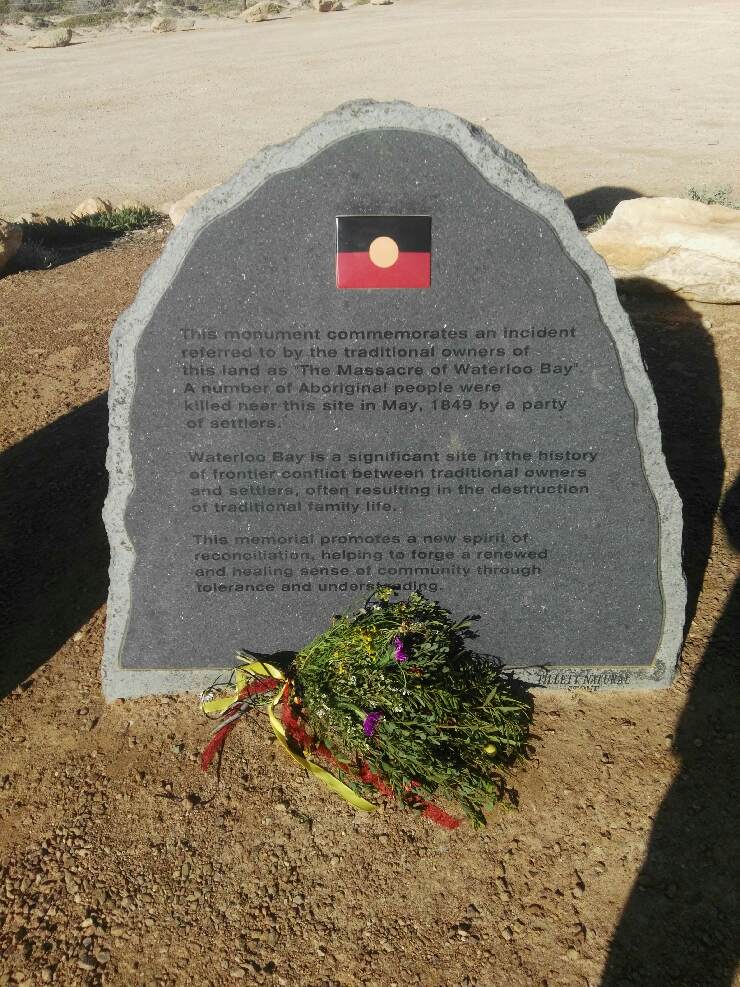
Waterloo Bay Massacre
The cliffs at Waterloo Bay, near the small town of Elliston on South Australia's Eyre Peninsula, are beautiful in the way that remote coastal places often are -- windswept limestone dropping into cold water, the sky enormous overhead. But the Wirangu and Nauo peoples who have lived along this coast for thousands of years carry a different knowledge of this place. Their oral histories record that in late May 1849, European settlers drove Aboriginal men, women, and children over these cliffs in an act of punitive violence. The number who died remains uncertain. The most recent scholarship suggests tens or scores. For more than a century, the local settler community resisted acknowledging what happened here.
A Peninsula on Fire
European settlers had arrived on the Eyre Peninsula only a decade earlier, establishing Port Lincoln in March 1839. The years that followed brought escalating violence between settlers and Aboriginal people as pastoral runs spread across traditional lands. The colonial government in Adelaide was distant -- both geographically and in its understanding of conditions on the ground. Soldiers were dispatched to Port Lincoln in 1842, but policing resources were thin and authority was vaguely defined, particularly with respect to Aboriginal people who had no standing in colonial law. When settlers' sheep were speared or shepherds attacked, reprisals were swift and rarely documented. When Aboriginal people were killed, the machinery of justice barely stirred.
The Killings That Sparked the Massacre
In the late 1840s, tensions on the Eyre Peninsula reached a crisis. Several European settlers and their employees were killed by Aboriginal people in separate incidents -- among them James Fastings and John Jones, along with Mrs. Easton, whose body was found after she had been killed while her husband was away. A shepherd named Beevor was also killed. These deaths terrified the scattered settler community and provoked calls for decisive action. What followed was not law enforcement but vengeance. A party of settlers, likely including both stockmen and others with a stake in the pastoral runs, organized an expedition to punish the Aboriginal people they held responsible. The expedition headed toward the coast, where groups of Aboriginal people were known to camp.
What Happened at the Cliffs
The precise details of what occurred at Waterloo Bay remain contested in written records but consistent in Aboriginal oral tradition. The settler party confronted Aboriginal people on or near the cliffs. Some were shot. Others -- by multiple accounts -- were driven over the cliff edge to their deaths on the rocks and in the water below. The first widely published account appeared in 1880, when Henry John Congreve wrote "A Reminiscence of Port Lincoln" for the Adelaide Observer. Historians have described his version as fanciful and sometimes wildly inaccurate, but the core claim of a massacre at Waterloo Bay was not invented by Congreve. It predated him in both settler gossip and Aboriginal memory. Later historians examined the archival record and found no formal documentation of a large-scale massacre -- which, given the remoteness of the location and the absence of any mechanism for recording violence against Aboriginal people, is precisely what one would expect.
The Long Refusal
In 1970, the Federal Council for the Advancement of Aboriginals and Torres Strait Islanders and the South Australian Aborigines Progress Association proposed building a memorial cairn on the cliffs at Waterloo Bay. The timing was deliberate -- it was to coincide with the bicentenary of Captain Cook's landing at Botany Bay, reframing the national celebration with a reminder of its costs. The chairman of the District Council of Elliston refused permission, demanding proof that a massacre had occurred before any memorial could be built. The demand for documentary evidence of an event that the perpetrators had every reason to conceal -- and that occurred in a place where Aboriginal testimony carried no legal weight -- was, in effect, a demand for silence. The memorial was not built.
Reckoning at Last
The silence did not hold. In October 2018, after years of community consultation and advocacy by the Wirangu people, a memorial was unveiled at Waterloo Bay. It stands where the cliffs meet the wind, looking out over the water where people died. The memorial's existence represents something that a generation of local leaders fought to prevent: public acknowledgment that this place carries history that cannot be wished away. Historian Robert Foster concluded that the rumors of a massacre are founded in fact, though embellished over time into a myth. What matters now is not the precise number of people killed, but that those deaths -- and the lives behind them -- are no longer invisible. The Wirangu and Nauo peoples' connection to this coast extends back thousands of years before 1849 and continues forward from it. Waterloo Bay is many things at once: a place of beauty, a place of grief, and a place that finally chose remembrance over forgetting.
From the Air
Located at approximately 33.66S, 134.90E, on the western coast of the Eyre Peninsula in South Australia. The Waterloo Bay cliffs are visible from low altitude as a dramatic coastal feature where limestone meets the Southern Ocean. The small town of Elliston lies nearby. Nearest airports: Ceduna (YCDU), Port Lincoln (YLNC). The coastline is rugged and windswept, with clear conditions common but Southern Ocean weather capable of producing sudden changes.