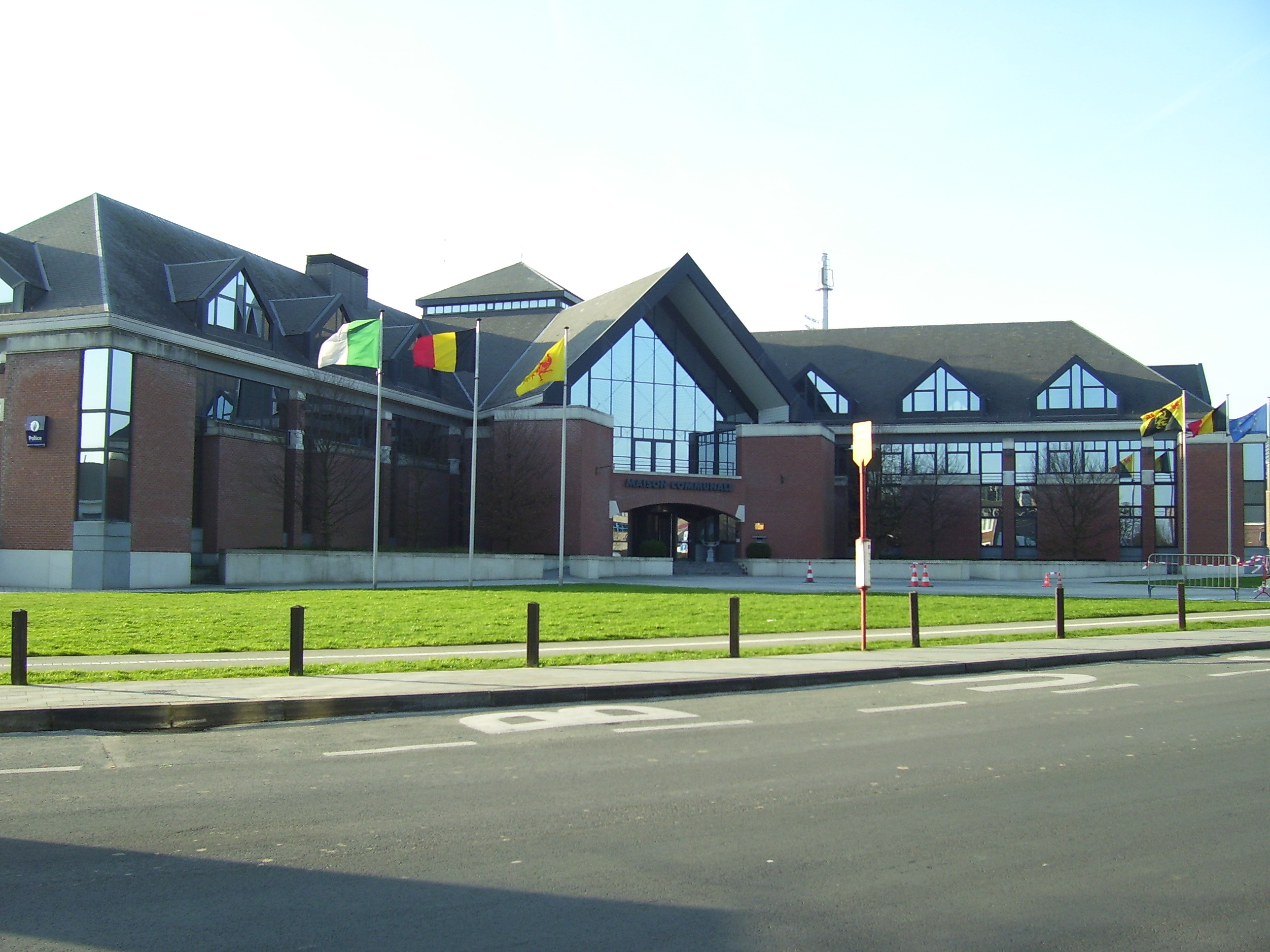
Waterloo, Belgium
Say the word and people picture artillery smoke, ABBA, Napoleon's collapsing imperial dream. The actual town of Waterloo is none of those things. It is a leafy Walloon commune of about thirty thousand people, fifteen kilometers south of Brussels, where European Commission staff live alongside Wellington's old chapel, where Mastercard's European headquarters share an address with a Carrefour hypermarket, and where the most exciting recent local news involved a Catalan separatist president renting a villa. The battle that gave the world its favorite metaphor for finality happened in the fields just south of here on 18 June 1815. The town itself was a stopover on a coal road, and in many ways still is.
A Coal Road and a Forest Edge
Waterloo first appears in writing in 1102, as a hamlet at the edge of the Sonian Forest where a road from Brussels to a coal mine in the south crossed a path leading to a small farming settlement. Travelers and merchants stopped here for the night - the woods were thick, bandits were a real problem, and a fire and a bowl of something hot were worth more than coins. The crossroads is still visible today, where the Chaussee de Bruxelles meets the Boulevard de la Cense. For five hundred years that was Waterloo's entire story: a place to pause on the way somewhere more important. Then in 1687, a royal chapel went up in the lower village, the one that would eventually become the Church of Saint Joseph. The Duke of Wellington reportedly prayed there in 1815 before riding south to meet Napoleon's army. The British and Dutch plaques inside still commemorate the men who never came back.
The Battle and the Mound
On 18 June 1815, three armies converged on the rolling farmland a few kilometers south of the town. Napoleon, returned from exile and fighting his last campaign, brought the resurgent Armee du Nord. The Duke of Wellington commanded an Anglo-allied force from Britain, the Netherlands, Hanover, Brunswick, and Nassau. Field Marshal Blucher arrived late with the Prussians, and the day ended with the First French Empire broken for good. The Lion's Mound, built between 1820 and 1826 by King William I of the Netherlands, marks the spot where his son the Prince of Orange was knocked from his horse by a musket ball. Two hundred twenty-six steps lead to the top of the artificial hill. The stone lion at the summit faces France, paw on a globe, in a gesture that is part memorial and part warning. From up there the geography of the battle becomes obvious - the ridge, the sunken road, La Haye Sainte and Hougoumont, the woods Blucher's Prussians emerged from at dusk.
A Wealthy, Mixed-Up Suburb
Modern Waterloo is one of the wealthier towns in Wallonia, and one of the most international. Nearly one in five registered residents holds a non-Belgian passport - the largest groups are French, Italian, British, American, and Swedish, drawn by the international schools and the easy commute to the European institutions in Brussels. Six districts make up the commune: Centre, Chenois west of the railway, Joli-Bois south of center, Mont-Saint-Jean to the north of the battlefield, and the two Faubourgs flanking the long Chaussee de Bruxelles. A row of shops nicknamed Petit Paris stretches along the chaussee. The European headquarters of Mastercard sits in an office park east of town. St. John's International School and the Scandinavian School draw students from across the city. The official language border with Flemish-speaking Sint-Genesius-Rode runs just north of the commune; signs change from French to Dutch the moment you cross it.
The Argenteuil Estate
Northeast of the center, the Argenteuil estate has accumulated history like sediment. In 1831 the Belgian aristocrat Ferdinand de Meeus assembled 250 hectares of former Sonian Forest into a single domain. The first chateau burned down in 1847; a second, designed by Jean-Pierre Cluysenaar, rose in 1858. In 1929 the American businessman William Hallam Tuck bought a chunk of the estate and built the Chateau Bellevue, designed by New York architect William Delano. After 1961, King Leopold III and Princess Lilian made Bellevue their home, until her death in 2003. There was once talk of converting it into a residence for the President of the European Union. Instead the Belgian government sold it in 2004. The original Chateau d'Argenteuil now houses the Scandinavian School and the European School of Bruxelles-Argenteuil.
The Singing Nun and the Catalan
Two people give a sense of Waterloo's particular flavor. In September 1959 a young woman named Jeannine Deckers joined the Missionary Dominican Sisters of Our Lady of Fichermont, in Waterloo. As Sister Luc-Gabrielle she recorded a folk song about Saint Dominic that became a global pop hit in 1963 - Dominique by The Singing Nun reached number one in the United States and Canada. Half a century later, on 2 February 2018, the town confirmed that the deposed Catalan president Carles Puigdemont had rented a villa here. He still lives there. A municipality that lent its name to one of history's most decisive defeats now quietly hosts a man trying very hard not to suffer the same fate.
From the Air
Located at 50.72N, 4.38E, about 15 km south of Brussels city centre and just south of the Flemish-French language border. The Lion's Mound is easy to spot from altitude - a near-perfect conical hill on otherwise flat farmland, rising about 40 meters above the surrounding fields. Nearest airport is Brussels (EBBR) about 22 km north. Charleroi (EBCI) lies 35 km south. Clear weather typical of the Brabant plateau; afternoon convective cloud common in summer.