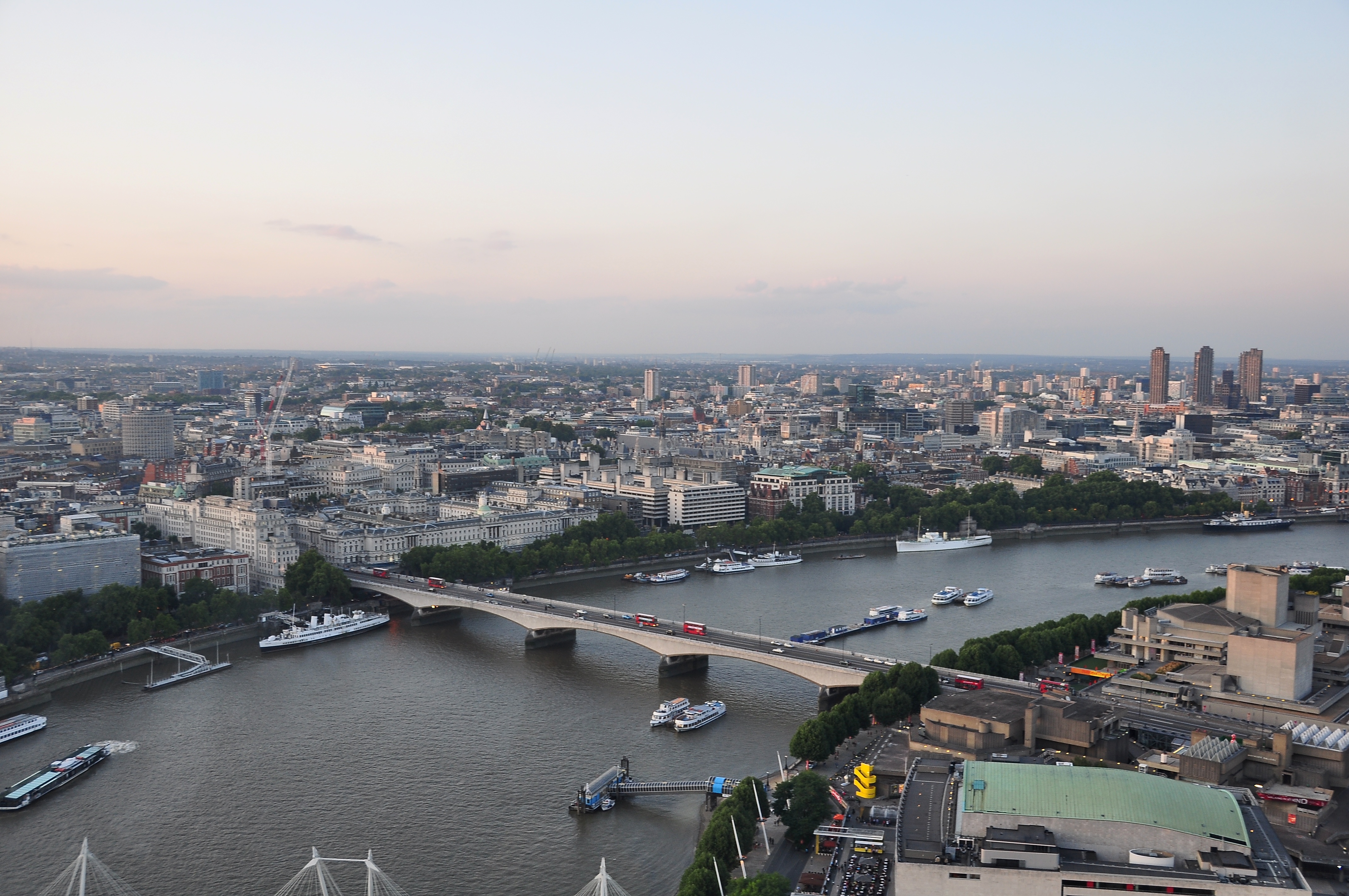
Waterloo Bridge
There is a view from Waterloo Bridge that no other Thames crossing can match. Stand at the centre and look west toward Westminster, the South Bank, and the London Eye; turn east and the City's towers rise beyond the curve of the river, with Canary Wharf glinting in the distance. It is widely considered the finest panorama in London, which is why Claude Monet painted the bridge 41 times between 1900 and 1904, working from a suite at the Savoy Hotel. But the bridge Monet painted no longer exists. The one standing today was built during the Second World War, largely by women.
Rennie's Beautiful Failure
The first Waterloo Bridge, designed by John Rennie and opened in 1817, was considered one of the most beautiful bridges in Europe. Its nine granite arches, separated by pairs of Doric columns, stretched 2,456 feet including approaches, and the Italian sculptor Antonio Canova reportedly called it the finest bridge in the world. It was named to commemorate the 1815 British victory at the Battle of Waterloo, though during the 1840s it gained a darker reputation as a popular location for suicide. Thomas Hood's 1844 poem "The Bridge of Sighs" took its inspiration from the suicide of a young woman there. Michael Faraday conducted magnetohydrodynamic experiments from the bridge in 1832, attempting to measure the electrical potential generated by salt water flowing through the Earth's magnetic field. But Rennie's masterpiece had a fatal flaw: scour from increased river flow, accelerated after the demolition of Old London Bridge, was undermining the foundations.
The Ladies' Bridge
By the 1920s, Rennie's bridge was sinking. A temporary steel framework was erected alongside to carry southbound traffic while engineers debated what to do. In the 1930s, London County Council decided to demolish and replace it entirely, hiring Sir Giles Gilbert Scott -- architect of Battersea Power Station and the red telephone box -- to design the new crossing. Scott, who freely admitted he was no engineer, created a structure of reinforced concrete beams shaped to resemble arches, supported by Ernest Buckton and John Cuerel of Rendel Palmer & Tritton. Construction was underway when war broke out in 1939. Male labourers were called up for military service almost immediately, and despite the bridge being designated a project of national importance by the Ministry of Transport, the shortage of men became acute. Women took over. From the start of the war through to the bridge's completion in 1945, they were the predominant construction workforce. The bridge became known as "The Ladies' Bridge," a name that persisted for decades.
The Umbrella Murder
Waterloo Bridge entered the history of espionage on 7 September 1978, when Georgi Markov, a Bulgarian dissident writer, was walking across it on his way to work at the BBC World Service. Someone jabbed him in the back of the leg with what felt like the tip of an umbrella. Markov turned to see a man picking up a dropped umbrella and hailing a taxi. By that evening, Markov had developed a high fever. Four days later, he was dead. An autopsy revealed a tiny platinum-iridium pellet embedded in his calf, drilled with holes that had contained ricin. The assassination was carried out by agents of the Bulgarian secret police, the Committee for State Security, possibly with technical assistance from the KGB. The "umbrella murder" became one of the most notorious Cold War killings, and it happened on an ordinary London bridge during the evening commute.
Stones Scattered Across the World
When Rennie's bridge was demolished, its granite was dispersed across the former British Empire in an unusual act of architectural recycling. Two stones were sent to Canberra, Australia, where they sit between the spans of the Commonwealth Avenue Bridge. Others were used to build a monument in Wellington, New Zealand, honouring Paddy the Wanderer, a beloved stray dog that roamed the wharves from 1928 to 1939. Stone balusters were shipped to Rhodesia for the author Dornford Yates's house. Recovered timbers ended up as shelving in the library at Anglesey Abbey. The bridge that replaced them is the only Thames crossing to have been damaged by German bombs during the Blitz, and the only one substantially built by women. It is also, thanks to its position at a curve in the river, the bridge that best captures London's ability to present entirely different faces depending on which way you look.
From the Air
Located at 51.509N, 0.117W, Waterloo Bridge crosses the Thames at a bend that makes it visible from altitude as a distinctive angled crossing. The South Bank Centre and Royal Festival Hall are immediately to the south, with Somerset House and the Strand to the north. Nearest airports: EGLC (London City, 6nm E), EGLL (Heathrow, 14nm W). Best viewed at 1,500-3,000 ft AGL.