The Waterloo Campaign
On 1 March 1815, Napoleon Bonaparte stepped ashore at Golfe-Juan with about a thousand soldiers, a handful of cannon, and an Empire he no longer technically possessed. He had escaped from Elba. Nineteen days later he was back in Paris, sleeping again in the Tuileries; Louis XVIII had fled north in his nightshirt. Across Europe, the assembled diplomats of the Congress of Vienna stopped quarreling long enough to declare Napoleon an outlaw and to pledge 150,000 men each to remove him. The Hundred Days had begun. They would end on a Belgian hillside one hundred and eleven days later, in mud, in blood, and in the long red light of a June evening, with the French army running, the Old Guard dying in formation, and an English duke and a Prussian field marshal embracing in the smoke at La Belle Alliance.
A Gambler's Arithmetic
Napoleon had perhaps a quarter of a million soldiers he could put in the field. Arrayed against him, in various stages of mobilization, were almost a million Russians, Austrians, Prussians, British, Dutch, and assorted Germans. The Russian and Austrian armies were still weeks away from the French frontier. The British and Prussians were already in Belgium - the Duke of Wellington's polyglot Anglo-allied force of about 93,000 around Brussels, Marshal Blucher's 116,000 Prussians a day's march to the east. Napoleon's only real chance was to defeat them separately before the others arrived. So in the second week of June, with the secrecy he had used to such effect twenty years earlier in Italy, he moved 128,000 men north toward the Belgian border. On 15 June, just before dawn, French outposts crossed the river Sambre at Charleroi. The campaign had begun, and almost no one on the Coalition side knew it.
The Famous Ball
On the evening of 15 June, while French cavalry was already brushing aside Prussian pickets, the Duchess of Richmond hosted a ball in Brussels. Wellington was there. So were his senior officers, dancing in scarlet coats, courting the daughters of the local nobility. Reports of the French advance reached him during dinner. He listened, considered, and continued the evening with what an attending officer later called calm visible courtesy - but he had been wrong about Napoleon's line of attack, and he knew it. Most of his army was deployed too far west. Sometime after midnight he turned to the Duke of Richmond and asked for a map. Bending over it, he traced his finger to the village of Waterloo, just south of Brussels on the Brussels road, and said, by various accounts: I shall have to stop him here. Officers slipped away from the dance through the early hours to find their regiments. Many of them died the next day at Quatre Bras.
Three Days, Four Battles
What followed was one of the most compressed military campaigns in European history. On 16 June, Napoleon fought two battles at once. To his left, Marshal Ney engaged Wellington at the crossroads of Quatre Bras and failed to take it - a battle the French should have won. To his right, Napoleon himself shattered Blucher's Prussians at Ligny in the largest action of the campaign; the seventy-two-year-old field marshal was knocked off his horse and ridden over twice by his own cavalry. The Prussians retreated north through the night, not east toward their lines of supply as Napoleon expected, but toward Wavre - and toward Wellington. The next day, 17 June, the rains came. Napoleon, oddly slow that morning, finally sent Marshal Grouchy with 33,000 men to pursue the Prussians. By dusk on 17 June, Wellington had pulled his army back to a long, low ridge near a village called Waterloo. Napoleon's main force pursued. The two armies bivouacked in the rain across a shallow valley about a kilometer apart and waited for dawn.
Waterloo, 18 June 1815
The battle began late, around eleven thirty, because Napoleon waited for the ground to dry enough for his artillery. He had perhaps 73,000 men against Wellington's 68,000 - a slight numerical advantage, and a more pronounced advantage in cannon. Wellington's only hope was to hold long enough for Blucher to arrive from the east. So Wellington held. The French assaulted Hougoumont farm on the right; the Coldstream Guards held it. They assaulted La Haye Sainte in the center; the German Legion held it until their ammunition ran out. Marshal Ney, in a moment of catastrophic misjudgment, launched massed cavalry against unbroken British squares without infantry support, and lost his best horsemen for nothing. And all afternoon, on the eastern horizon, dark columns kept appearing through the trees: Bulow's Prussian IV Corps, then Pirch, then Zieten, marching cross-country through swollen streams to reach the battle. By seven that evening Napoleon committed his last reserve, the Imperial Guard, to a final attack on Wellington's center. The Guard had never been defeated. The Guard was defeated. Whether by the British 52nd Light Infantry firing into their flank or by Dutch and Belgian troops to their front, they wavered, broke, and ran. La Garde recule - the Guard retreats - and behind them, the French army dissolved.
The Pursuit
What happened after Waterloo is less famous than the battle, but it took longer and it killed more men. The Prussian cavalry, fresh because they had not fought at Waterloo, pursued the French through the night without mercy. Blucher's exhausted soldiers - many of them sixteen and seventeen years old, militia who had marched from Pomerania - sang as they pushed south. The French army that had crossed the Sambre on 15 June essentially ceased to exist as an organized force. Marshal Grouchy, off to the east, had fought his own battle at Wavre on 18 and 19 June, winning tactically, irrelevant strategically; he kept his 33,000 men intact and made one of the more competent retreats in French military history, but he came home to a defeated empire. Coalition columns marched on Paris through the last week of June, fighting small bloody actions at Villers-Cotterets, Compiegne, Senlis. By 30 June, Blucher had crossed the Seine. On 3 July, the French capitulated at Saint-Cloud. The two Coalition armies entered Paris on 7 July.
Abdication and St. Helena
Napoleon never rallied his army. He rode straight from Waterloo back to Paris, hoping to find political support to continue the war. He found none. His brother Lucien pressed him to dissolve the Chambers and declare himself dictator. Napoleon, exhausted, replied: alas, I have dared only too much already. He abdicated on 22 June in favor of his four-year-old son. The boy was in Austria. The empire was over. Napoleon fled west to Rochefort hoping to reach America, but Royal Navy frigates blockaded the harbor. On 15 July he surrendered to Captain Frederick Maitland of HMS Bellerophon. The British sent him to the island of Saint Helena, fifteen hundred miles from anywhere, where he died of stomach cancer six years later. The Hundred Days had cost roughly sixty thousand killed and wounded at Waterloo alone, and the political settlement that followed - the Treaty of Paris of November 1815 - locked France behind borders that have changed remarkably little since. The Napoleonic era, which had run for sixteen years and reshaped half a continent, ended in twenty-three days.
From the Air
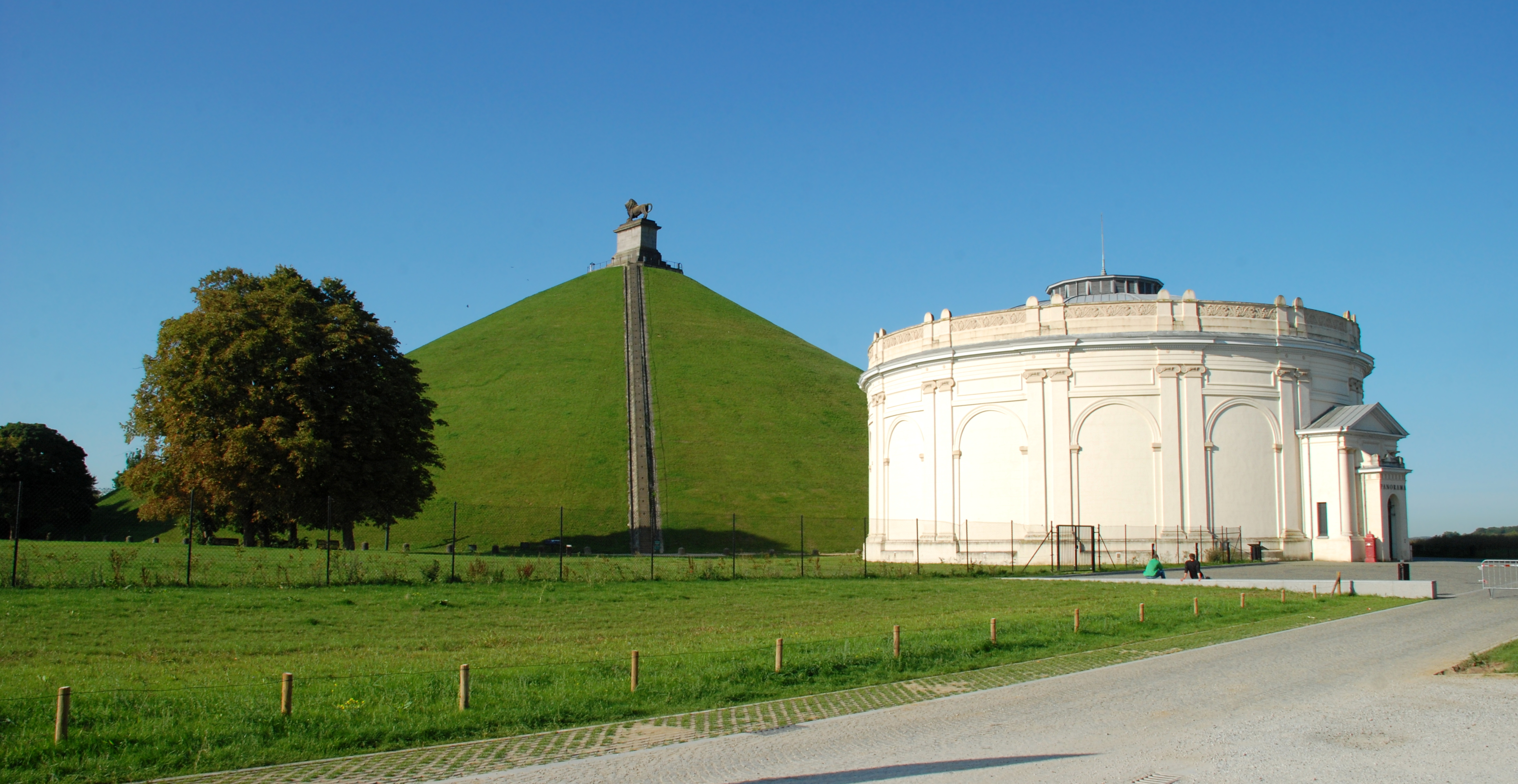
The Waterloo campaign played out in modern Belgium across roughly 70 km. Key sites: Charleroi (50.40 N, 4.44 E) where the French crossed the Sambre; Quatre Bras (50.58 N, 4.45 E); Ligny (50.52 N, 4.58 E); Wavre (50.72 N, 4.61 E); and the Waterloo battlefield itself near Braine-l'Alleud and Plancenoit (50.68 N, 4.41 E). The Lion's Mound at Waterloo is visible from cruise altitude as a conical man-made hill, 43 meters high, just south of Brussels (EBBR). The Pajottenland and Brabant Wallon below the approach lanes are gentle agricultural country - much as the armies marched across in June 1815.