Watts Riots
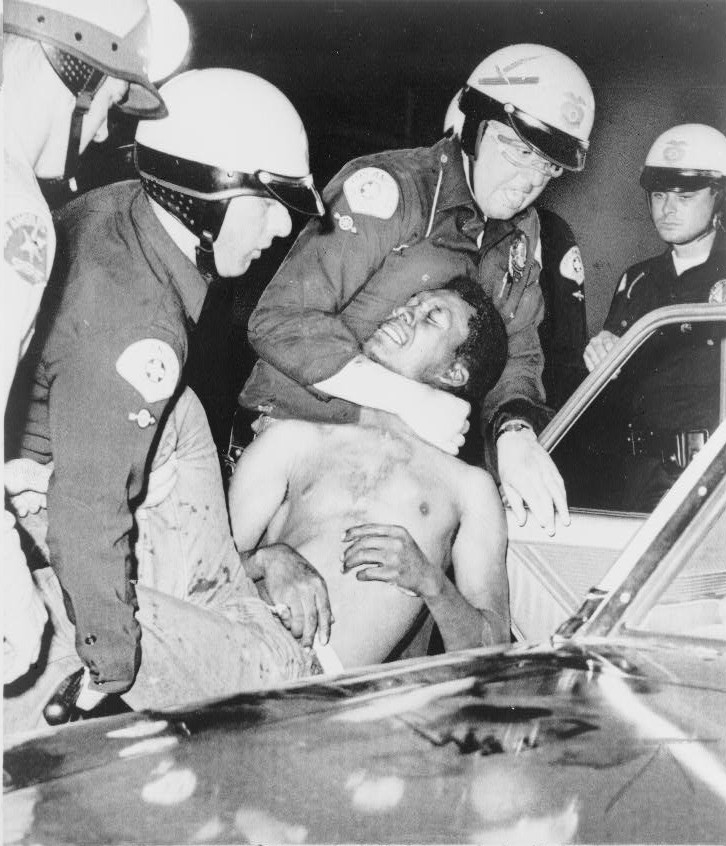
On August 11, 1965, a California Highway Patrol officer pulled over a 21-year-old Black man named Marquette Frye on Avalon Boulevard in the Watts neighborhood of Los Angeles. What followed was a routine traffic stop that became a physical confrontation, and a physical confrontation that, in the heat of an August evening, in a neighborhood where grievances had been accumulating for decades, became something else entirely. By the time it was over six days later, 34 people were dead, more than a thousand were injured, nearly 4,000 had been arrested, and over $40 million in property had been destroyed. Los Angeles had been trying to understand what happened ever since.
The Conditions That Made It Possible
The riot did not begin with Marquette Frye's traffic stop. It began in the 1940s, when Black workers and their families migrated to Los Angeles in the Second Great Migration and found a city that had constructed elaborate legal and informal systems to confine them to specific neighborhoods — principally South Central Los Angeles and Watts. Restrictive covenants prevented Black homebuyers from purchasing property in most of the city. Employment discrimination limited access to good-paying jobs in the defense and manufacturing industries that were transforming the LA economy.
The Los Angeles Police Department under Chief William Parker maintained these arrangements through aggressive policing of Black neighborhoods. Parker's department had a national reputation for professionalism that obscured its deeply racialized approach to law enforcement. Black residents of Watts experienced routine harassment, excessive force, and the knowledge that the institutions of the city were not designed to protect them. The temperature in Watts on August 11, 1965, was about 92 degrees. The accumulated temperature of two decades of exclusion was something no thermometer could measure.
Six Days
Marquette Frye failed a field sobriety test and was being arrested when the confrontation with the growing crowd of onlookers escalated. An officer struck Frye with a baton. Frye's mother, Rena, arrived and was also arrested. The crowd that had gathered interpreted what it was watching through the lens of everything that had come before — every earlier encounter with police, every indignity, every awareness of how the institutions of the city regarded them.
The violence that followed spread through Watts and its surrounding neighborhoods over six days. Buildings burned. Stores were looted — with particular attention paid to businesses that residents believed had exploited the community. The National Guard deployed 14,000 soldiers. The geographic extent of the unrest covered an area of 46 square miles. By the time it ended on August 16, the toll was 34 dead, more than 1,000 injured, approximately 3,500 arrested, and property damage that would, in today's values, be measured in hundreds of millions of dollars.
The McCone Commission
California Governor Pat Brown appointed a commission chaired by former CIA director John A. McCone to investigate the causes and recommend responses. The McCone Commission's report, published in December 1965, identified unemployment, poor housing, inadequate schools, and hostile policing as contributing factors. Its recommendations included job creation programs, improved transit connections to employment centers, and police reform.
The response to those recommendations was inadequate. Some federal investment in Watts followed, through Great Society programs, but the structural conditions the commission identified — segregation, discrimination, exclusion — were not fundamentally altered. Twenty-seven years later, when another police brutality incident sparked another uprising in Los Angeles, many observers noted that the conditions that had produced the Watts riots in 1965 remained largely in place.
Legacy and Memory
The Watts riots produced cultural as well as political responses. The Watts Writers Workshop emerged from the aftermath, nurturing writers who processed the uprising and its causes through literature. Budd Schulberg, who founded the workshop, worked with residents to create a space for creative expression in a community that the mainstream cultural institutions of Los Angeles had systematically excluded. The Watts Towers, Simon Rodia's extraordinary sculptural complex that had stood in the neighborhood for decades before the riots, became a symbol of the community's creative capacity in the face of neglect.
The community of Watts has never fully recovered from the economic destruction of those six days. White flight from surrounding suburbs accelerated after 1965. Investment that might have rebuilt the neighborhood did not materialize at the scale required. The history of what happened in August 1965 is remembered nationally as a turning point in the civil rights era — a moment when the northern and western migration that was supposed to escape southern racism revealed that racism had simply taken different institutional forms in the cities of the West.
From the Air
The Watts neighborhood is centered at approximately 33.938636 N, 118.238043 W, in South Los Angeles, roughly 10 miles south of downtown. The neighborhood sits within the broad southern plain of the LA basin, south of the Santa Monica Freeway (I-10) and north of the 105 freeway. Los Angeles International Airport (KLAX) lies approximately 7 miles to the west-southwest. The Watts Towers, Simon Rodia's sculptural landmark, are visible from low-altitude flights over the neighborhood.