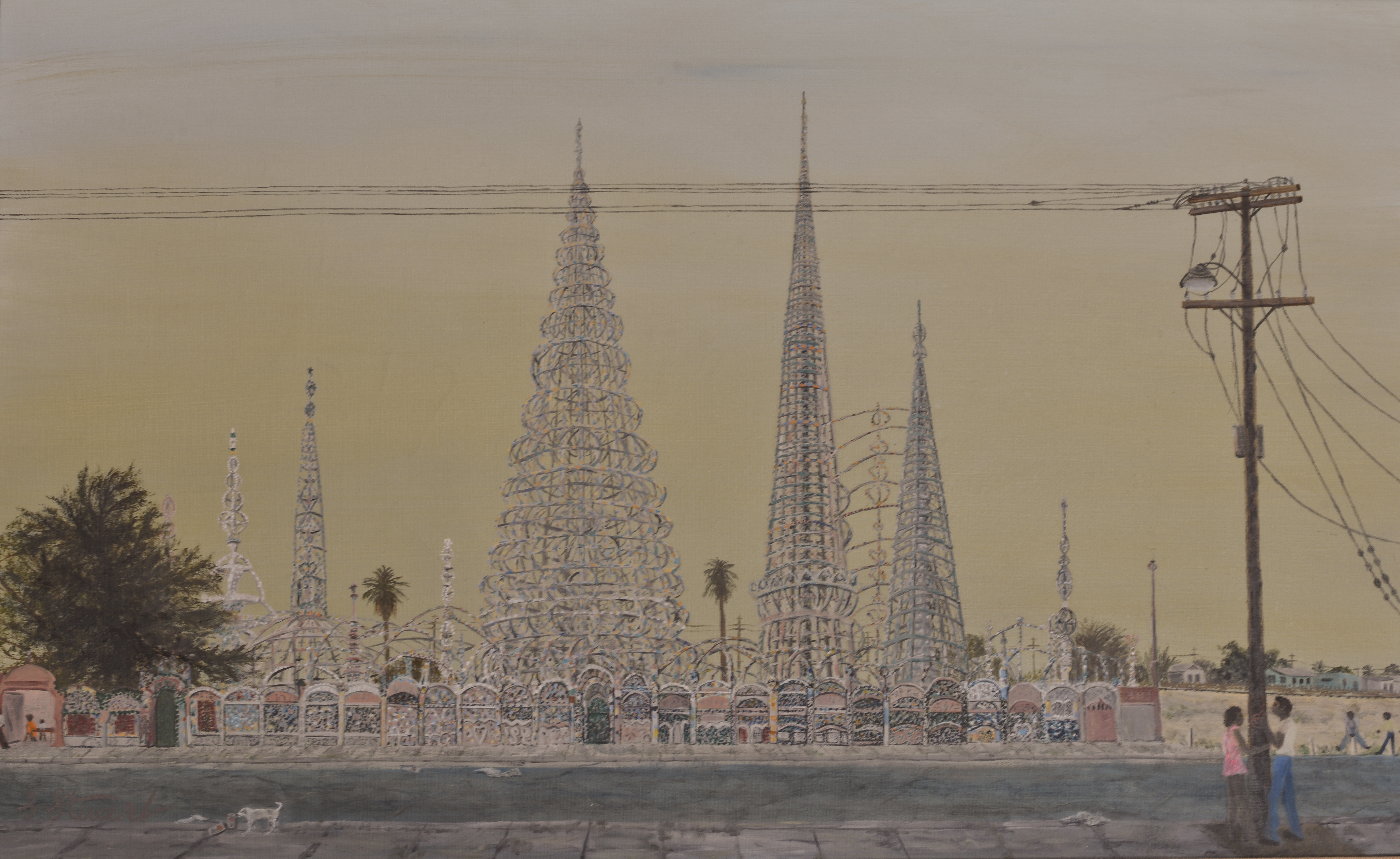
The Watts Towers
In Watts, a working-class neighborhood in South Los Angeles, 17 interconnected towers rise from a residential lot. The tallest reaches 99 feet. They're made of steel pipes, rebar, wire mesh, and mortar, covered with a mosaic of broken bottles, seashells, tiles, pottery, and mirror fragments. Sabato 'Sam' Rodia, an Italian immigrant construction worker, built them single-handedly between 1921 and 1954, using no power tools, no scaffolding, and no architectural plans. He called the project 'Nuestro Pueblo' - Our Town. When he finished, he gave the property away and moved to Northern California, never returning. The city tried to demolish the towers as a safety hazard; an engineering test proved they could withstand 10,000 pounds of force. They survived, were designated a National Historic Landmark, and stand today as one of the most remarkable achievements in outsider art - proof of what one obsessive person can build.
The Builder
Sabato Rodia was born in Italy around 1879 and immigrated to America as a teenager. He worked as a laborer, tile setter, and construction worker across the American West, moving frequently, married and divorced twice. In 1921, he bought a triangular lot in Watts and began building. He worked evenings and weekends for 33 years, climbing his towers on window-washer's scaffolding of his own design. He embedded objects in wet mortar: bottle bottoms, ceramic tiles, seashells, corn cobs, anything with interesting color or texture. He never explained his motives. When asked why, he said: 'I had in mind to do something big, and I did.' In 1954, at age 75, he stopped, gave the property to a neighbor, and left.
The Construction
Rodia worked without blueprints, power tools, or scaffolding. He bent steel rebar and pipe by hand, embedding them in concrete footings, building upward intuitively. He wrapped the structures in wire mesh, covered them in mortar, and pressed decorative elements into the surface while the mortar was wet. The structural system is a series of interconnected arches and towers, remarkably strong despite appearing improvised. The tallest tower reaches 99.5 feet. The decorations include over 25,000 seashells, thousands of pieces of broken pottery (some from local kilns, some from garbage), and colored bottle glass that catches the Los Angeles light. The entire complex covers less than a third of an acre.
The Rescue
In 1959, the City of Los Angeles ordered the Watts Towers demolished as a safety hazard. A group of artists and architects fought back, demanding an engineering test. In October 1959, a crane applied 10,000 pounds of lateral force to the tallest tower. The tower held; the crane's cable snapped. The towers were saved. They were designated a Los Angeles Historic-Cultural Monument, then a National Historic Landmark, then a California Historical Landmark. An arts center was built next door. The towers became a symbol of community resilience, especially after the 1965 Watts riots, when they survived unscathed amid burned buildings.
The Art
The Watts Towers belong to no artistic movement, which is part of their importance. Rodia had no formal art training and no apparent interest in the art world. He created from compulsion, from vision, from something he couldn't explain. Art historians classify the towers as 'outsider art' or 'folk art,' but these categories seem inadequate for something so monumental and intentional. The towers reference no obvious source; they're sui generis, entirely Rodia's invention. Their influence on later artists is substantial - Simon Rodia (his American name) proved that one determined person could create something extraordinary with discarded materials and stubborn will.
Visiting Watts Towers
The Watts Towers are located at 1727 East 107th Street in Watts, Los Angeles. The towers are visible from the street, but tours of the site require tickets, available at the adjacent Watts Towers Arts Center. Tours operate Thursday through Saturday; reservations are recommended. The arts center hosts exhibitions, classes, and the annual Watts Towers Day of the Drum and Jazz Festival. The surrounding Watts neighborhood is residential and working-class; visitors should exercise normal urban caution. The Blue Line Metro station at 103rd Street is a short walk away. LAX is 15 miles west. The towers are best photographed in late afternoon when the sun illuminates the embedded glass and tiles.
From the Air
Located at 33.94°N, 118.24°W in Watts, South Los Angeles. From altitude, the Watts Towers are barely visible - slender spires in a residential neighborhood, dwarfed by surrounding urban development. The site is just east of the Alameda Corridor railroad. Downtown Los Angeles is 10 miles north. LAX is 15 miles west. The terrain is flat Los Angeles basin - grid streets, low-rise buildings, the concrete channel of the Los Angeles River. The towers' significance is invisible from above; they must be experienced from ground level to be understood.