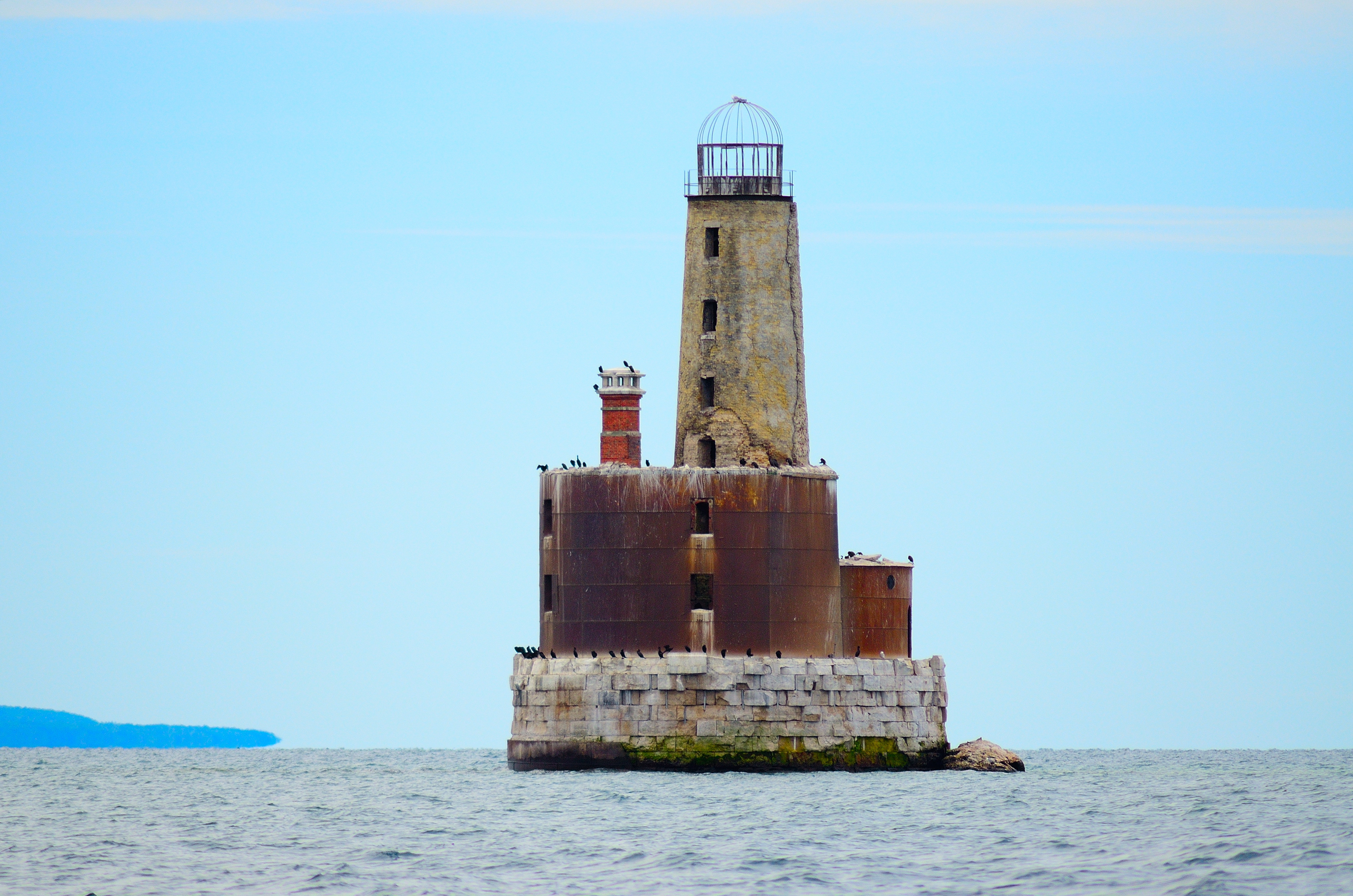
Waugoshance Light
In October 1871, as the Great Chicago Fire consumed city blocks and the Peshtigo Fire incinerated entire towns across Wisconsin, an impenetrable curtain of smoke rolled across Lake Michigan. At the Waugoshance shoal -- one of the most dangerous shallow stretches in the Straits of Mackinac -- lighthouse keepers rang their fog bells for days without rest, desperately trying to warn ships groping blind through the haze. Many vessels were lost anyway. That scene captures everything about Waugoshance Light: a lonely outpost at the edge of navigable water, staffed by people whose courage could not always overcome the indifference of the lake.
Where Ships Learned to Turn
The waters around Waugoshance Point, in Emmet County at the northern tip of Lake Michigan, are treacherous by design. The lakebed here extends outward in a broad, shallow projection that boats large enough to weather storms cannot cross safely. During the second half of the nineteenth century, this shoal marked the critical turning point for every vessel navigating the Straits of Mackinac or traveling Lake Michigan's eastern shore between the mainland and the Beaver Islands. With depths sometimes less than a few feet, the passage demanded a warning. In 1832, the answer came in the form of the Lois McLain, a wooden lightship -- the first lightvessel stationed anywhere on the Great Lakes. For nearly two decades, that fragile vessel held the line. But a permanent structure was clearly needed.
Cream City Brick and Boilerplate
The Waugoshance Light that replaced the lightship in 1851 was built to endure. Constructed from Cream City brick -- the distinctive pale yellow brick of Milwaukee -- the tower rose from the shoal waters and operated continuously for over sixty years. But Lake Michigan is unforgiving. Waves, ice, and wind eroded the brickwork relentlessly, and the lighthouse eventually required encasement in steel boilerplate, a protective shell similar to what was applied at Big Sable Point Light further south. From 1851 to its deactivation in 1912, Waugoshance guided thousands of ships through some of the most perilous waters on the Great Lakes. After 1912, modern shipping shifted to the deeper Gray's Reef passage to the west, and Waugoshance was bypassed. The light went dark, and the structure became federal property with no active purpose.
Target Practice
Abandonment was only the beginning of Waugoshance's decline. During World War II, the U.S. Navy found a use for the derelict lighthouse: bombing practice. Explosions and fire destroyed the keeper's house and burned away all the wood framing inside the tower. What survived was a metal shell, and even that began falling away. By the late twentieth century, Waugoshance stood as a skeletal ruin in open water, its walls punched through, its structure listing. Erosion continued its slow work from below while weather attacked from above. The lighthouse earned a place on the Lighthouse Digest "Doomsday List" -- one of only five endangered Michigan lighthouses, alongside Fourteen Mile Point Light, Gull Rock Light, Manitou Island Light, and Poverty Island Light.
A Thirty-Year Fight, Lost
In 2000, Chris West founded the Waugoshance Lighthouse Preservation Society with the goal of stabilizing and restoring the structure. The Society purchased the lighthouse from the Coast Guard, secured an extended lease, and performed intermittent repairs over two decades. But Lake Michigan had other plans. Rising water levels during 2019 and 2020 accelerated the deterioration dramatically. Engineers estimated that stabilizing the foundation alone would cost $300,000 -- a sum the small nonprofit could not raise. In January 2021, the Society announced its dissolution via Facebook, stating that long-term preservation costs were simply prohibitive. Remaining funds were donated to local organizations with similar missions, and the lighthouse was returned to the Coast Guard. The Society's members reformed as an admiration society and petitioned to remove and preserve the distinctive birdcage lantern cap. That request was denied.
Watching It Disappear
Today, Waugoshance Light stands as both a monument and a warning. Located roughly west of Mackinaw City near Wilderness State Park, it is accessible only by boat -- or from the air, where its isolation becomes starkly apparent. The crumbling tower rises from shallow water with nothing around it but open lake and sky. Each passing season chips away more of the structure. The lighthouse that once guided ships through smoke and fog, that withstood decades of Great Lakes winters, that survived even Navy bombers, is finally yielding to the one force it cannot outlast: time. Whether it will still be standing in another decade is an open question, making any visit -- or flyover -- a chance to witness a piece of Great Lakes history in its final chapter.
From the Air
Waugoshance Light sits at approximately 45.7861N, -85.0911W on an exposed shoal west of Mackinaw City at the northern tip of Lake Michigan's lower peninsula. Best viewed from 1,500-2,500 feet AGL, the ruined tower is visible as a solitary structure surrounded by shallow water with no land nearby. The Mackinac Bridge provides an unmistakable reference point to the east. Nearby airports include Pellston Regional Airport (KPLN) about 15 nm southeast and Mackinac Island Airport (KMCD) roughly 12 nm east. Wilderness State Park shoreline lies to the south. Conditions can deteriorate quickly in the Straits -- fog and wind are common, particularly in spring and fall.