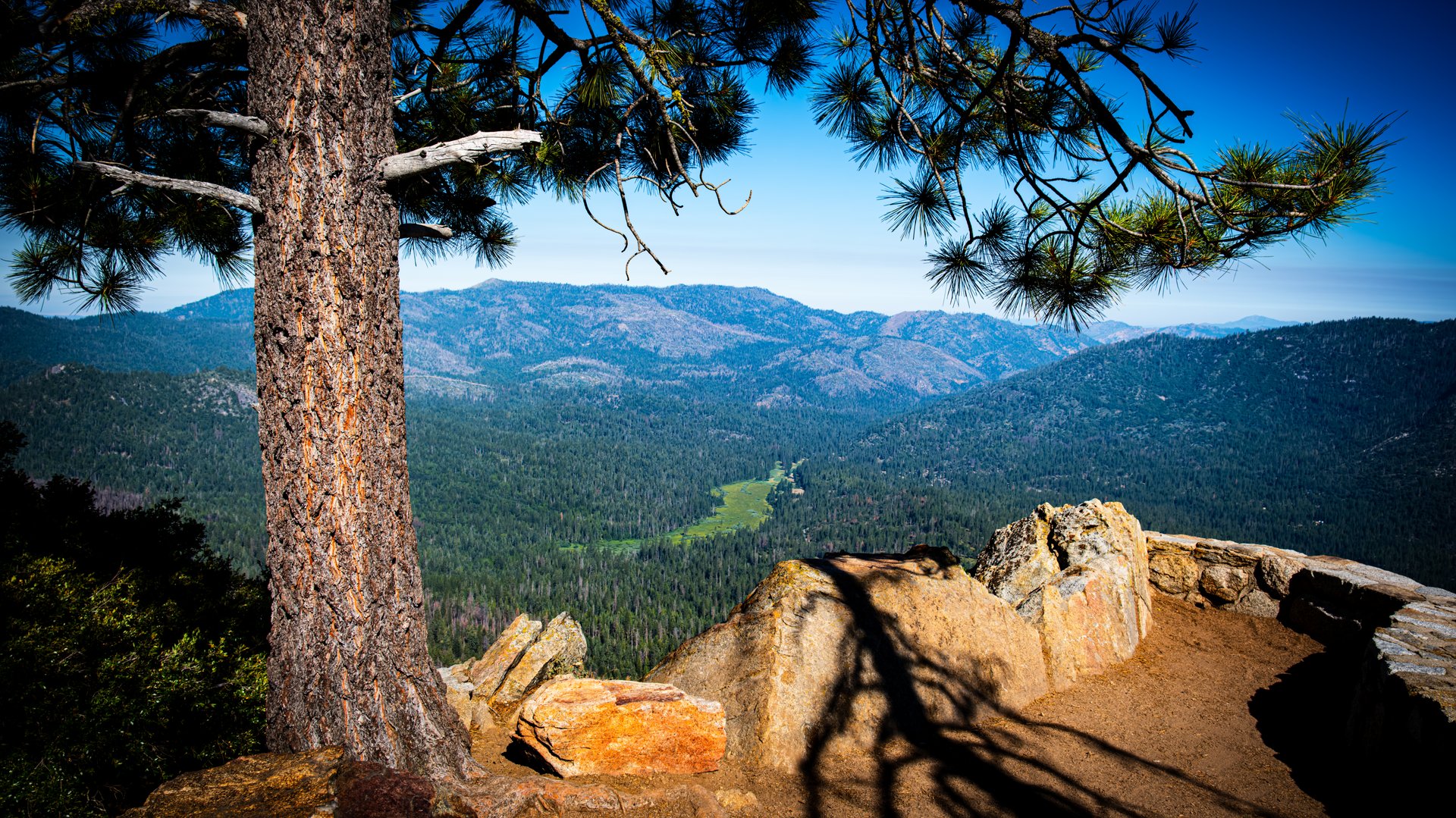
Wawona
Jean Bruce Washburn renamed the town in 1884, believing "Wawona" meant "Big Tree" in the local indigenous language. She was wrong. The word is Miwok for evening primrose, the wildflower that blooms pale yellow in Sierra meadows at dusk. It is a fitting error for a place that has always been more complicated than outsiders assume. Wawona sits at about 4,000 feet in the southern end of Yosemite National Park, a community so small that the 2020 census counted just 111 residents. Yet this handful of meadows along the South Fork of the Merced River has been a crossroads for millennia, first for the Southern Miwok people, then for gold-rush travelers, stagecoach tourists, cavalry troops, and eventually the millions who pass through on their way to Yosemite Valley.
The Guardian's Gamble
The Miwok knew this place as Pallachun, meaning a good place to stay. Galen Clark agreed. He arrived in the 1850s, a man in his mid-forties who believed tuberculosis would soon kill him. He built a simple homestead along the South Fork, hoping the mountain air might buy him a little time. It bought him half a century. Clark discovered the Mariposa Grove of Giant Sequoias in 1857 with Milton Mann and immediately began campaigning for their protection. When Abraham Lincoln signed the Yosemite Grant in 1864, creating the first instance of the federal government setting aside land for public preservation, Clark was appointed its guardian. His way station at Wawona became the primary stopover for visitors making the arduous journey into Yosemite Valley by horseback and stagecoach. Clark lived to ninety-six, long enough to see the place he had found as wilderness become one of America's most famous landscapes.
The Washburn Empire
In 1874, Clark sold his property to three brothers from Vermont: Henry, Edward, and John Washburn. They transformed his modest homestead into something grander. The Washburns built the 23-mile Wawona Road from Wawona into Yosemite Valley, completed in just four months with the labor of Chinese immigrants. In 1876, they erected Long White, a guest house that became the nucleus of the Wawona Hotel. The hotel opened formally in 1879 and hosted former President Ulysses S. Grant later that same year. The Washburns covered Clark's open bridge in 1879, built a general store, and ran a stagecoach operation that made Wawona the gateway to the park. Their enterprise thrived for decades until 1932, when the federal government purchased 2,665 acres of Washburn land for $150,000, folding Wawona into the expanding national park.
A Hotel That Outlasted Its Name
The Wawona Hotel still stands, a Victorian-era complex of white clapboard buildings with broad verandas and a nine-hole golf course that feels transplanted from New England. Designated a National Historic Landmark in 1987, it is one of the largest intact Victorian mountain resorts within any national park. Its history has not been entirely smooth. In 2016, a dispute between the federal government and outgoing concessionaire Delaware North over trademark rights forced a temporary renaming to Big Trees Lodge. The hotel regained its historic name in 2019 after a settlement. Through it all, the hotel has kept its unhurried character: no televisions in the rooms, a Saturday-night piano player in the parlor, and a dining room where the pace of service matches the pace of the surrounding meadows.
Small Town, Deep Roots
Modern Wawona is barely a town. Its 111 residents make it one of the smallest census-designated places in California. There is no gas station, no grocery store, no cell service to speak of. What there is: the covered bridge and Pioneer Yosemite History Center, where relocated historic buildings form an open-air museum of the park's pioneer era. Chilnualna Falls, a strenuous hike that climbs over 2,000 feet through granite and mist. The Wawona Meadow, where the Miwok once gathered and deer still graze at dawn. And the tunnel tree, or what remains of it. The Wawona Tunnel Tree, a giant sequoia with a passage carved through its base in 1881, was one of the park's most photographed attractions until it toppled under heavy snow in 1969. Its fallen trunk still lies in the Mariposa Grove, a reminder that even the biggest things in Yosemite are not permanent.
From the Air
Located at 37.537°N, 119.656°W in the southern portion of Yosemite National Park, at approximately 4,000 feet elevation. From altitude, Wawona appears as a bright green meadow along the South Fork of the Merced River, with the white Victorian buildings of the Wawona Hotel visible against the surrounding dark forest. Highway 41 passes through the area, connecting Fresno to Yosemite Valley. The Mariposa Grove of Giant Sequoias is about 4 miles south near the park's South Entrance. Fresno Yosemite International (KFAT) is roughly 60 miles southwest; Mariposa-Yosemite (KMPI) is about 30 miles west.