Walk In and Help Yourselves
When Galen Clark was away from his homestead, he left the door unlocked with a handwritten sign: "Walk in and help yourselves, but please close and fasten the door." This was the 1850s, the Sierra Nevada, and there was no other place to sleep for twenty-five miles in any direction. Clark's Station, as it came to be known, occupied the midpoint between the town of Mariposa and Yosemite Valley -- a geographical accident that made his modest cabin the only option for anyone heading into the mountains. He charged nothing, or close to it, and went broke in the process. What he built, though, outlasted his finances. The Wawona Hotel stands today as the largest surviving Victorian-era hotel complex inside any United States national park, a National Historic Landmark since 1987, its wraparound porches still overlooking the same forested hillside where Clark once welcomed strangers for free.
Debt, Stagecoaches, and the Washburn Transformation
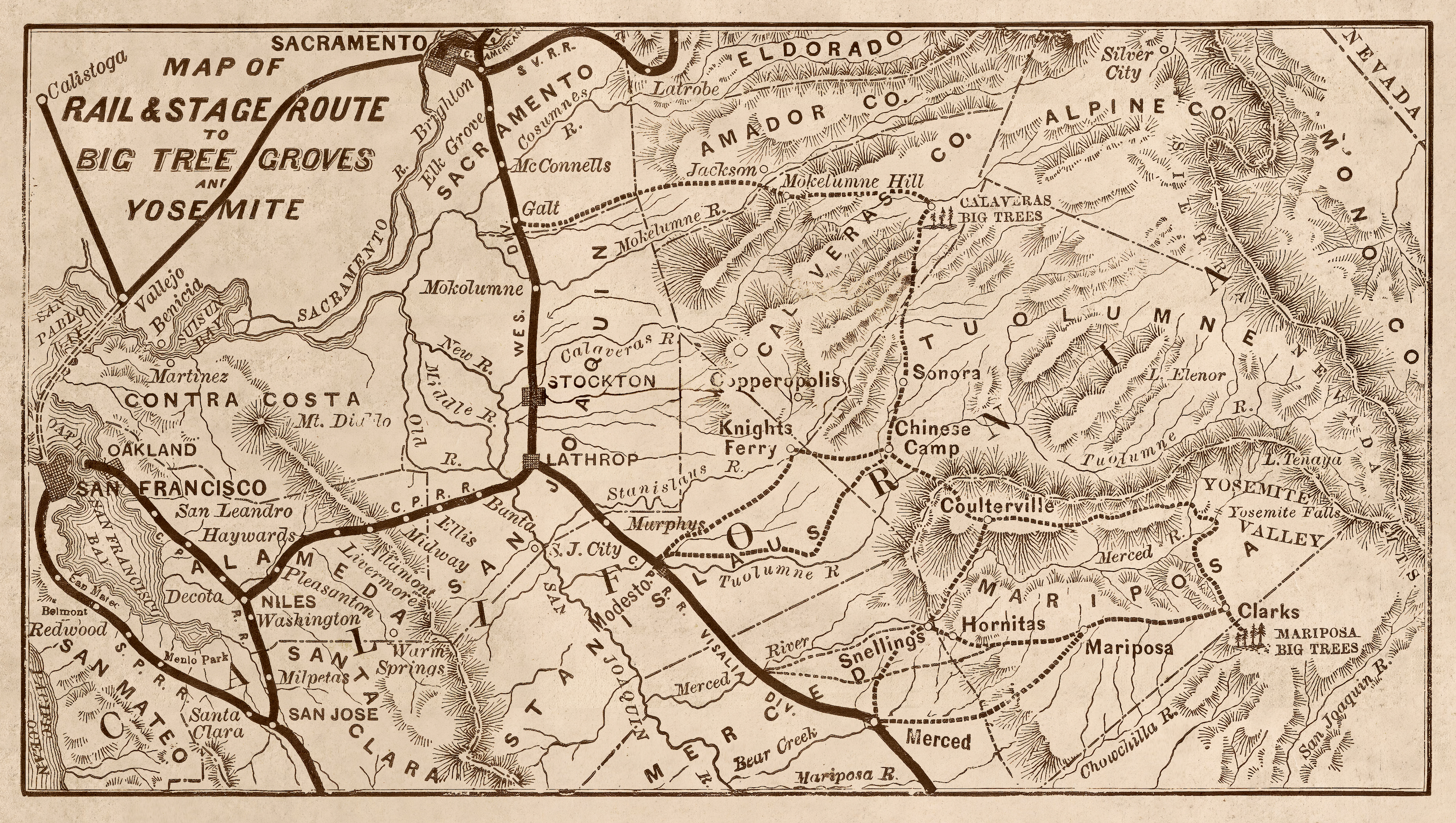
Clark's generosity was sincere but unsustainable. By 1874, escalating costs and accumulated debt forced him to sell the station and his unfinished road to the Washburn brothers, who operated the Yosemite Stage and Turnpike Company -- a stagecoach line linking Yosemite's destinations to the San Joaquin Valley. The Washburns completed the wagon road to Yosemite Valley by April 18, 1875, and immediately began expanding. By 1876, they had added the Clark Cottage and the Long White building, transforming a rustic waypoint into something approaching a resort. Stagecoaches departed daily, carrying up to eight passengers on three bench seats, with lunch stops at Galen Clark's old cabin near the Mariposa Grove. Because no town existed for miles, the hotel had to be its own small civilization. A post office opened around 1886. Telephones arrived in 1905. Electricity followed in 1908. The Wawona Hotel was less a business than a settlement.
The Painter in the Studio
Thomas Hill was already famous when he arrived. A landscape painter associated with the Hudson River School, Hill established a studio at the Wawona Hotel in the early 1880s, completed by January 1884. For hotel guests, the studio became a destination within a destination -- a chance to watch an artist translate Yosemite's granite and light into oil on canvas. Hill's paintings of the valley and the grove circulated widely, shaping how Americans imagined the Sierra Nevada before photography made the journey unnecessary. His presence elevated the hotel from a comfortable stopover to a cultural institution. The studio still stands, part of the complex that earned the hotel its National Historic Landmark designation. Art and hospitality have coexisted here for over a century.
Automobiles, Golf, and a Mountain Reinvented
When automobiles were legalized in Yosemite in 1913, the stagecoach era ended abruptly. Clarence Washburn, who took over the family business after his father John's death in 1917, understood the shift. He modernized the hotel with amenities that matched the expectations of motorists who could now arrive in hours rather than days: tennis courts, croquet lawns, fountains, and a swimming tank, all added by 1917. His most audacious move was commissioning a mountain golf course at Wawona Meadow, designed by professional golfer Walter Fovargue -- the first of its kind in California. The course turned the hotel into a destination for a new class of visitor, one who expected recreation alongside scenery. Clarence managed the hotel through the 1934 season, guiding it through the transition from frontier hospitality to resort leisure.
Evening Primrose and a Name Restored
The name Wawona carries a quiet correction. For years, it was popularly believed to derive from a Miwok word meaning "big tree" or imitating an owl's hoot. Linguistic research revealed something more delicate: "Wawona" translates to evening primrose in the Miwok language. The hotel's name, in other words, honors a wildflower rather than a giant. The hotel itself has weathered its own identity crisis. In 2016, a legal dispute between the federal government, incoming concessionaire Aramark, and outgoing operator Delaware North -- which claimed trademark rights to several Yosemite place names -- forced the hotel to temporarily shed its historic name. On July 15, 2019, a settlement restored it. The seven buildings that compose the complex still stand on their forested hillside, oriented to the cardinal directions, their architecture blending Greek Revival, Stick-Style, and Eastlake influences with an integrity that is rare in structures built over four decades.
The Guest Register
Three presidents have slept at the Wawona Hotel. Ulysses S. Grant visited during the era when reaching Yosemite required genuine commitment. Rutherford B. Hayes came when the stagecoach was still the only option. Theodore Roosevelt, whose 1903 camping trip with John Muir in Yosemite helped catalyze the national conservation movement, knew the property as well. In later decades, actors Robert Redford and Brad Pitt added Hollywood to the register. But the hotel's character was set long before celebrity arrivals. It was set by Clark's open door, by the Washburns' daily stagecoaches, by Thomas Hill painting in his studio while guests watched. The largest Victorian hotel complex in any national park began as one man's instinct to leave the door open for strangers. That instinct, more than any architectural style, is what survives.
From the Air
Located at 37.54°N, 119.65°W in southern Yosemite National Park. The hotel complex is visible as a cluster of white buildings on a forested hillside north of Wawona Road (Highway 41), near the junction where the road turns toward the Mariposa Grove of giant sequoias. The Wawona Meadow and its historic golf course create an open clearing nearby. Best viewed below 3,000 feet AGL. Nearest airports: Mariposa-Yosemite (KMPI), approximately 25 nm west; Fresno Yosemite International (KFAT), about 60 nm south. Mountain terrain with variable winds; afternoon thermals common in summer.