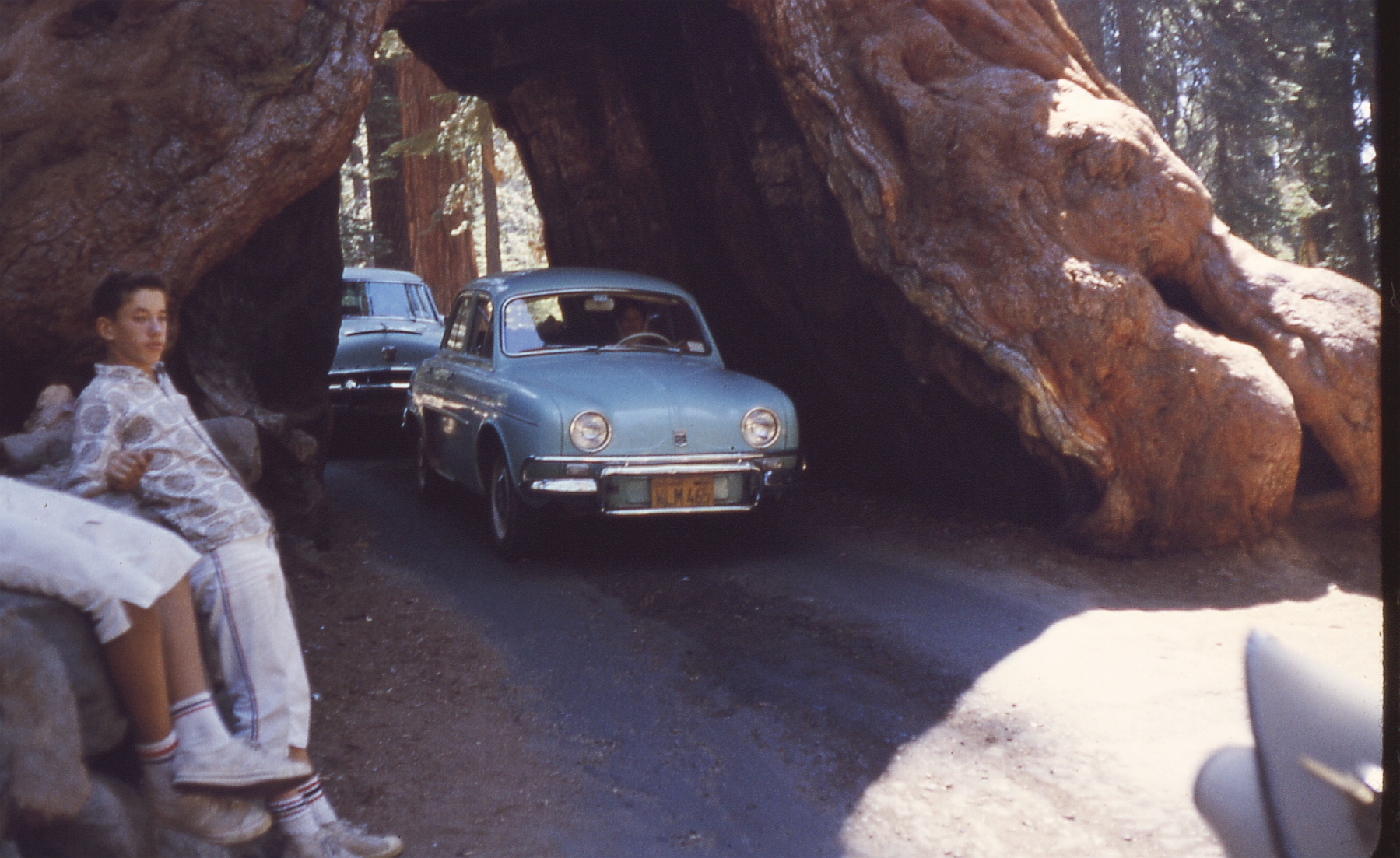
The Tunnel That Toppled a Giant
The Scribner brothers earned seventy-five dollars for the job. In 1881, they took their tools to a giant sequoia in the Mariposa Grove of Yosemite National Park and carved a tunnel through its base, widening a scar that fire had already burned into the heartwood. The tree was 227 feet tall and 26 feet in diameter. It had stood for perhaps two thousand years. The tunnel took considerably less time. Commissioned by the Yosemite Stage and Turnpike Company, the opening was sized for a stagecoach -- wide enough for horses and wheels, tall enough for passengers to pass through without ducking. The Wawona Tunnel Tree, as it came to be known, would spend the next eighty-eight years as one of the most photographed trees on Earth before collapsing under a heavy snowfall in February 1969.
The Business of Spectacle
The tunnel was never about the tree. It was about traffic. The Yosemite Stage and Turnpike Company needed tourists, and tourists needed reasons to make the long, uncomfortable stagecoach journey into the Sierra Nevada. A tree you could drive through was a reason. Visitors posed for photographs in the tunnel's mouth, standing or seated in carriages, dwarfed by the sequoia's bulk. The images circulated in newspapers and postcards, drawing more visitors, who posed for more photographs. By the time the National Park Service was established in 1916, the Wawona Tree was already famous. Stephen Mather, the agency's first director, recognized its value immediately. Mather and his chief aide, Horace Albright, were building a case to Congress that national parks deserved funding, and that case depended on visitation numbers. The tunnel tree delivered crowds.
See America First
Mather and Albright had already partnered with western railroads on the "See America First" campaign, pitching the parks as a patriotic alternative to European travel. When automobiles arrived in Yosemite -- legalized in the park in 1913 -- the strategy shifted from rails to roads. The Wawona Tunnel Tree adapted effortlessly. Where stagecoaches had once squeezed through, Model Ts now puttered, their drivers grinning for the camera. In the 1920s, the Park Service actively promoted automobile tourism. Roads and roadside attractions multiplied across Yellowstone, the Grand Canyon, and Yosemite. Albright argued in a 1931 letter that roads served accessibility: "those who are not as strong and agile as you and I, for they too are entitled to their inspiration and enjoyment." The scenic drive entered the national vocabulary, and the drive-through tree became its emblem. The Wawona Tree was no longer just a curiosity. It was policy.
A Logo, a Novel, and a Name
The tree's fame extended well beyond the park. Pacific Life adopted the Wawona Tree as its corporate symbol in the early 1900s, drawn to what the sequoia represented: endurance, strength, protection. In 1956, the company commissioned sculptor Spero Anargyros to carve a likeness of the tree in the lobby of its San Francisco headquarters. A replica appeared on Pacific Life's centenary medallion in 1968 -- one year before the tree fell. The sequoia may also have inspired the 1946 children's book Big Tree, by Mary and Conrad Buff, though the connection remains uncertain. As for the name itself, popular belief held that "Wawona" was a Miwok word for "big tree" or an imitation of an owl's call. Birds were considered spiritual guardians of the sequoias. The true etymology remains debated, but the word carries weight either way -- big tree or owl's cry, both fit a giant that spoke to anyone who stood beneath it.
February 1969
The tunnel had always weakened the tree. Removing that much heartwood compromised the structural integrity of the base, and the sequoia had developed a slight lean even before the Scribner brothers finished their work. The lean worsened over the decades. Snow accumulated on the branches -- giant sequoias hold enormous weight in their crowns -- and in February 1969, after a particularly heavy storm, the Wawona Tree fell. It did not snap or splinter dramatically. It simply tipped, slowly, and came to rest on the forest floor. The Fallen Tunnel Tree, as it is now called, still lies where it landed. Visitors walk through the tunnel that stagecoaches and automobiles once used, the opening now horizontal rather than vertical. Moss grows on the bark. Ferns colonize the gap where the road once passed.
The Last Tunnel Trees
The Wawona Tree was not the only sequoia carved for tourism. Throughout the late 1800s and early 1900s, tunnels were cut into big trees across California -- the Pioneer Cabin Tree in Calaveras Big Trees State Park, a dead tunnel tree in Tuolumne Grove, and others now forgotten. The practice inflicted severe damage on every tree it touched. The Pioneer Cabin Tree held on until 2017 before it, too, fell in a storm. The Tuolumne tree was already dead when tunneled. Every drive-through sequoia in California has either fallen or died. The Park Service stopped cutting tunnels long ago, recognizing what the Scribner brothers' seventy-five-dollar job made plain: a tree with a hole through its heart will eventually come down. The question was never whether, only when.
From the Air
Located at 37.51°N, 119.60°W within the Mariposa Grove area of southern Yosemite National Park. The grove sits at approximately 5,600 feet elevation on a south-facing slope, visible from the air as a cluster of exceptionally large tree crowns among the surrounding mixed conifer forest. The Fallen Tunnel Tree lies on the forest floor and is not visible from altitude. Look for the Mariposa Grove parking area and road terminus off Wawona Road (Highway 41). Nearest airports: Mariposa-Yosemite (KMPI), approximately 25 nm west; Fresno Yosemite International (KFAT), about 55 nm south. Terrain is mountainous with granite domes and ridges; afternoon thermals and gusty winds common in warmer months.