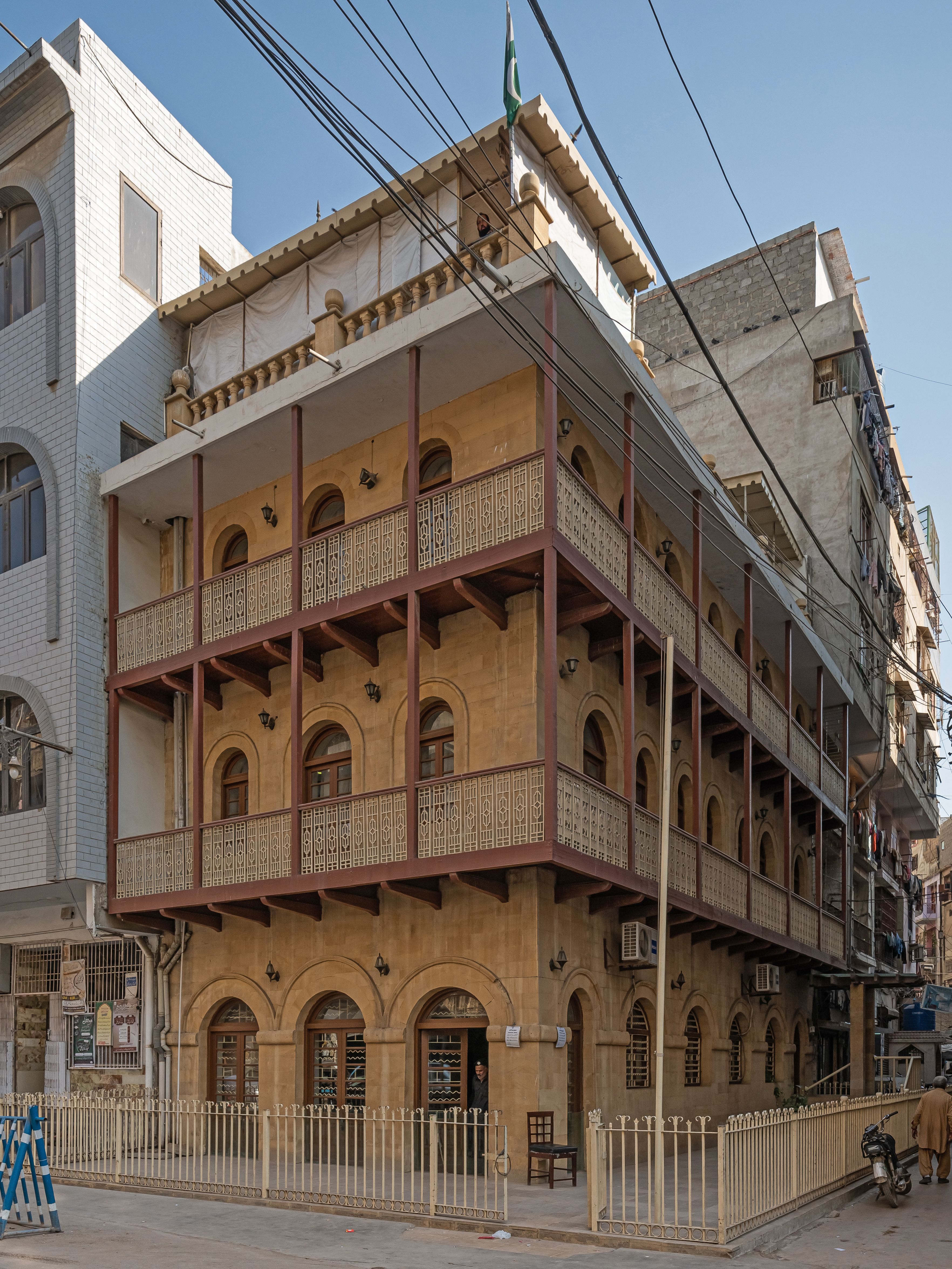
Wazir Mansion
For years, the wrong town got credit for birthing a nation's founder. Muhammad Ali Jinnah's birthplace was widely misidentified as Jhirk, a small town near Karachi, until his sister Fatima Jinnah set the record straight in her 1960s biography My Brother. The true location was a rented house in Karachi's Kharadar district, a building now known as Wazir Mansion. Jinnah's father, Jinnah Bhai Poonja, had come to Karachi from the family's ancestral village of Paneli in Gujarat's Gondal State, drawn by a business partnership with an English merchant company called Graham's Shipping and Trading Company. He rented the house in 1874. Two years later, his son was born.
A Gujarati Family in a Sindhi Port
The Jinnah family's roots lay far from Karachi. Paneli, their ancestral village, sat in the princely state of Gondal in the Kathiawar peninsula of Gujarat, in what is now western India. Jinnah Bhai Poonja was a merchant, and Karachi's growing port offered commercial opportunities that a small Gujarati village could not. The house he rented was not grand -- Kharadar was and remains one of Karachi's older, more densely packed neighborhoods, close to the harbor and the old city walls. By 1900, the elder Jinnah had returned to Gujarat. The house passed through other hands, eventually being purchased in 1904 by Wazir Ali Ponawala, whose name the building still carries.
The Mystery of the Birthplace
That Jinnah's birthplace could be misidentified for decades says something about the chaos of nation-building. After Partition in 1947, records were scattered, families were displaced, and the details of a leader's early life were less important than the urgent work of governing a new country. Fatima Jinnah's biography corrected the historical record, describing the family's journey from Paneli to Karachi and making clear that it was in this Kharadar house -- not in Jhirk -- where her brother first entered the world on 25 December 1876. The correction came quietly, in a book, rather than through any dramatic revelation.
A House Becomes a Shrine
Wazir Mansion is now officially the Quaid-e-Azam Birthplace Museum, though its physical modesty stands in contrast to the grand mausoleum of Mazar-e-Quaid where Jinnah is buried. The house sits in a neighborhood that has changed enormously since the 1870s but retains its character as one of Karachi's oldest quarters. Visitors come to see the rooms where the founder of Pakistan spent his earliest years, rooms that carry no architectural distinction but possess the weight of origin. Jinnah's later residences -- Quaid-e-Azam House in Karachi, South Court in Mumbai, the house in New Delhi that now serves as the Dutch Embassy, and the Quaid-e-Azam Residency in Ziarat where he died -- are larger and more imposing. But this is where it began: a rented room in a port city, a merchant's family, and a child who would redraw the map of South Asia.
From the Air
Located at 24.851N, 66.998E in the Kharadar district of Karachi South, one of the city's oldest neighborhoods near the harbor. The area's dense, narrow streets and low-rise buildings are characteristic of old Karachi. Nearest airport is Jinnah International Airport (OPKC). The harbor and Manora Island are visible to the south, marking the maritime landscape that drew Jinnah's father to this city.