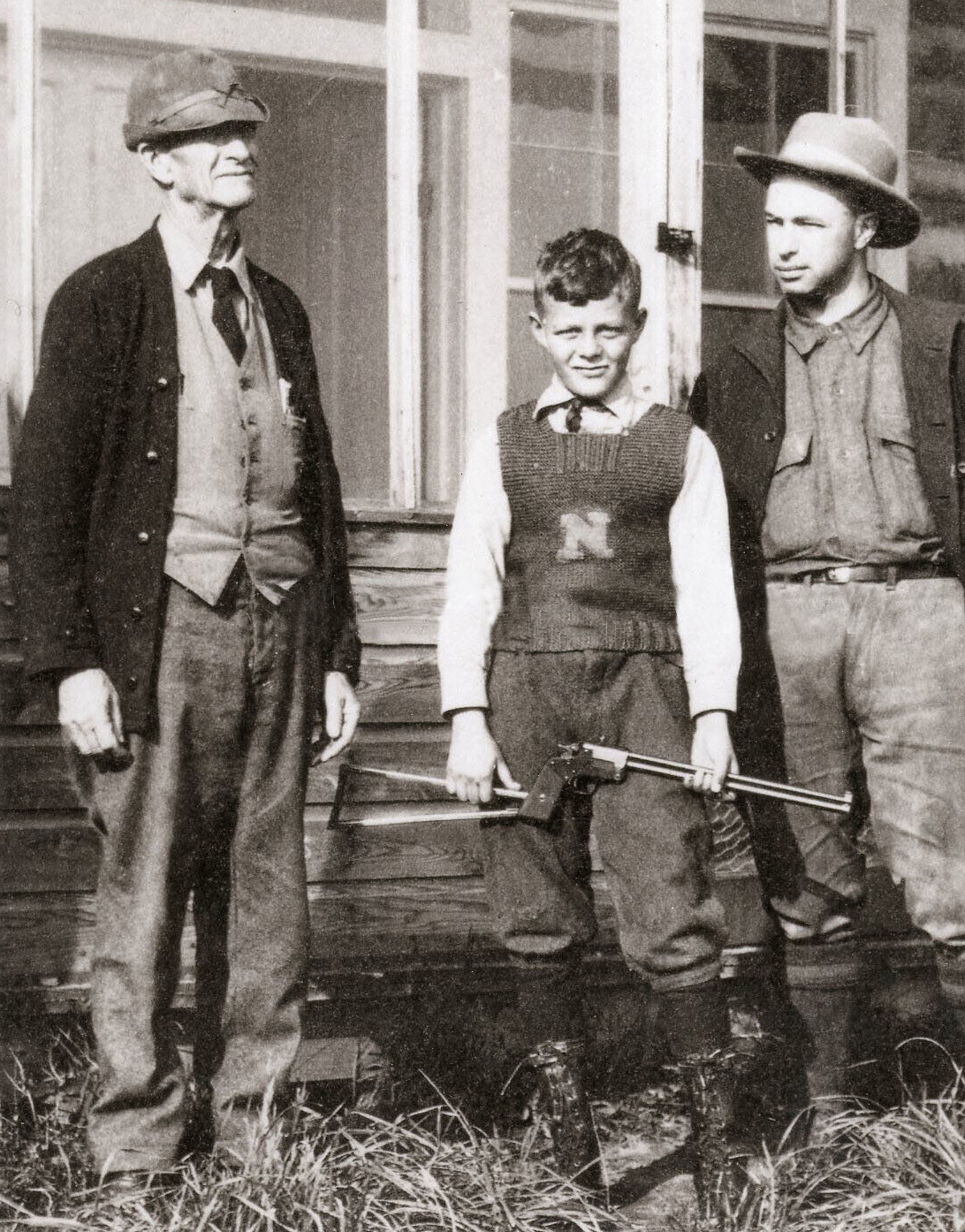
Webster Marble
After a long day of hauling fifty pounds of surveying gear through Michigan's white pine forests, the other timber cruisers would settle around the campfire to rest. Webster Marble would pull out his sketchbook. While his companions dozed, this small, wiry man drew designs for better tools -- lighter axes, waterproof compasses, match safes that would not let you down when you fell into a river. He had been doing this work since the 1870s, walking alone into the Upper Peninsula wilderness for months at a time, measuring timber stands for lumber companies in a region still viewed more as a resource deposit than a place to live. Two decades of that brutal, solitary labor gave Marble an intimate understanding of what a person actually needs in the woods, and from his garage in Gladstone, Michigan, he built a company that outfitted America's transition from surviving the outdoors to enjoying it.
Raised in the Woods
Webster Lansing Marble was born on March 23, 1854, in Milwaukee, Wisconsin, the third of six children. His father, Lansing Marble, was a trapper and basket maker who moved the family to Vassar, Michigan, in 1858 and then to Frankfort, Michigan, in 1868. The elder Marble ran a bushel basket business using proprietary machines that increased production from one basket per day to over a hundred, and he eventually sold the Milwaukee factory to devote more time to the outdoors. Webster grew up hunting, fishing, and trapping alongside his siblings in rural Michigan. Both his father's entrepreneurial instinct and his passion for the wild shaped the boy who would later merge those two impulses into a single career. Webster married Rosa M. Derry in Frankfort in 1878. They had two sons, William Lansing and Floyd Webster.
Twenty Years in the White Pines
For two decades, Marble worked as a timber cruiser and surveyor in Northern Michigan. Timber cruisers were the advance scouts of the logging industry -- they hiked alone into uncut forest, measured acreage and estimated lumber yields, and reported back to the companies. In the Upper Peninsula of the late 1800s, this was genuinely remote work in a landscape valued for its copper, iron, and timber, not its hospitality. Demand for wood had exploded after the Great Chicago Fire of 1871, keeping Marble employed for years. His fellow cruisers admired his uncanny ability to estimate usable lumber from a given stretch of forest just by looking at it. Every day he carried a heavy razor-sharp hatchet and over fifty pounds of equipment through dense woods. That daily reality -- the weight, the weather, the river crossings, the need for tools that worked when wet, cold, or battered -- became the laboratory for his inventions.
From Garage to Madison Square Garden
In the early 1890s, Marble created his first product -- the Marble Universal Gunsight -- from his garage in Gladstone, patenting it under the name Gladstone Manufacturing Company. The Financial Panic of 1893 delayed wider production for years, so he kept timber cruising to support his family while tinkering at odd hours. In 1898, he unveiled the Marble Safety Axe and renamed the company accordingly, expanding his workshop to 640 square feet. The real breakthrough came when Frank H. Van Cleve, the wealthy founder of Gladstone itself, became a partner. In 1899, Marble traveled to New York City to showcase his products at the national Sports Expo at Madison Square Garden. His timing was perfect. Americans were beginning to view the outdoors not as a place of work and danger but as a place of recreation and adventure. At the height of his marketing push, Marble distributed more than one million copies of Marble's Message monthly magazine, and his advertising had reached more than twenty million people by 1912.
Tools That Crossed Oceans
Over his lifetime, Marble registered patents for more than sixty inventions. The Marble Ideal knife, introduced in 1900, was the first hunting knife purpose-built for outdoor use -- sturdy enough for real work, customizable in handle, guard, sheath, and blade length from four to eight inches. His waterproof compass was the first to use a rotating compass card instead of just a needle, making it readable in any lighting, and small enough to pin to a jacket. The Marble Match Safe was born from personal experience: after falling into the Sturgeon River and soaking his matches, Marble built a waterproof container by nesting an empty 12-gauge shotgun shell inside a 10-gauge shell. The production version was a metal cylinder with a striking surface and watertight lid, first patented in 1900. These tools traveled far beyond Michigan. Teddy Roosevelt carried Marble knives, compasses, and matchboxes on his expeditions to Africa in 1909 and the Amazon in 1914. When Charles Lindbergh flew solo across the Atlantic on May 21, 1927, he kept his matches dry in a Marble Match Safe and wore a small Marble Compass pinned to his coat. Several of Lindbergh's Marble products are preserved by the Smithsonian.
Gladstone's Lasting Legacy
Marble Arms still operates in Gladstone today, manufacturing steel gunsights distributed across the United States, Canada, Australia, and Germany. The company's influence on the region runs deep -- two successful Delta County businesses, Bark River Knives and Rapid River Knifeworks, were founded by former Marble Arms employees. Webster Marble was inducted into the Sporting Goods Industry Hall of Fame in 1965, alongside the creator of Wilson Sporting Goods and the inventor of laminated skis. In 2019, the Webster Marble: Inventing the Outdoors Museum opened at the Delta County Multi-Use Complex at the U.P. State Fairgrounds in Escanaba, ten minutes from the factory. Its 4,000 square feet of exhibits -- safety axes, hunting knives, a Ford Model T touring vehicle, original marketing material -- represent the first permanent loan the Michigan History Center has ever made to another facility. Michigan declared November 15 "Webster L. Marble Day." In Gladstone and Escanaba, they celebrate the man who spent twenty years carrying too much weight through the woods and decided to do something about it.
From the Air
Webster Marble's legacy is centered in Gladstone, Michigan, at approximately 45.84N, 87.05W, on the western shore of Michigan's Upper Peninsula along Little Bay de Noc. The Marble Arms factory remains in operation in Gladstone. The Webster Marble Museum is located at the U.P. State Fairgrounds in nearby Escanaba, about 10 miles south. Delta County Airport (KESC) is located between the two towns. From the air, Gladstone sits at the head of Little Bay de Noc where it narrows northward, with Escanaba's harbor and Sand Point visible to the south along the shoreline. The terrain is flat and forested, typical of the Upper Peninsula landscape Marble spent decades surveying.