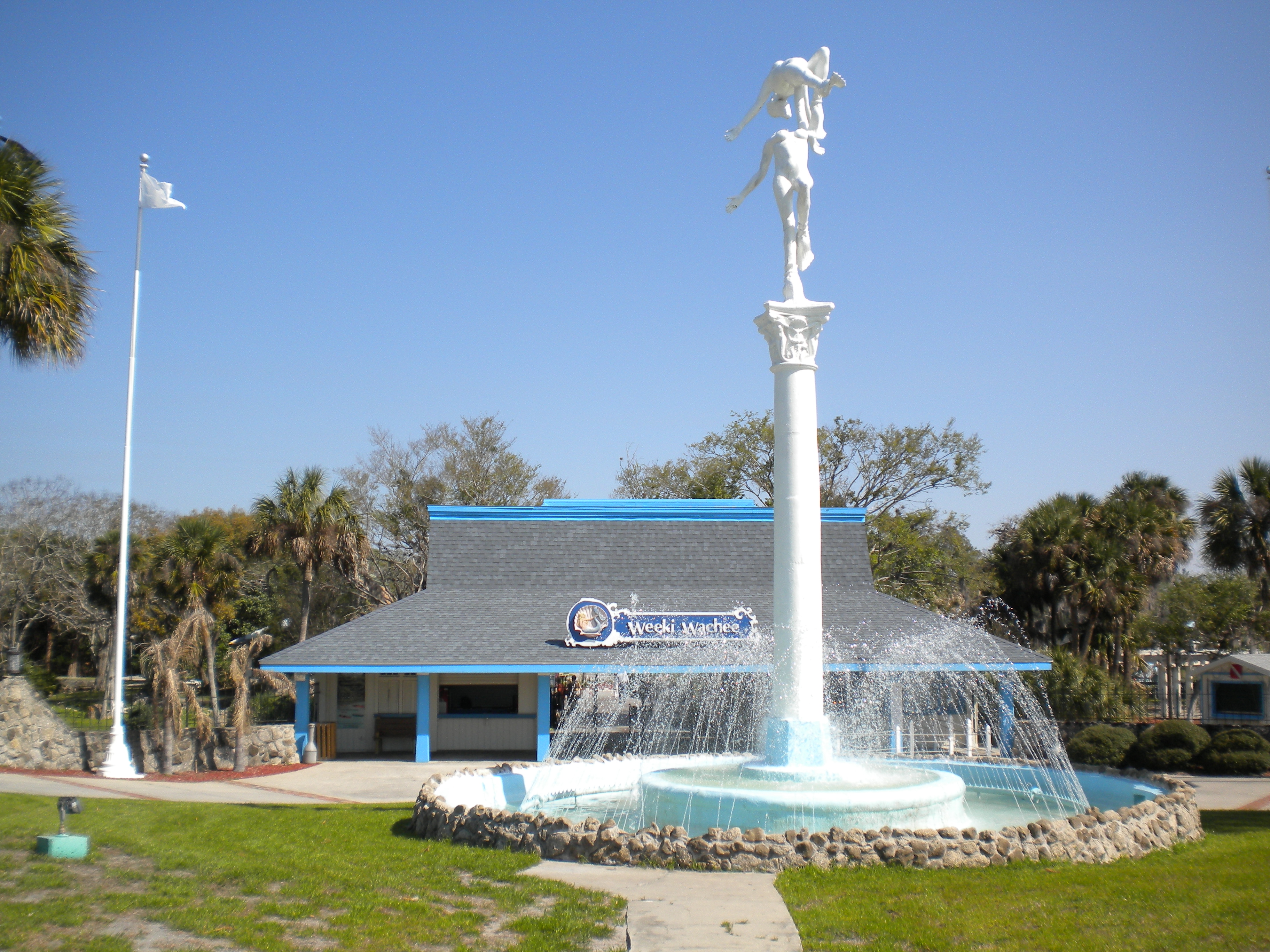
Weeki Wachee Springs
On October 13, 1947, a stunt swimmer named Newt Perry invited a handful of curious Floridians to peer through a glass window embedded in limestone and watch women breathe underwater. There were eighteen seats. The performers inhaled from air hoses hidden among the rocks, executing choreographed routines in the crystal-clear flow of a spring the Seminole people had named Weeki Wachee -- "Little Spring" or "Winding River" in their language. Nearly eight decades later, the mermaids are still performing, the spring still flows, and beneath it all lies a cave system that plunges 407 feet below the surface, the deepest known freshwater cave in the United States. Weeki Wachee Springs is that rare place where mid-century American spectacle and genuine natural wonder occupy the same piece of ground.
The Showman's Spring
Newt Perry was a competitive swimmer and stunt performer who understood that Florida's springs could be more than swimming holes. He pioneered the technique of breathing from submerged air hoses, which freed performers to stay underwater for entire shows without scuba gear. His first theater at Weeki Wachee was a crude affair -- eighteen seats wedged into the limestone beside an underwater viewing window. But the spectacle of women in fish-tail costumes gliding through impossibly clear water proved irresistible. A larger fifty-seat theater followed, cut deeper into the lime rock with bigger windows. By the 1960s, Weeki Wachee had become one of Florida's premier roadside attractions, drawing visitors off the highway with the promise of real live mermaids. On January 20, 1964, the park hosted the world's first underwater movie premiere when Warner Bros. screened The Incredible Mr. Limpet in the submerged theater.
Mermaids in the Modern Age
The mermaid shows survived the era of Disney and universal theme parks through sheer charm and stubborn persistence. In 1982, the park added Buccaneer Bay, a waterpark with water slides, a lazy river, and a white sand beach. On November 1, 2008, the state of Florida took over Weeki Wachee Springs as a state park, ensuring the mermaid tradition would continue. The park was listed on the National Register of Historic Places in 2020. Pop culture kept circling back: Kelly Clarkson's music video for "Stronger" featured the mermaids; Amy Seimetz's 2012 film Sun Don't Shine used the springs as a backdrop; and Netflix's 2023 documentary series MerPeople brought the story to a global audience. In 2006, comedian Thomas J. Kelly became the park's first male mermaid, his stint chronicled in a web series called The Little Merman. The performances remain largely unchanged from Perry's original vision -- no scuba tanks, no special effects, just human breath control and the spring's astonishing clarity.
Four Hundred Feet Down
The spring that makes the mermaid shows possible is far more than a scenic pool. In the summer of 2007, when discharge levels dropped low enough to allow cave access, the Karst Underwater Research team mounted a series of exploration dives into the system beneath Weeki Wachee. Over three months, from May 22 to August 30, divers pushed through approximately 6,700 feet of passage in multiple branches, decompressing for hours on the way back up. The average depth was 265 feet of fresh water; the deepest point reached 407 feet, establishing the Weeki Wachee cave system as the deepest known freshwater cave in the United States. The sheer volume of water rising from this depth is what gives the spring its legendary clarity -- cold, filtered through miles of limestone, emerging into sunlight so transparent that the mermaids seem to float in midair when viewed through the theater windows.
A Seminole Name, a Florida Legacy
The Seminole people who named this spring understood its nature better than the showmen who came later. Weeki Wachee -- Little Spring -- is almost an understatement for a system this deep and powerful, but the name captures the modest surface appearance: a pool of blue water in the Florida scrub, unremarkable until you look beneath it. The Weeki Wachee River carries the spring's outflow toward the Gulf of Mexico, winding through wetlands and coastal flats. The surrounding area of Hernando County has grown from rural crossroads to suburban sprawl, but the spring itself remains fixed, pumping clear water upward from the limestone as it has for millennia. That the same feature can support both mermaids in sequined tails and some of the most technically demanding cave dives on the continent captures something essential about Florida -- a state that has always insisted its natural wonders and its eccentricities are one and the same.
From the Air
Located at 28.52N, 82.57W in Hernando County on Florida's Nature Coast. The springs and Buccaneer Bay waterpark complex are visible from moderate altitude, with the Weeki Wachee River winding southwest toward the Gulf. Brooksville-Tampa Bay Regional Airport (KBKV) is approximately 10 miles to the east in Brooksville. Tampa International Airport (KTPA) is about 50 miles to the south. The Gulf coastline is visible to the west. US Route 19 runs past the park entrance. Best viewed at 1,500-3,000 feet AGL; the spring's turquoise water stands out against the surrounding vegetation.
Sources
- Weeki Wachee Springs
- Weeki Wachee Springs State Park - Florida State Parks
- History of Weeki Wachee Springs
- Florida Memory - Audience watching premiere of The Incredible Mr. Limpet at Weeki Wachee Springs
- Florida Department of State - Weeki Wachee Springs National Register Designation
- Wikipedia - Stronger (What Doesn't Kill You)