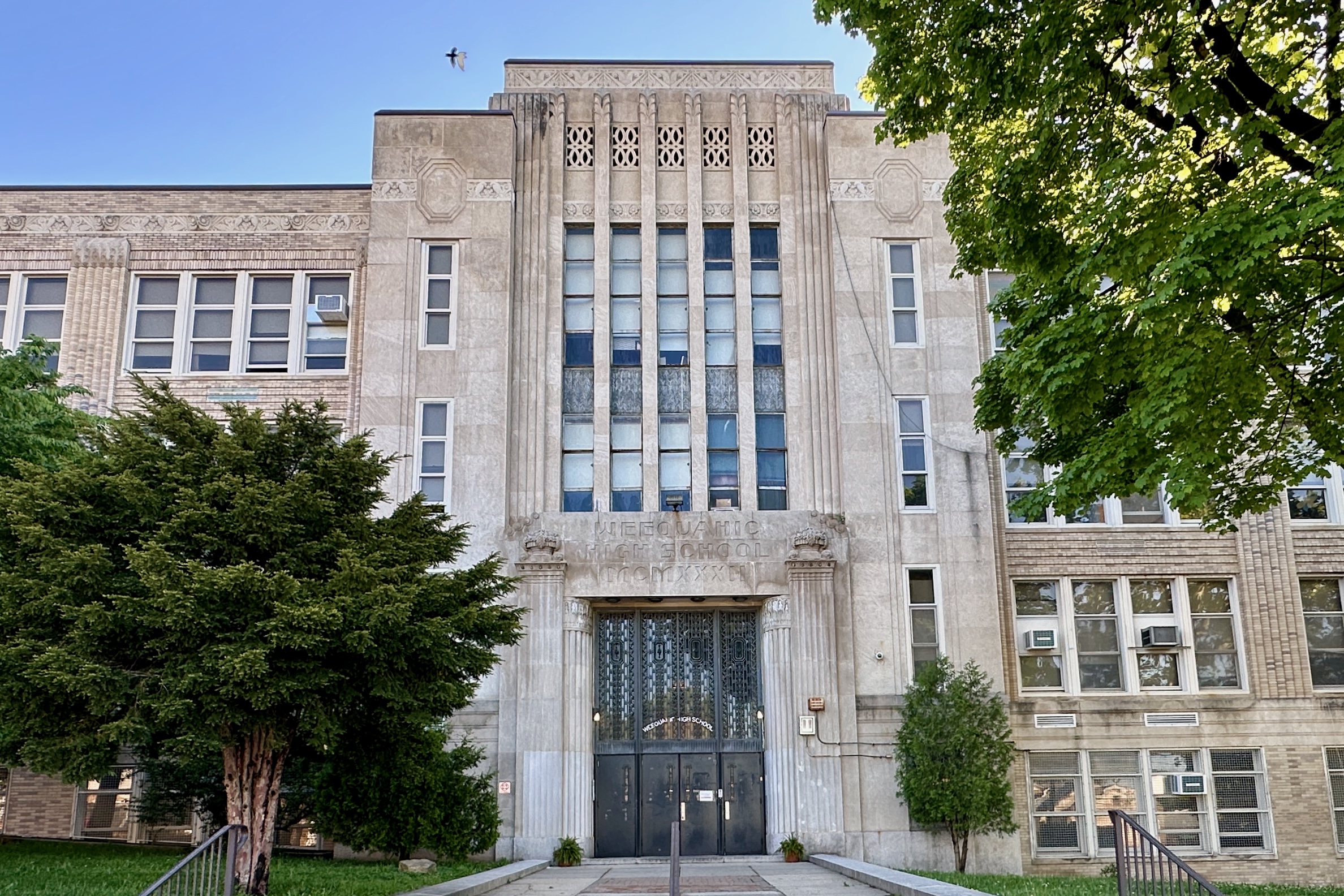
Weequahic High School
In 1967, twelve thousand people filled Atlantic City's Convention Hall to watch a high school basketball game. The Weequahic High School Indians finished that season 26-0, ranked number one in the country, their winning streak stretched to 40 games. It was the kind of moment that defines a school's identity for generations. But Weequahic's identity runs far deeper than any championship -- this Art Deco building on Chancellor Avenue in Newark's South Ward has produced an almost implausible concentration of talent across arts, law, science, activism, and sport since its doors first opened in 1933.
Depression-Era Foundations
Construction finished in 1932 and classes began the following September, with Max J. Herzberg as the first principal -- a post he would hold for 18 years. The building itself carries the optimism of its era and the scars of it. Inside the school hangs "Enlightenment of Man," a New Deal mural painted by Michael Lenson, who directed New Jersey's mural activities for the Works Progress Administration. The neighborhood surrounding the school, the Weequahic section of Newark, was then a thriving Jewish community -- a world that alumnus Philip Roth would later immortalize in novels like Portnoy's Complaint and The Plot Against America. The school was listed on the National Register of Historic Places in 2024, a recognition of both its architectural significance and its role in Newark's cultural history.
The Court and the Gridiron
Coach Lester Fein built a basketball dynasty in the 1960s that produced multiple NBA players. The 1962 team won the Group IV state title before 4,500 fans, finishing 24-3. A year later, a 25-1 season brought another Group IV championship. Then came 1967: a perfect 26-0 record, the national number-one ranking, and that record crowd of 12,000 at Convention Hall. Football found its own glory later. The 2006 team won Weequahic's first-ever sectional championship, the first for any Newark school since 1975, with coach Altariq White named state Coach of the Year. The Thanksgiving "Soul Bowl" rivalry against Malcolm X Shabazz High School, one of New Jersey's fiercest football matchups, was revived in 2009 after a 16-year hiatus.
An Unlikely Alumni Roll Call
The roster of Weequahic graduates reads less like a high school alumni list and more like a catalog of American achievement. Philip Roth, class of 1950, became one of America's most celebrated novelists. Allen Klein, also class of 1950, went on to manage the Beatles and the Rolling Stones. Reese Schonfeld, class of 1949, co-founded CNN and the Food Network. Barbara Kruger, class of 1963, became an internationally recognized conceptual artist. Muriel Fox, class of 1945, co-founded the National Organization for Women. Al Attles, class of 1955, played in the NBA and coached the Golden State Warriors for 13 years. Bo Porter, class of 1990, managed the Houston Astros. Victor Parsonnet, a cardiac surgeon, advanced pacemaker technology. Sandy Grossman directed the television broadcast of 10 Super Bowls. From one school in one Newark neighborhood, an extraordinary stream of influence flowed outward across American culture.
Weequahic Today
The neighborhood has changed profoundly since the predominantly Jewish community of Roth's youth. Today, with an enrollment of about 553 students, the school serves a different demographic but carries the same name, the same orange-and-brown colors, and the same sense of identity. The documentary Heart of Stone, screened at the Sundance Film Festival in 2009, captured principal Ron Stone's efforts to sustain the school's mission in a community facing deep economic challenges. The high school newspaper is still called The Calumet, the yearbook is still The Legend, and the alumni association still raises scholarship money. Weequahic has never been merely a building. It has been, for nearly a century, a place where Newark's ambitions take shape -- sometimes against long odds, sometimes to the roar of 12,000 strangers in a convention hall, and always with a sense that what happens inside these walls ripples outward in ways no one can predict.
From the Air
Weequahic High School is located at approximately 40.709N, 74.220W in Newark's South Ward, adjacent to Weequahic Park. From the air, look for the large Art Deco school building on Chancellor Avenue, with the park's 80-acre lake visible immediately to the south. Newark Liberty International Airport (KEWR) is roughly 2 miles east. Recommended viewing altitude: 2,000-3,000 feet AGL.