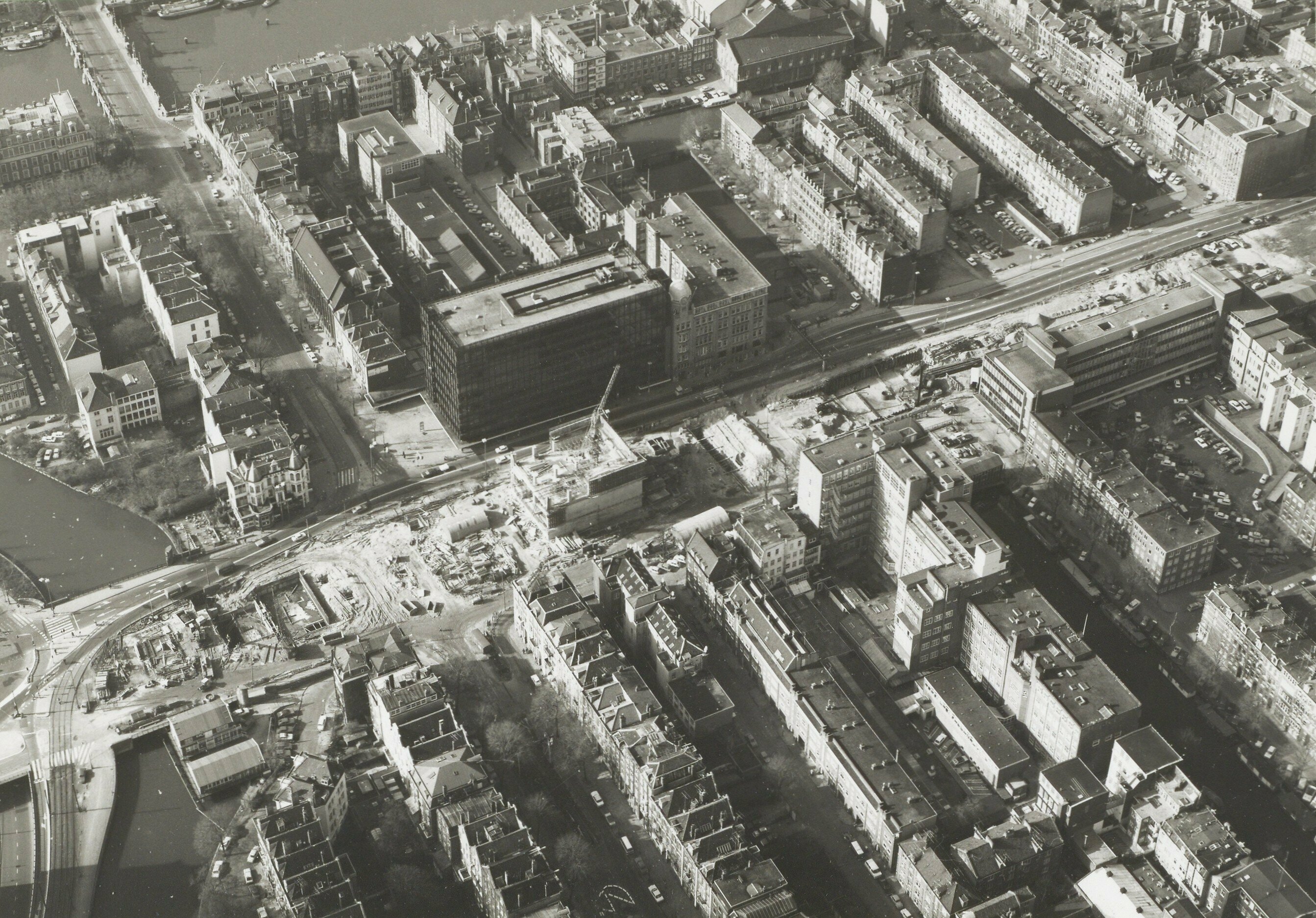
Weesperplein metro station
There is a second platform at Weesperplein that no train will ever reach. Walk down to the tracks, look across, and what you see is the normal working metro of any European city: lines 51, 53, and 54, sandwich shop upstairs, students from the universities pouring through the gates. Now imagine, directly below your feet, another platform exactly like this one, only sealed in concrete and silence. It was built in the early 1970s for an East–West metro line that was never laid. When the rest of the network was cancelled, the planners did something stranger than abandon it: they finished it as a nuclear shelter for five thousand people, then locked the door.
The Line That Never Came
In the original plan, Weesperplein was going to be a crossroads. Two metro lines, one running north–south, one running east–west, meeting under the centre of Amsterdam. Engineers knew that retrofitting an intersection later would be a nightmare, so they built the lower platform first, in advance, hollowing out a vast concrete chamber beneath the working station. Columns supporting the structure above narrowed the space to a single island platform, with a planned connecting track threading between the two lines. Then in 1975 the politics collapsed. Protests over the demolition of houses near Nieuwmarkt, where the construction method required ripping out whole blocks of the medieval city, turned violent. Out of that fight, only the truncated East Line survived; every other route on the map was cancelled. Weesperplein was left with a finished shell for a railway that would not arrive.
Five Thousand Beds Beneath the Street
Rather than wall up the empty platform, the city repurposed it for a different kind of emergency. The Cold War was at one of its later peaks, and Amsterdam, like every European capital, was thinking about what to do when the sirens went. The lower level became a fallout shelter with capacity for five thousand people: beds, water tanks, garbage chutes designed for disposing of radioactive clothing, showering bays with bulkheads at the very bottom. Caissons forty metres wide, even broader than those used at Amsterdam Centraal, formed the structure. The shelter was never tested with a real population. It was maintained quietly for decades, then quietly stopped being maintained from 1999 onward, and most of the equipment was stripped out in 2004 to make room for smoke-extraction machinery. The chamber is still down there, doing nothing in particular, waiting.
Brutalist Bones
The station that passengers actually use was designed by Ben Spängberg and a colleague from the city's architectural office, in the raw brutalist idiom of its decade. Bare concrete, hard edges, a generous central hall. When the first train rolled through on 25 January 1977, the mayor of Amsterdam, Ivo Samkalden, drove it personally under the supervision of GVB engineers. The line opened to the public on 16 October that year. For its first few years Weesperplein was the southern terminus: trains pulled in, took the switch just beyond the platform, and ran back out toward Bijlmermeer. In 1984, braille patterns appeared on the handrails, an early small kindness. Most of the original concrete was later painted over with anti-graffiti coating in light grey, then re-coated again during a 2017–2018 renovation that aimed, gently, to bring back the brutalist mood without the brutalist grime.
Reflections on the Ceiling
Three works of art were chosen from 198 submissions in a national competition. Matthijs van Dam's Luchtspiegelingen is the one most riders look at without quite knowing they are looking at it. Twelve panels, originally installed on the platform ceiling in 1977, show the streets directly above the station as if seen from below: Weesperstraat, Sarphatistraat, roads and cars and sky, with clouds passing across an inverted gaze. Stand under them and the heavy concrete dissolves into a strange feeling of looking up through forty metres of earth. The panels were removed in 2010 over fire safety concerns and reinstalled eight years later on the ceiling of the main hall. Charles Bergmans contributed Verplaatsing, ten blocks of hard stone that travellers used as benches; decades of waiting passengers have polished their surfaces smooth and shiny.
The Twin in the Forest
In 2014 the Dutch defence ministry built an exact replica of Weesperplein in the woods near Vught, in North Brabant, so that police, paramedics, firefighters and military teams could rehearse emergencies in the country's busiest underground space without disrupting the real one. It is a strange honour, having your station cloned in a forest for the sake of practice fires. Above ground, Weesperplein keeps doing its everyday job. Around 32,000 passengers pass through it on an average weekday, making it the third-busiest station on the Amsterdam Metro after Centraal and Zuid, and the busiest in the city with no mainline train connection. The space below them, the shelter that was never needed and the line that was never built, stays exactly as it has for half a century, an unused civic just-in-case under the floor of a working city.
From the Air
Weesperplein sits at 52.36°N, 4.91°E in central Amsterdam, just south-east of the Amstel and within a few hundred metres of the University of Amsterdam campuses. From the air, the station itself is invisible, but you can locate it from the broad rectangle of Weesperstraat cutting north from the river toward the canal ring. Amsterdam Schiphol (EHAM) is about 15 km south-west, the obvious approach point for any visit. Best viewed in daylight at low altitude in clear weather; the city centre's tight grid of canals and the dark line of Weesperstraat make a useful navigation cue toward Centraal Station.