Wei (state)
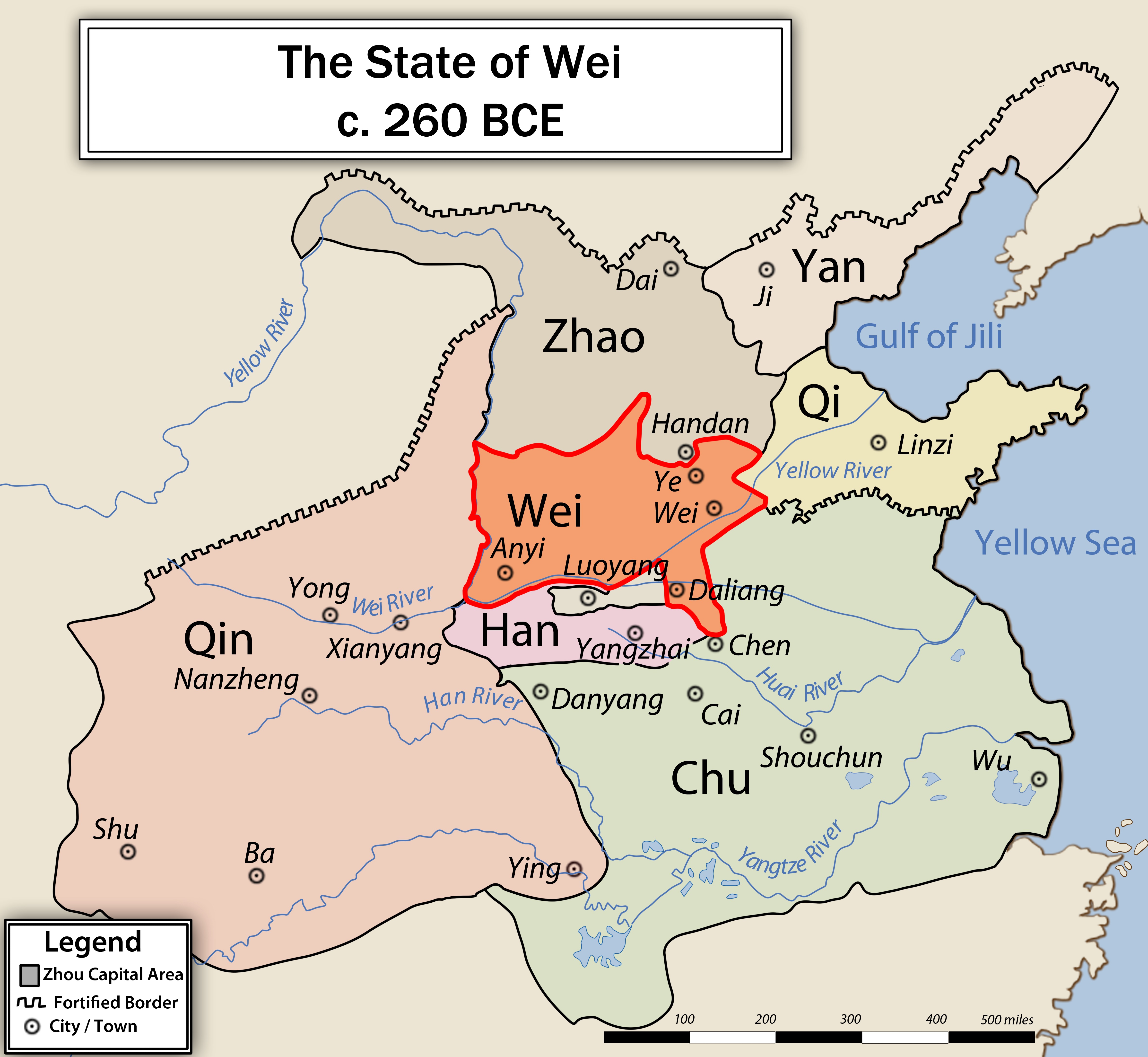
The state of Wei died the way the Yellow River always kills: by water. In 225 BC, the Qin general Wang Ben diverted the river into Wei's capital Daliang -- present-day Kaifeng -- and drowned it. The flood destroyed a dynasty whose roots stretched back to Zhou royalty, through two centuries of military innovation, philosophical patronage, and catastrophic strategic miscalculation. Wei had once been the strongest of the seven warring states. It ended as a lesson in what happens when a great power looks east while the real threat grows in the west.
Three States from One
Wei's founding was an act of dismemberment. The state of Jin, once the dominant power of the Spring and Autumn period, had been hollowed out from within by powerful noble families. In 453 BC, the houses of Wei, Zhao, and Han allied to destroy the rival house of Zhi, splitting Jin's territories among themselves. For half a century, this partition had no legal standing -- the three operated as independent powers while still nominally serving Jin's figurehead rulers. Only in 403 BC did King Weilie of Zhou formally elevate the heads of all three houses to the rank of marquess, legitimizing what everyone already knew. The ruling house of Wei traced its lineage to Gao, Duke of Bi, a son of King Wen of Zhou, giving it an ancient claim to royal blood that most rival states could not match.
The Reforms That Built an Empire
Under its first two rulers, Marquess Wen and Marquess Wu, Wei became the most powerful state in China. The third ruler, King Hui, pushed even further. He adopted Legalist reforms proposed by the philosopher-statesman Li Kui, implemented irrigation projects along the Yellow River, and declared himself an independent sovereign. Wei's military innovations were formidable, and its territory stretched across parts of modern Henan, Hebei, Shanxi, and Shandong. But Hui made a fateful strategic choice. Believing Qin to the west was weak and its lands barren, he focused his ambitions eastward, toward the richer and more populated states. A series of defeats followed, most devastatingly at the Battle of Maling in 341 BC, where the Qi general Sun Bin annihilated a Wei army. While Wei exhausted itself fighting in the east, Qin's expansion went largely unimpeded.
Lord Longyang's Fish
Wei's cultural legacy includes one of China's most famous parables about love and impermanence. According to the Records of the Warring States, a king of Wei had a lover named Lord Longyang with whom he enjoyed fishing. One day Longyang began to weep on the riverbank. When the king asked why, Longyang explained that he had caught a fish and been delighted -- until he caught a larger one, at which point he wanted to throw the first back. "I am also a previously-caught fish," Longyang said. "I will also be thrown back." To reassure him, the king declared that anyone who dared speak of other beauties would be executed along with their entire family. The story became the origin of the Chinese term "Lord Longyang" as an allusion to same-sex love, and the parable itself endures as a meditation on the anxiety of being replaced.
Death by Flood
Wei's decline was gradual but irreversible. After losing the strategic Hexi region on the Yellow River's west bank to Qin, the state moved its capital from Anyi to Daliang, giving rise to its alternate name: Liang. From this point forward, Wei fought a continuous and losing defensive war against Qin expansion. The final blow came in 225 BC, when Wang Ben used the river itself as a weapon, channeling its waters through Daliang's walls. The capital and the dynasty drowned together. Wei's story is written into the stars -- literally. In traditional Chinese astronomy, the state is represented by stars in the "Twelve States" asterism, a celestial archive of a political order that vanished more than two thousand years ago but left its mark on the heavens.
From the Air
Located at 34.80N, 114.31E at the site of ancient Daliang, now modern Kaifeng, Henan province. The flat Yellow River plain extends in every direction, with the river itself historically shifting course through this area. Nearest major airport is Zhengzhou Xinzheng International (ZHCC/CGO), approximately 75 km west. The terrain is among the flattest in China, characteristic of the Central Plains.