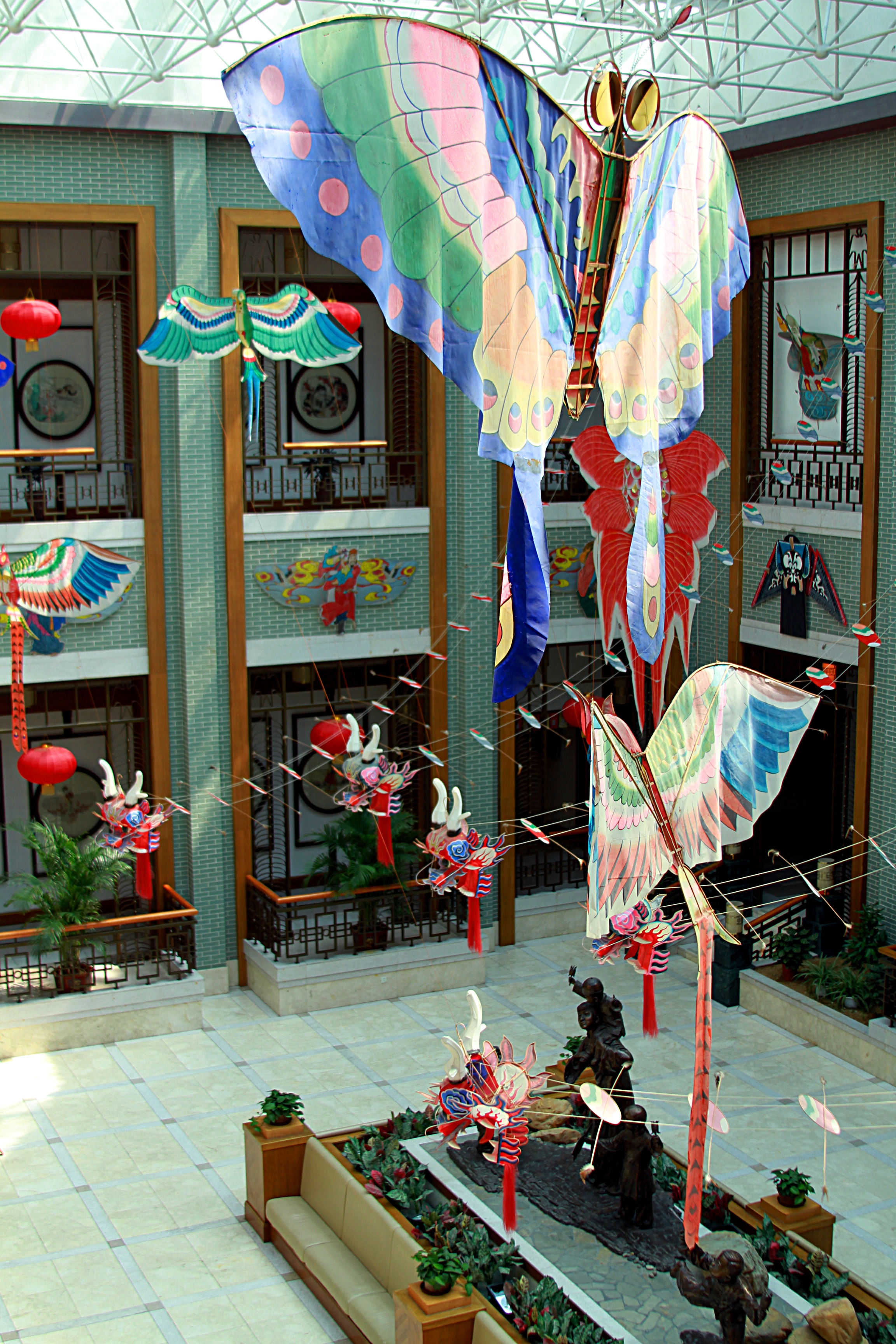
Weifang World Kite Museum
The building itself is a kite. Or rather, it is shaped like one -- specifically, the dragon-head centipede kite that Weifang is famous for. A composite ceramic dragon runs along the roofline, paved with peacock orchid glazed tiles, so that the museum appears to undulate against the sky like something that might actually lift off. It is an appropriate conceit for a city that has claimed the title of World Capital of Kites and built a 8,100-square-meter museum to prove it deserves the name.
From Battlefield to Festival
Kites in China are not toys. They began as military signaling devices and evolved over centuries into instruments of scientific measurement, religious ritual, and eventually pure aesthetic pleasure. The Weifang World Kite Museum, which opened on April 1, 1989, after two years of construction, traces this evolution through seven exhibition halls and a projection hall. The galleries move from the ancient origins of kite-making through Weifang's distinctive regional styles to kites from around the world. Weifang's connection to kites is not incidental. The city hosts the annual Weifang International Kite Festival, and the museum serves as both archive and ambassador for that tradition. A 2002 renovation added a circular-screen movie theater, and a 2024 upgrade introduced an XR digital experience space that lets visitors encounter kite history through virtual and extended reality.
Thread and Bamboo, Hands-On
The Folk Craft Experience Hall inverts the usual museum relationship between visitor and object. Professional artists demonstrate Weifang's local craft traditions on site -- not only kite-making but also New Year paintings and paper-cuts -- and visitors can build their own kites under their guidance. Indoor windless kite-flying performances prove that these objects work even without weather to cooperate. The hands-on approach reflects Weifang's understanding that kite-making is not a dead art to be preserved behind glass. It is a living craft that needs new practitioners as much as it needs archivists. The multifunctional hall, built during a 2011 renovation, uses holographic projection across a 10-meter imaging area to recreate the old Weixian street market where kite sellers once hawked their wares.
The Kite That Contains a City
Weifang kites are distinctive for integrating the atmosphere of daily life and local character into their designs. The main content of each kite is coordinated with its shape, so that a dragon kite does not merely look like a dragon but tells a story about dragons through its painted surfaces. This integration of art and engineering -- material selection, color theory, aerodynamic form -- distinguishes Weifang's tradition from kite-making elsewhere in China and around the world. The museum was recognized in January 2020 as one of Shandong Province's 'Six Good' scenic spots and in October 2021 was selected among the province's 100 most popular tourism destinations. But the deeper significance is in what the collection reveals: that for Weifang, kites are not a category of object but a category of identity.
From the Air
Located at 36.70N, 119.12E in the Kuiwen District of Weifang, Shandong Province. The museum's dragon-shaped roofline is distinctive from lower altitudes. Nearest airport: Weifang Nanyuan Airport (ZSWY), approximately 8 km south. Best viewed at 2,000-3,000 ft. During the annual International Kite Festival (typically April), the skies around Weifang fill with kites visible from considerable altitude.