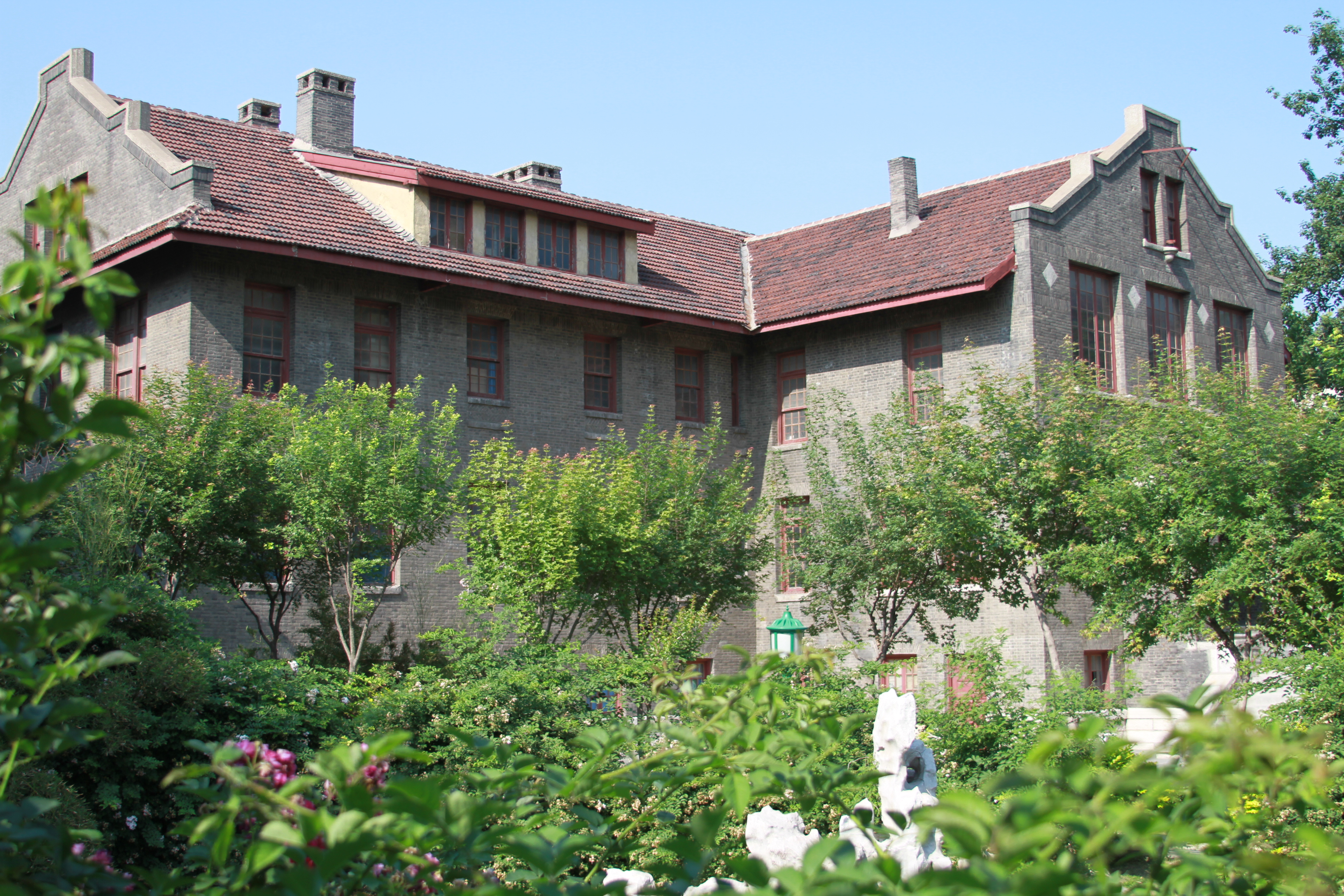
Weixian Internment Camp
They called it the Courtyard of the Happy Way, though happiness had nothing to do with it. The name belonged to the Presbyterian mission compound near Weifang, Shandong, before the Japanese military converted it into one of the largest civilian internment camps in wartime China. From March 1943 until American paratroopers landed without opposition on August 17, 1945, more than 2,200 British, American, Canadian, Australian, Italian, and other Allied civilians lived behind its walls -- missionaries, businessmen, scholars, and more than 350 children, some separated from their parents for the duration of the war.
A City Block at the Edge of Survival
The compound was roughly the size of a single city block. An internee described what they found: bare walls, bare floors, dim electric lights, no running water, primitive latrines, two houses with showers, three huge public kitchens, a desecrated church, and a dismantled hospital. Within ten days, the doctors and nurses among the internees had an operating room, laboratory, and pharmacy functioning. The Japanese garrison -- a commandant, five staff, and 30 to 40 guards -- was surprisingly small and largely absent from daily life inside the walls. The internees governed themselves through nine elected committees, creating what theologian Langdon Gilkey called a complete socialist democracy. The two problems that consumed them most were age-old: how to make a lazy person work, and how to distribute scarce food fairly.
Bread, Eggs, and the Black Market
Food dominated everything. Three kitchens served meals built around bread, tea, and vegetable soup. Two elderly Persian bakers trained a corps of internee bakers to staff the compound bakery with Japanese-supplied flour, though rations shrank steadily as the war continued. The compound wall's length and the scarcity of guards made black marketing almost inevitable. Chinese farmers brought produce to the wall, and internees smuggled goods over it or through holes created by removing bricks. At the peak, an estimated 1,300 eggs per day crossed into the compound. The Japanese executed two Chinese farmers to stop the trade; after a pause, it resumed with the guards themselves acting as middlemen, taking commissions. Catholic priests and monks proved the most resourceful black marketers. Children received a tablespoon of crushed eggshells daily as a calcium supplement -- a small measure of how inventive desperation can become.
Bricks with Messages Tied to Them
Resistance at Weihsien took forms suited to a compound full of linguists and clergy. Father Raymond de Jaegher, a Belgian Jesuit fluent in Chinese, began by throwing bricks over the wall with messages and money attached, addressed to Chinese Nationalist guerrillas operating in the region. Later, he volunteered to supervise the cesspool workers allowed inside to haul away night soil, turning them into covert couriers. When de Jaegher's superiors forbade his own escape for fear of Japanese reprisals, American scholar Arthur Hummel Jr. took his place. On the night of June 9-10, 1944, Hummel and British businessman Laurence Tipton went over the wall and joined the guerrillas, maintaining contact with de Jaegher and eventually helping to arrange Red Cross food shipments that kept the camp from starvation.
The Weight of a Red Cross Parcel
In January 1945, about 1,500 food parcels from the American Red Cross arrived by donkey cart. Each weighed roughly 20 kilograms and contained canned meat, butter, cigarettes, cheese, powdered milk, coffee, and chocolate -- enough for one parcel per person. But several Americans, including missionaries, argued that parcels from the American Red Cross should go only to the 200 Americans in camp, giving each American seven and a half parcels. The standoff between American claimants and the rest of the camp grew bitter enough that the Japanese themselves intervened, ruling one parcel per person. Gilkey, an American, reflected afterward that without the Japanese guards maintaining order, the community might have destroyed itself. Among the 31 people who died during internment was Eric Liddell, the Olympic gold medalist depicted in Chariots of Fire. Thirty-three children were born.
From the Air
Located at 36.70N, 119.13E near the city of Weifang in Shandong Province. The former compound site is within the modern urban area. Nearest airport: Weifang Nanyuan Airport (ZSWY). The flat Shandong plain offers clear visibility. Best viewed at lower altitudes for urban context. The site is close to the Weifang World Kite Museum.