Well of Barhout
For generations, the people of Al-Mahrah province in eastern Yemen considered it bad luck to even speak of the hole. Roughly 30 meters across at the surface, the Well of Barhout drops straight down into darkness for 112 meters -- a sheer limestone shaft that locals call the Well of Hell. Folklore holds that it was created as a prison for jinn, and superstition warns that objects near the edge can be sucked into its depths. For centuries, no one went down to check. Then, on September 15, 2021, a team of Omani cavers clipped into their harnesses and rappelled into the void.
A Shaft Through Deep Time
The Well of Barhout is a karst sinkhole, carved over millions of years by slightly acidic rainwater dissolving the soluble limestone bedrock of the Hadramawt Group. The primary rock is the Umm er Radhuma Formation, a massive dolomitic limestone laid down during the Paleocene to Middle Eocene epochs. Water percolated through fissures, widening them grain by grain, until the overlying material gave way and the roof collapsed into the cavity below. What remains is a nearly perfect cylinder: 30 meters wide at the mouth, widening to 120 meters at the bottom, as if the earth had swallowed itself. The shaft passes through two distinct rock layers. The upper layer, roughly 61 meters thick, is porous enough to let rainfall filter through. The lower layer is far less permeable, forcing that water sideways -- and into the sinkhole as four waterfalls, each plunging 46 meters through the dark.
Into the Well of Hell
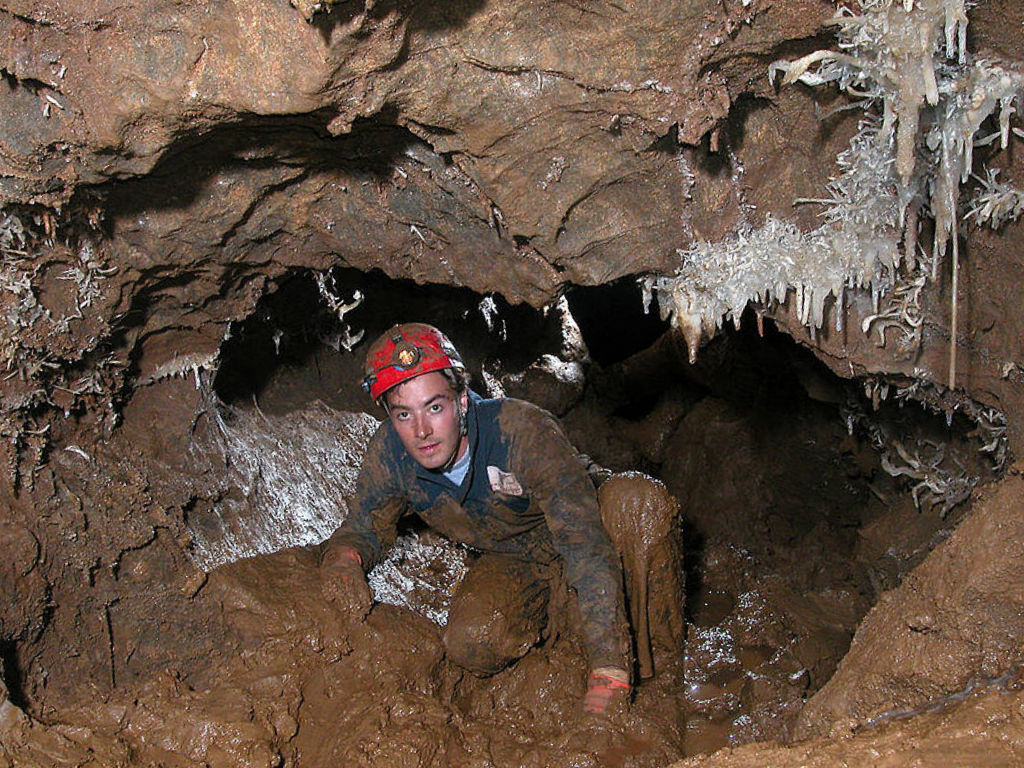
The Oman Cave Exploration Team arrived with ropes, harnesses, LED lights, gas detectors, cameras, and surveying tools. What they found at the bottom was not the realm of imprisoned spirits but something nearly as unexpected: a functioning ecosystem. Snakes moved across the cave floor alongside beetles, lizards, and toads. Birds nested in crevices, their calls echoing off wet stone. Dead animals and decomposing birds littered parts of the chamber -- creatures that had fallen in and never climbed out. The air itself was compromised. Oxygen levels ran low, replaced by the sharp smell of decay and the mineral tang of standing water. The team collected samples of rock, soil, water, and dead birds for laboratory analysis. They documented stalactites hanging from the ceiling, stalagmites rising from the floor, and something unexpected: grey and lime-green cave pearls, small concretions formed layer by layer from mineral-rich dripping water.
Where Demons Dare Not Follow
The jinn legend did what legends often do -- it kept people away, and in doing so, it preserved something. The Well of Barhout sat undisturbed for centuries in one of Yemen's most remote provinces, a region where conflict and poverty have made scientific exploration nearly impossible. Al-Mahrah sits at the eastern edge of the country, bordering Oman, far from the war zones that have devastated western Yemen but also far from any research institutions. Local residents avoid the sinkhole. Some believe approaching it brings misfortune; others say the strange sounds rising from the depths are the voices of the damned. The sounds, of course, are wind funneling through the shaft and water striking stone. But the effect is the same: the well commands respect, whether you explain it with geology or with faith.
What the Darkness Holds
The 2021 descent answered some questions and raised others. The waterfalls explain the cave pearls and the stalactite formations -- this is an active hydrological system, not a dead hole in the ground. The ecosystem suggests that organic material falls or washes in regularly enough to sustain a food chain of insects, amphibians, reptiles, and birds. But the reduced oxygen levels and the sheer depth of the shaft create an environment that selects harshly: what lives here has adapted to living here, and nothing else. From the air, the Well of Barhout is almost invisible -- a dark circle in the pale limestone of the Al-Mahrah plateau, easy to miss and easier to avoid. Which is, perhaps, how it survived long enough to be explored in the first place.
From the Air
Located at 17.34N, 52.44E in the Al-Mahrah Governorate of eastern Yemen. The sinkhole appears as a dark circular opening approximately 30 meters wide in pale limestone terrain. Extremely difficult to spot from cruising altitude; best viewed from lower altitudes under clear conditions. Nearest significant airport is OOSA (Salalah, Oman) approximately 300 km to the east. The surrounding terrain is arid, sparsely vegetated limestone plateau.