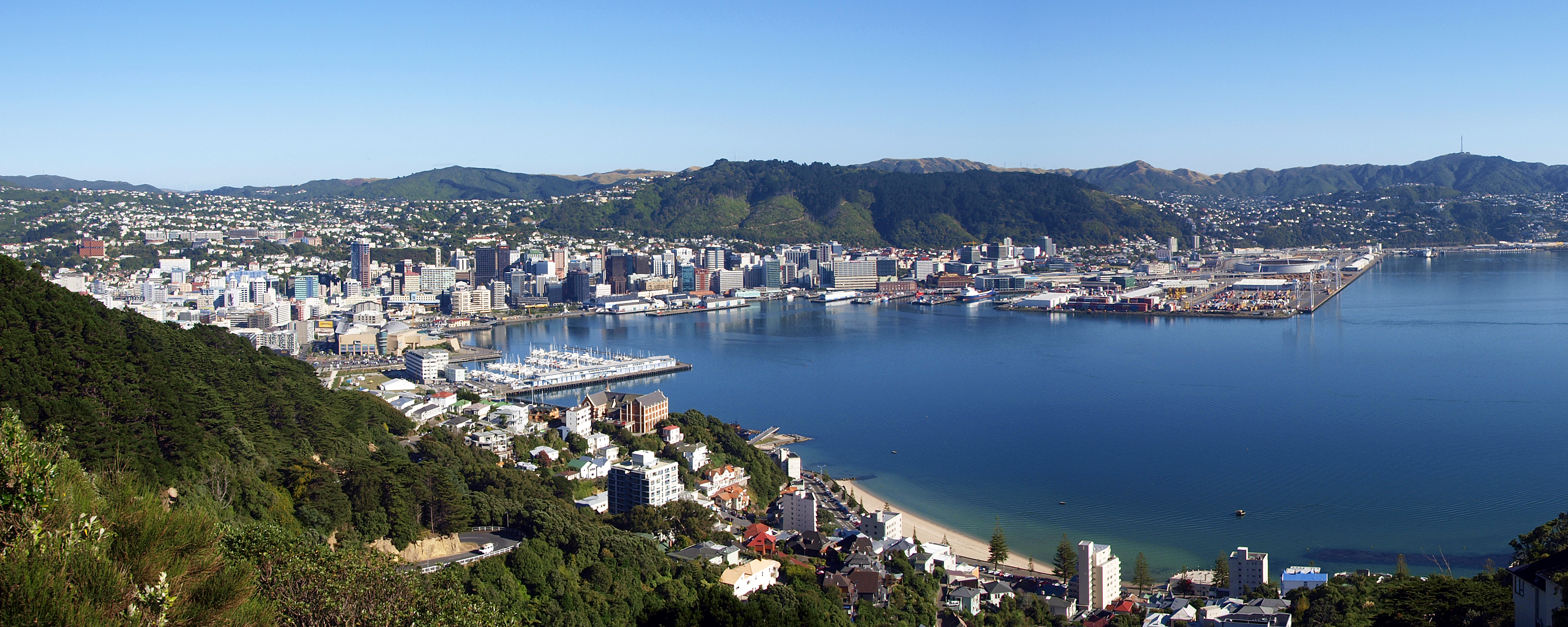
Wellington
Wellington became New Zealand's capital in 1865, replacing Auckland with a location more central to a country stretching 1,600 kilometers from north to south. Around a harbor at the southern tip of the North Island, the city clusters against steep hills, its position on Cook Strait exposing it to winds averaging 22 km/h with gusts far higher. That geography cuts both ways. The same terrain that funnels relentless wind prevents sprawl, forcing a density other New Zealand cities avoid. With 215,000 in the city proper and 430,000 across the metropolitan area, Wellington is small by global capital standards - yet it anchors New Zealand's government, film industry, and cafe culture with outsized intensity.
The Wind
Wellington's wind is legendary and inescapable. Between the North and South Islands, Cook Strait's weather accelerates through a natural funnel, blasting the city more days than not. Engineers designed the harbour bridge to flex under the pressure. The cable car climbing from Lambton Quay operates in gusts that would shut down other transit systems, and pedestrians on exposed streets lean hard into blasts strong enough to knock the unprepared off their feet. Wellingtonians complain about it constantly. They secretly love it.
Beyond discomfort, the wind reshapes how the city works. Hillside houses are built to withstand it. Cuba Street's outdoor cafes operate on the understanding that merely windy qualifies as acceptable weather - storming is another matter. The reputation keeps some people from moving here, which suits those already settled just fine. Wellington's wind is both filter and identity: the price of harbor views, and the reason every corner cafe stays busy pouring something warm.
Te Papa
Te Papa Tongarewa - the Museum of New Zealand - opened on Wellington's waterfront in 1998, its building as ambitious as its collections. The approach was revolutionary. Interactive exhibits and earthquake simulators drew visitors into direct experience. Marae (Maori meeting houses) were integrated into the building's architecture, making New Zealand's bicultural identity structural rather than decorative. Collections span natural history specimens to the colossal squid hauled from Antarctic depths by fishing boats.
Could a national museum reinvent itself entirely? Te Papa tried, and succeeded well enough to draw millions of visitors. Free admission keeps it accessible. Changing exhibitions give locals reasons to return season after season. Maori and Pakeha perspectives sit alongside each other, reflecting official bicultural policy in tangible form. More than a museum, Te Papa is a statement - the institution anchoring Wellington's cultural ambition.
The Film Industry
Wellington is Middle-earth's home. Weta Workshop, headquartered here, brought Peter Jackson's Lord of the Rings trilogy to physical life, while Weta Digital created the digital effects. Jackson's industry outlasted his own projects, providing visual effects and production services for global cinema while nurturing local filmmakers. In the suburb of Miramar, studios, soundstages, and workshops employ thousands in an industry that barely existed before Jackson bet his career on hobbits.
Filmmaking gave Wellington something government alone could not: economic base and cultural identity rolled together. A Wellywood sign briefly graced the hills before controversy forced its removal. Tours visit filming locations across the region. Fans arrive specifically because Jackson worked here - all of it soft power generated by successful storytelling. Wellington is far too small to be Hollywood, but it proved world-class effects work could happen anywhere talent chose to concentrate.
The Coffee Capital
Wellington's coffee culture is intense enough to surprise visitors from much larger cities. Along Cuba Street and Courtenay Place, cafes compete fiercely on quality. Baristas often train for championship competitions. The flat white - which New Zealand claims to have invented - is served here with a skill mass coffee culture cannot replicate. Why so much devotion to the cup? Partly weather: wind drives people indoors and creates steady demand for warm shelter. Partly identity, too - Wellington asserting distinction from Auckland one espresso at a time.
Per capita, the density of good cafes here may be the highest in the world. Wellingtonians cite this statistic with pride bordering on obsession. The coffee is genuinely excellent, the roasters serious about craft, the customers demanding enough to keep standards sharp. Cafe culture has become a tourism product in its own right. Visitors arrive specifically to drink what they cannot find at home, and they are rarely disappointed.
The Compact Capital
Geography forces Wellington into a compactness other capitals cannot achieve. Harbor on one side, steep hills on the other - there is simply nowhere to sprawl. Commuters reaching the suburbs ride trains rather than drive. The central city is walkable in ways Auckland is not, producing an urban density that feels almost European: streets where pedestrians dominate, a scale a government town can sustain.
Compactness carries costs, though. Housing prices climb as demand outstrips a supply geography itself limits. Beyond the rail lines, commuters face congestion worsening each year. And beneath it all lies seismic risk: earthquakes destroyed much of the city in 1855 and again in 1942. Wellington sits directly on an active fault line, a fact the earthquake museum explains in sobering detail. Residents accept the danger because the same geology that creates it also carved the harbor and compressed the compact city they treasure.
From the Air
Wellington (41.29S, 174.78E) sits at the southern tip of New Zealand's North Island on Port Nicholson harbor. Wellington International Airport (NZWN/WLG) lies 6km southeast of the city center with one runway, 16/34 (1,936m). Crosswind conditions and the short runway make this a challenging approach - many airlines deploy smaller aircraft here. Harbor and hills create distinctive topography visible from altitude. Look for the Beehive, the executive wing of Parliament. Cook Strait separates the North and South Islands below. Weather is maritime temperate, windy year-round with strong southerlies common. Expect turbulence on approach. Fog and low cloud can affect operations.