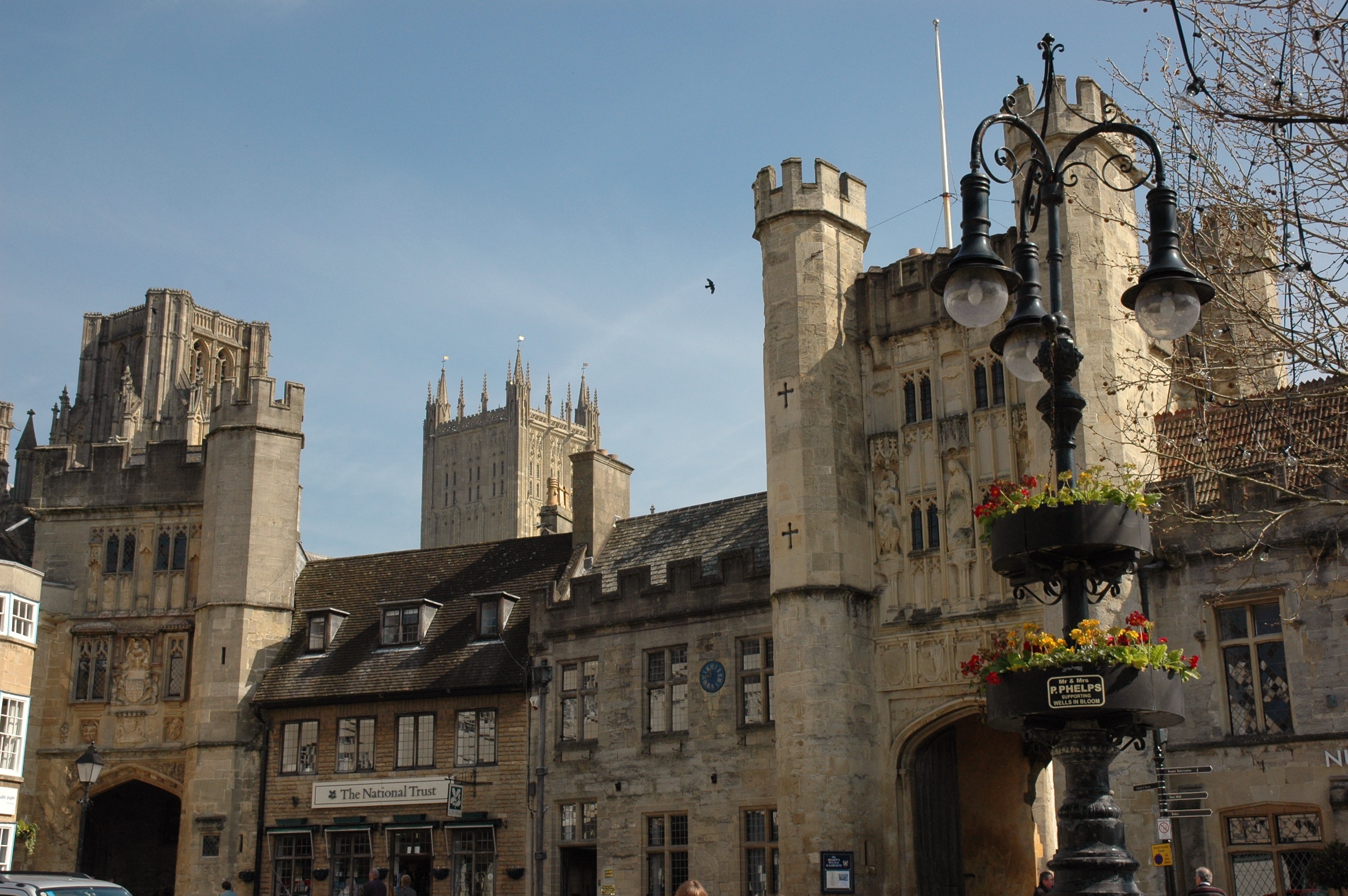
Wells Cathedral
Walk into Wells Cathedral and the first thing that stops you is impossible to miss. At the crossing where nave meets transept, three enormous stone arches interlock in a pattern that looks less like medieval engineering than modern sculpture. These are the scissor arches, installed around 1338 when the central tower began to sink under its own weight. The solution was radical: inverted arches braced against upright ones, creating a figure of eight in stone that redistributed the load and saved the tower. Nearly seven centuries later, they remain the building's most startling feature, a moment where structural necessity produced something beautiful.
Three Hundred Faces
The west front of Wells Cathedral is a gallery wall in stone. Approximately three hundred sculpted figures fill its facade, arranged in tiers of niches across the full width of the building. Kings, bishops, angels, and saints stand in carved company, many of them dating from the thirteenth century. The architectural historian John Harvey called it the "supreme triumph of the combined plastic arts in England." Nikolaus Pevsner was less impressed, describing the facade as "spare" with "harsh uprights and horizontals like steel scaffolding." Both assessments contain truth. The west front is overwhelming in its ambition and strangely grid-like in its organisation, a tension between exuberance and geometry that mirrors the building itself.
The Oldest Gothic
Building began around 1175 under the direction of Bishop Reginald de Bohun, making Wells one of the earliest examples of fully Gothic architecture in England. John Harvey went further, arguing that it was Europe's first truly Gothic structure, breaking from the last constraints of the Romanesque style. The nave was complete by around 1240, its pointed arches, clustered columns, and ribbed vaults establishing a visual language that would dominate English church building for the next three centuries. The Chapter House, an octagonal space reached by a graceful staircase worn smooth by medieval feet, was completed around 1306. Its single central column fans outward into thirty-two ribs, supporting the vaulted ceiling like a stone palm tree.
The Clock That Jousts
High on the north wall of the transept, an astronomical clock has marked time since the late fourteenth century. Its face displays the hours, minutes, the position of the sun and moon, and the lunar phase. Above it, a set of mechanical jousting knights circles on the quarter hour, charging and unhorsing each other in an automated tournament that has been entertaining visitors for over six hundred years. The clock mechanism was replaced in the nineteenth century, but the face and the jousting figures are original. Below the clock, a second, older face in the exterior wall uses a 24-hour display. Together, they represent some of the oldest surviving clock mechanisms in Europe.
A Precinct Preserved
Wells Cathedral is surrounded by one of the most complete medieval ecclesiastical precincts in England. The Bishop's Palace, moated and gated, sits to the south. Vicars' Close, a fourteenth-century residential street built for the cathedral's choir men, runs to the north and is claimed as the oldest continuously inhabited residential street in Europe. The Close's small houses, each with a chimney and a strip of garden, form a complete medieval streetscape that has survived essentially unchanged. The cathedral itself receives over 300,000 visitors annually and holds daily services, maintaining the purpose for which it was built. England's smallest city has produced one of its grandest churches, a place where engineering innovation, artistic ambition, and eight centuries of continuous worship converge.
From the Air
Located at 51.210N, 2.644W in the city of Wells, Somerset, England's smallest city. The cathedral's distinctive profile and tower are visible from the air, with the moated Bishop's Palace nearby. Nearest airports: Bristol (EGGD) approximately 17nm north, Exeter (EGTE) approximately 40nm southwest. Best viewed from 2,000-3,000ft to appreciate the cathedral precinct and surrounding city.