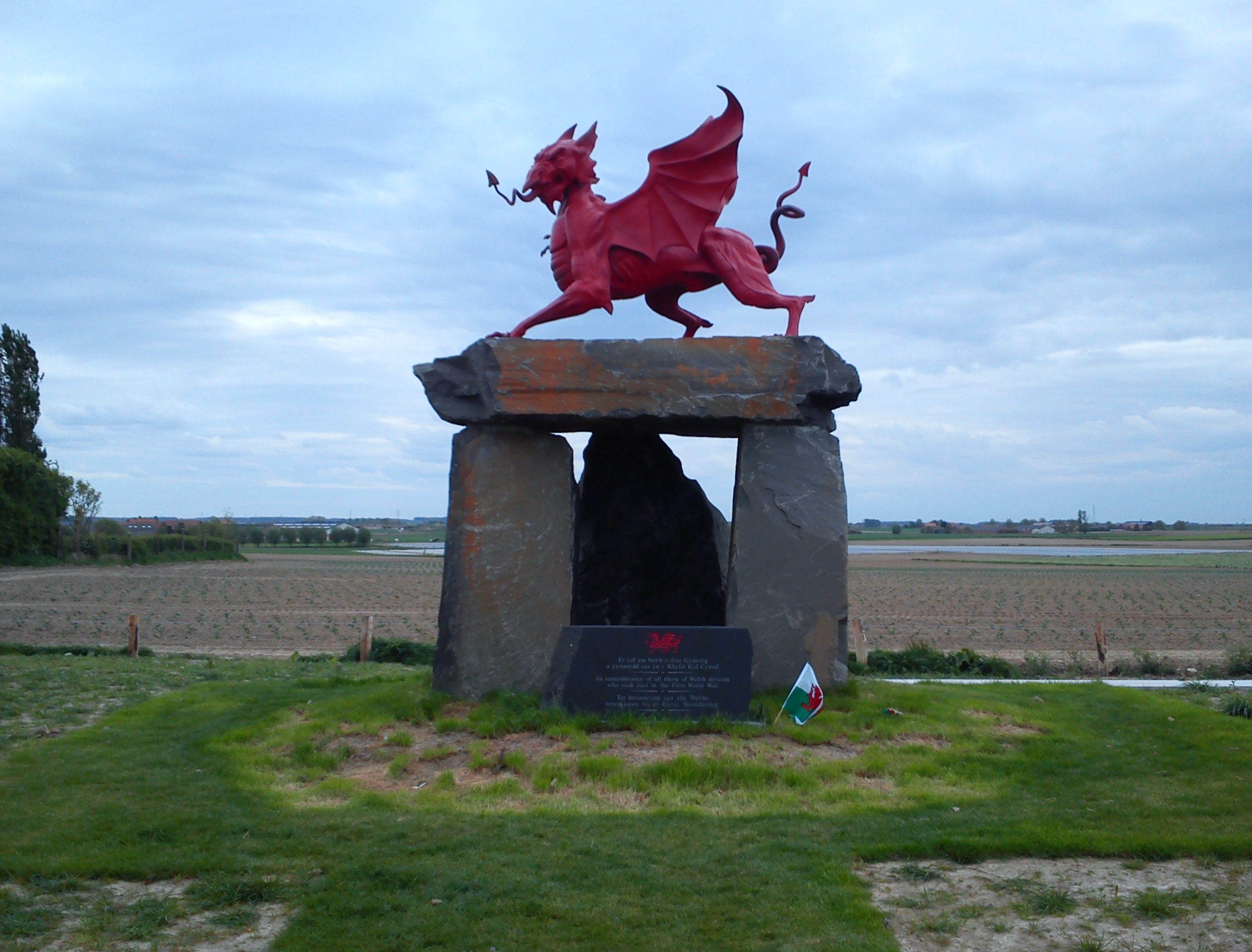
Welsh Memorial Park, Ypres
Ellis Humphrey Evans, a 30-year-old shepherd from a farm near Trawsfynydd in Gwynedd, was killed on Pilkem Ridge on 31 July 1917. He died on the first day of the offensive that became known as Passchendaele. Six weeks later, at the National Eisteddfod in Birkenhead, his poem 'Yr Arwr' - The Hero - was judged the winner of the Chair, the most prestigious prize in Welsh-language literature. The master of ceremonies called his bardic name three times: 'Hedd Wyn.' Hedd Wyn. Hedd Wyn. No one rose. He was buried in Belgium. The Chair, draped in black, became known as Y Gadair Ddu - the Black Chair. It still stands at his family farm. For 97 years afterwards, no Welsh national memorial to the Great War existed on the ground where so many Welshmen had died. In 2014, on a ridge a few kilometres from where Hedd Wyn fell, they finally built one.
The Black Chair
Hedd Wyn - Blessed Peace - was the bardic name Ellis Humphrey Evans had taken as a young poet competing in local eisteddfodau. He had been called up to the Royal Welch Fusiliers in early 1917 and given six weeks of farm leave to help with the harvest. He used some of the time to finish his poem 'Yr Arwr'. He sent the manuscript to the Eisteddfod committee just before reporting to barracks. He was killed near Iron Cross Ridge on Pilkem on the morning of the opening attack, the bardic chair he had not yet won standing empty in Birkenhead. When his pen-name was called at the Eisteddfod chairing ceremony and no one stood, the chair was draped in black and carried, after the festival, back to Yr Ysgwrn, the family farm. It is still there. The chair is still in the parlour. The film Hedd Wyn, released in 1992, was nominated for an Academy Award in 1994. The grief, the parents who outlived their son, the silence at his name - it has not faded in a hundred years.
What Wales Lost
Wales lost more people, as a percentage of its population, than any other country in the United Kingdom during the First World War. About 280,000 Welsh men served in the British Army; some 40,000 of them did not come home. The Welsh divisions and regiments - the 38th (Welsh) Division, the South Wales Borderers, the Monmouthshire Regiment, the Welsh Guards, the Welch Regiment, the Royal Welch Fusiliers - fought across France, Flanders, Gallipoli, Palestine, Salonika. The 38th came in for particular punishment at Mametz Wood on the Somme in July 1916, where it lost nearly 4,000 men in five days clearing the wood metre by metre. Field Marshal Haig later called the 38th 'one of his best divisions', a back-handed verdict from a commander whose praise was usually reserved for British units. The Welshmen who fought in 1917 on Pilkem Ridge were the rebuilt 38th, the new replacements who had filled out the ranks after Mametz.
Why 2014, Not 1924
Wales had no national Great War memorial on the Western Front for nearly a century. There is a specific memorial to the 38th Welsh Division at Mametz on the Somme, unveiled in 1987. There are regimental memorials scattered across France and Flanders. There are men of Welsh descent buried in nearly every CWGC cemetery in the Salient. But a national Welsh memorial - one that simply said, to all those of Welsh descent who took part in the First World War - did not exist anywhere outside Wales until 16 August 2014. The campaign for it began in 2011, led by the Welsh Memorial in Flanders committee under Peter Carter Jones BEM and the Flemish committee led by Erwin Ureel MBE. The local Belgian community bought the land. The Welsh government and Welsh donations raised more than 250,000 pounds. The land was granted in perpetuity. The First Minister Carwyn Jones and the Flemish minister-president Geert Bourgeois unveiled the memorial together. A century of waiting ended that afternoon.
The Cromlech and the Dragon
The memorial takes the form of a cromlech - the ancient Celtic burial form found across Wales and Brittany, three upright stone slabs supporting a flat capstone overhead. The stone is Welsh blue pennant, quarried at the Graig quarry in Pontypridd in the Rhondda valley, shipped across to Belgium for the construction. On top of the cromlech stands an 8-foot bronze dragon - red, rampant, the Welsh dragon of the Mabinogion and the national flag - sculpted by Lee Odishow. The inscription beneath the dragon reads, plainly: 'To all those of Welsh descent who took part in the First World War between 1914 and 1918.' Around the cromlech the park holds a large boulder welcoming visitors in Welsh, a headstone shaped like the CWGC pattern but inscribed with the words of 'Hen Wlad Fy Nhadau' - the Welsh national anthem, Land of My Fathers - and a flag pole flying the dragon overhead. Seven smaller stones bearing the cap badges of the five Welsh regiments and two Welsh divisions were unveiled in 2017.
The Ridge Where He Died
Pilkem Ridge is gentle. A car climbs it without noticing. On 31 July 1917 it took the Welsh divisions all morning to take, and they took it. The first wave reached their objectives. The 38th cleared Pilkem village. Then the rain began, and continued for most of August, and the offensive that opened so well on this ridge dissolved into the slow drowning march toward Passchendaele that became the synonym for futile suffering in the modern memory of the war. Hedd Wyn fell that morning, somewhere on the slopes near the memorial that now stands a little way north of where he died. The memorial park looks east across the same fields he last saw. The bronze dragon faces the ground. The Welsh anthem on the headstone says: O bydded i'r heniaith barhau - May the old language endure. It has. So has the memory of the men who fought here in it, and of the poet who died with one final poem unread.
From the Air
Located at 50.903 N, 2.900 E - on Pilkem Ridge between the villages of Pilkem and Langemark, 6 km north of Ypres. Nearest airport is Ostend-Bruges (EBOS), 55 km northwest. Lille (LFQQ) is 40 km south. Recommended viewing altitude 1,500-3,000 ft. From the air the ridge is barely visible - a gentle swell of less than 30 metres above the surrounding farmland - which is precisely the topography that made it so hard to take in 1917. The neighbouring villages of Boezinge (formerly Pilkem) and Langemark mark the ends of the line the Welsh divisions fought across.