West Antarctica
No nation claims Marie Byrd Land. In a world where countries squabble over every inhabitable rock, this pie-slice of Antarctica - roughly the size of Alaska - sits unclaimed because no one thought it worth the paperwork. Beneath its ice lies the lowest point on Earth not covered by ocean, pressed down nearly three kilometers below sea level by the sheer weight of frozen water above. West Antarctica is a place of extremes even by Antarctic standards: the continent's highest peak, its fastest-moving glacier, its most isolated research stations. Here, even the penguins don't come - it's too cold, too far from the sea. Think carefully about that before planning a visit.
Peaks Above, Depths Below
Mount Vinson rises to 4,892 meters - the highest point in Antarctica and one of the 'Seven Summits' that mountaineers collect like stamps. Unlike Everest, it requires no supplementary oxygen. But Vinson's challenge lies in its remoteness and the literally perishing cold: temperatures that can plunge below -40C, winds that strip heat from any exposed skin, and an evacuation distance measured not in helicopter hours but in days.
Meanwhile, somewhere beneath Marie Byrd Land's ice sheet, the Bentley Subglacial Trench and Byrd Subglacial Basin compete for the title of Earth's lowest non-oceanic point. The 2013 surveys put the Basin slightly deeper at 2,870 meters below sea level - depths invisible to any visitor, pressed down by ice nearly four kilometers thick. You walk (or ski, or skidoo) across what appears to be a frozen plain, never knowing the true basement lies farther below you than many mountains rise above.
The Ice That Moves
The Thwaites Glacier has earned the nickname 'Doomsday Glacier' - not for hyperbole but for physics. This river of ice, roughly the size of Britain, is racing toward the Amundsen Sea at two kilometers per year, accelerating as warm ocean water seeps beneath it. When - not if - it fully detaches, global sea levels will rise by over half a meter. More ice waits behind it.
West Antarctica has repeatedly shed and regained its ice cover over geological time, while its eastern neighbor has been frozen solid for fifteen million years. Climate scientists study West Antarctica with particular intensity because it shows every sign of beginning another shedding cycle. The ice here is inherently unstable, grounded on rock that sits below sea level, vulnerable to the warming waters that are already probing beneath its margins.
Bases That Move
Living on the ice teaches humility. Halley VI - the British research station - sits on the Brunt Ice Shelf, where four previous stations were crushed or carried out to sea. The current installation stands on gigantic retractable skis, a hybrid of freight train and Howl's Moving Castle, designed to be hauled further from the ice edge as the shelf cracks and calves. Even so, cracking concerns have left it unstaffed during recent winters.
The Argentinian Belgrano II perches on a nunatak - a rocky outcrop protruding from the ice - because previous attempts at ice-based stations failed. Germany's Neumayer III stands on stilts that can be periodically raised as snow accumulates around it. SANAE IV, the South African station, sits near a cliff edge specifically so the wind blows snow away rather than burying the structure. Each base number tells a story of predecessors lost to the ice.
Getting There, Barely
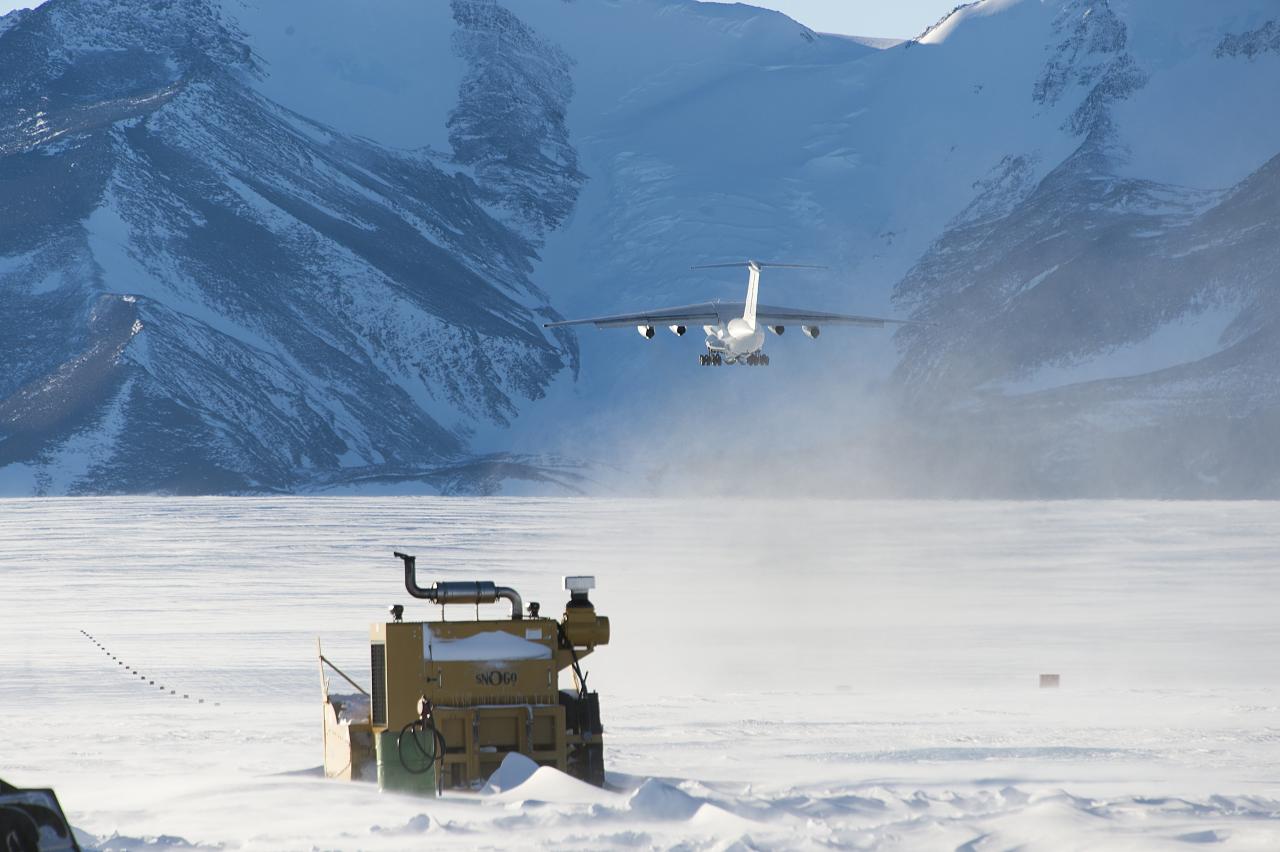
Union Glacier Camp is the private gateway to West Antarctica's interior. Operated by Antarctic Logistics & Expeditions, it receives weekly Ilyushin IL-76 jet flights from Punta Arenas during the austral summer - four hours covering 3,000 kilometers to land on natural 'blue ice' hard enough for wheeled aircraft. From here, ski-planes and overland vehicles fan out to support climbers heading for Vinson, runners in the annual Ice Marathon, and the occasional expedition to the South Pole.
Icebreakers supply the coastal stations, arriving in narrow windows of mid-summer before the pack ice can trap them. For most of West Antarctica, though, there is no getting there at all. Marie Byrd Land has no bases, no supply lines, no routes in or out. The Soviet Russkaya Station closed in 1990, the American Byrd Station in 2005. Some places on Earth remain beyond human reach, not because we lack technology but because there's simply no reason to go.
The End of Exploration
They say Antarctica is cold, but that's nothing compared to the chill you'll encounter showing up unannounced. Every few years, some adventurer loads a Cessna with a thermos flask and an extra pullover and tries to reach the South Pole solo. Some realize their folly and turn back. Some flop into the ocean and vanish. Some make it to the ice and find that no base will shelter an uninvited guest who hasn't paid their dues in permits, insurance, and expedition logistics.
This is not casual travel. The Ice Marathon costs over $22,000; climbing Vinson runs into the tens of thousands more. Medical evacuation insurance premiums alone would make most travelers pause. And yet people come - to run, to climb, to study the ice that holds so much of Earth's future in its frozen grasp. They come because West Antarctica is one of the last places on Earth where the planet still sets the terms.
From the Air
Located at 79S, 100W (approximate center of region). West Antarctica spans from the Antarctic Peninsula in the east to the Ross Sea in the west. The Ellsworth Mountains containing Mount Vinson (4,892m) are the primary visual landmark - look for the Sentinel Range rising from the ice sheet at approximately 78S, 86W. The massive Thwaites Glacier flows north into the Amundsen Sea, visible as a distinctive tongue of ice. Union Glacier Camp (seasonal, summer only) has a blue ice runway at approximately 79.5S, 83.5W. The ice sheet surface averages 2,000-3,000m elevation. Nearest major airport: Presidente Ibanez (PUQ) in Punta Arenas, Chile, 3,000km away. Expect extreme cold (-30 to -50C), high winds, and 24-hour daylight in summer/darkness in winter. This region is at the limits of long-range aviation; plan fuel and alternates very carefully.