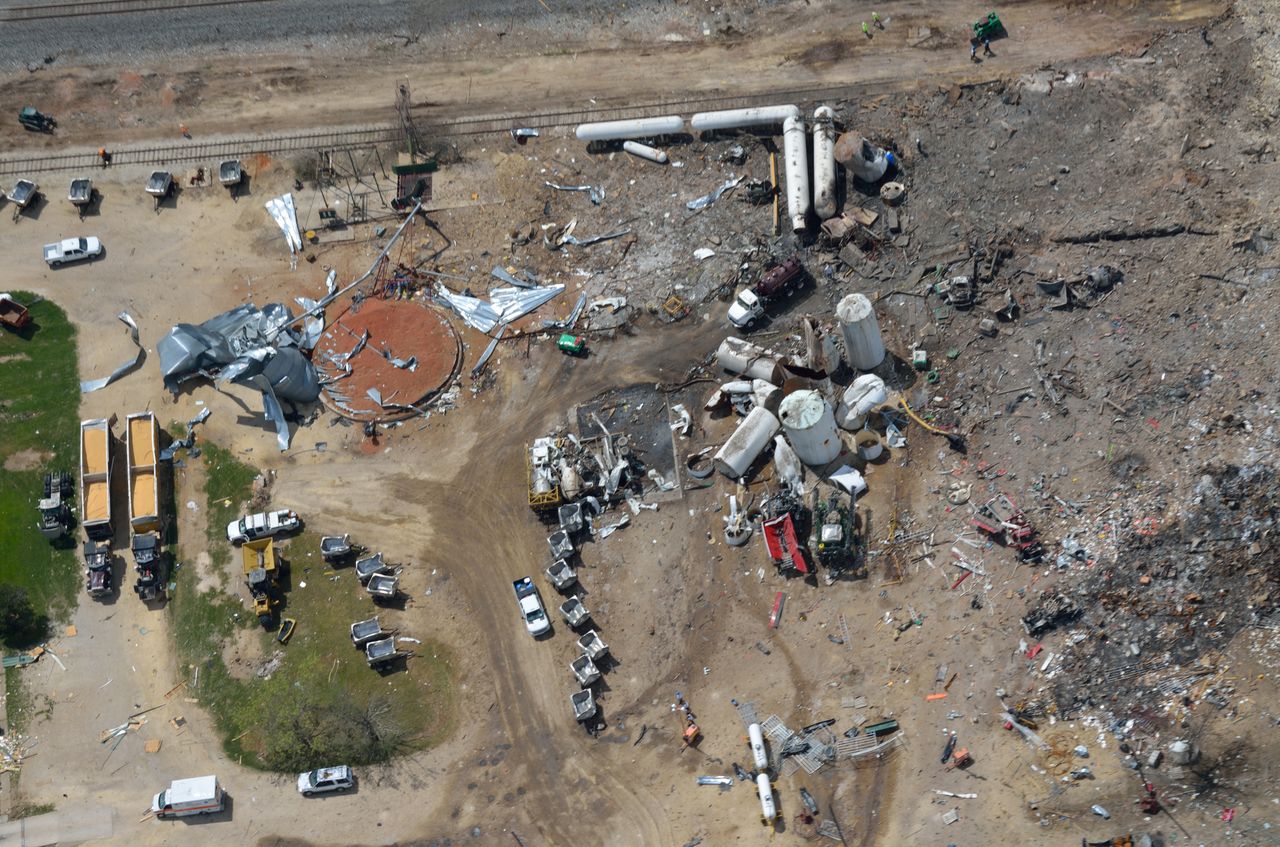
West Fertilizer Company Explosion
The last OSHA inspection was in 1985. The fine was thirty dollars. For nearly three decades after that, a fertilizer plant sat in the middle of West, Texas -- a small Czech-heritage community of about 2,800 people, eighteen miles north of Waco -- storing ammonium nitrate next to homes, a middle school, and a fifty-unit apartment building. On the evening of April 17, 2013, a fire broke out at the West Fertilizer Company. Volunteer firefighters rushed in. At 7:50 p.m., the plant detonated with the force of up to ten tons of TNT, registering as a 2.1-magnitude earthquake. The blast killed 15 people, injured more than 200, and obliterated everything within a wide radius. Windows shattered in Abbott, miles away. The explosion was heard as far north as Arlington.
Thirty Dollars and a Blind Eye
West Fertilizer Company had been supplying chemicals to local farmers since 1962. It was a small operation -- nine employees, owned by Adair Grain, Inc. The plant's regulatory history reads like a catalog of missed warnings. OSHA's 1985 inspection cited improper storage of anhydrous ammonia and fined the company thirty dollars, though penalties could have reached a thousand. In 2006, after neighbors complained of ammonia smells, the Texas Commission on Environmental Quality found unpermitted storage tanks. The EPA fined the owners $2,300 for failing to file a risk management plan on time. In 2012, the Department of Transportation levied another $5,250 in fines for ammonia storage violations. Yet the facility was classified as an exempt retail operation. It never appeared on OSHA's priority inspection list. And in an emergency planning report filed with the EPA in 2011, company officials wrote that their ammonia tanks posed no significant fire or explosion hazard.
Seven-Fifty P.M.
When a fire broke out at the plant that Wednesday evening, West's volunteer firefighters responded just as they would to any local emergency. They drove to the facility and began working to put out the flames. Nobody on the scene could have calculated the risk. The company had not disclosed its ammonium nitrate stockpile to the Department of Homeland Security, as federal law required for quantities over one ton. At 7:50:38 p.m. Central Daylight Time, two explosions ripped through the plant milliseconds apart. The detonation carved a crater where the building had stood. A fifty-unit apartment complex next door was destroyed. West Middle School, sitting adjacent to the facility, suffered heavy damage. Debris and shockwaves radiated outward, damaging fifty to seventy-five homes and businesses. Of the fifteen people killed, twelve were first responders -- ten professional emergency workers and two civilian volunteers who had come to fight the fire. Over a hundred injured were initially triaged on the high school football field before being moved to a community center when the football field proved too close to the still-burning site.
A Preventable Catastrophe
The investigation that followed stretched across years and multiple agencies. The Texas Rangers, the McLennan County Sheriff's Department, the Texas Fire Marshal, and the Bureau of Alcohol, Tobacco, Firearms and Explosives all joined the criminal inquiry. Investigators identified ammonium nitrate stored in a bin inside a seed building as the explosive fuel but could not initially determine what started the fire. In 2014, the U.S. Chemical Safety and Hazard Investigation Board delivered a damning verdict: the disaster was entirely preventable. Company officials had failed to safely store their chemicals. Federal, state, and local regulations were inadequate. The board found 1,351 facilities across the country storing ammonium nitrate, many in areas with no regulations keeping them away from populated neighborhoods. In May 2016, the ATF announced the fire had been deliberately set -- a finding disputed by other experts who noted the determination rested largely on the agency's inability to identify any other cause.
The Town Rebuilds
West's recovery was slow and contentious. The plant carried only one million dollars in liability insurance -- a sum that did not begin to cover the damage. Texas law, at the time, allowed fertilizer storage facilities to operate without any liability insurance, even when storing hazardous materials. FEMA initially declined additional aid in June 2013, citing Texas's ability to fund its own recovery, then reversed course in August and approved a major disaster declaration. At least seven lawsuits were filed against Adair Grain. In 2018, the city of West received $10.44 million in settlements. On the regulatory front, the Wall Street Journal reported in 2014 that U.S. fertilizer storage regulations remained unchanged. Texas finally acted in 2015, passing House Bill 942 to regulate the storage and inspection of ammonium nitrate and grant enforcement authority to local fire marshals and the state environmental agency.
Fifteen Stone Markers
In 2019, the city of West dedicated the Fallen Heroes Memorial on land roughly a hundred yards from where the fertilizer plant once stood. The memorial centers on a vertical stone wall that tells the story of what happened and what followed. Surrounding a reflecting pool and fountain, fifteen stone markers stand in a circle -- one for each person killed. The memorial cost approximately $300,000, most of it covered by donations from a community that refused to let the loss fade into abstraction. The site where the plant stood is now open ground. From above, the town of West looks like any other small Texas community along Interstate 35, its streets lined with kolaches and Czech heritage signs. But on the ground, the memorial stands as a permanent reminder that regulatory indifference and a thirty-dollar fine can carry a cost measured in human lives.
From the Air
Located at 31.816N, 97.088W, about 18 miles north of Waco along I-35. The explosion site is on the east side of town. Nearest major airport is Waco Regional (KACT), approximately 15nm south. From cruising altitude, the town of West is visible as a small cluster along the interstate corridor between Waco and Hillsboro. The memorial and cleared site of the former plant are near the railroad tracks on the east side of town.